Swiss Army
Swiss Army Deploys Helicopters to Fight Corsica Wildfires
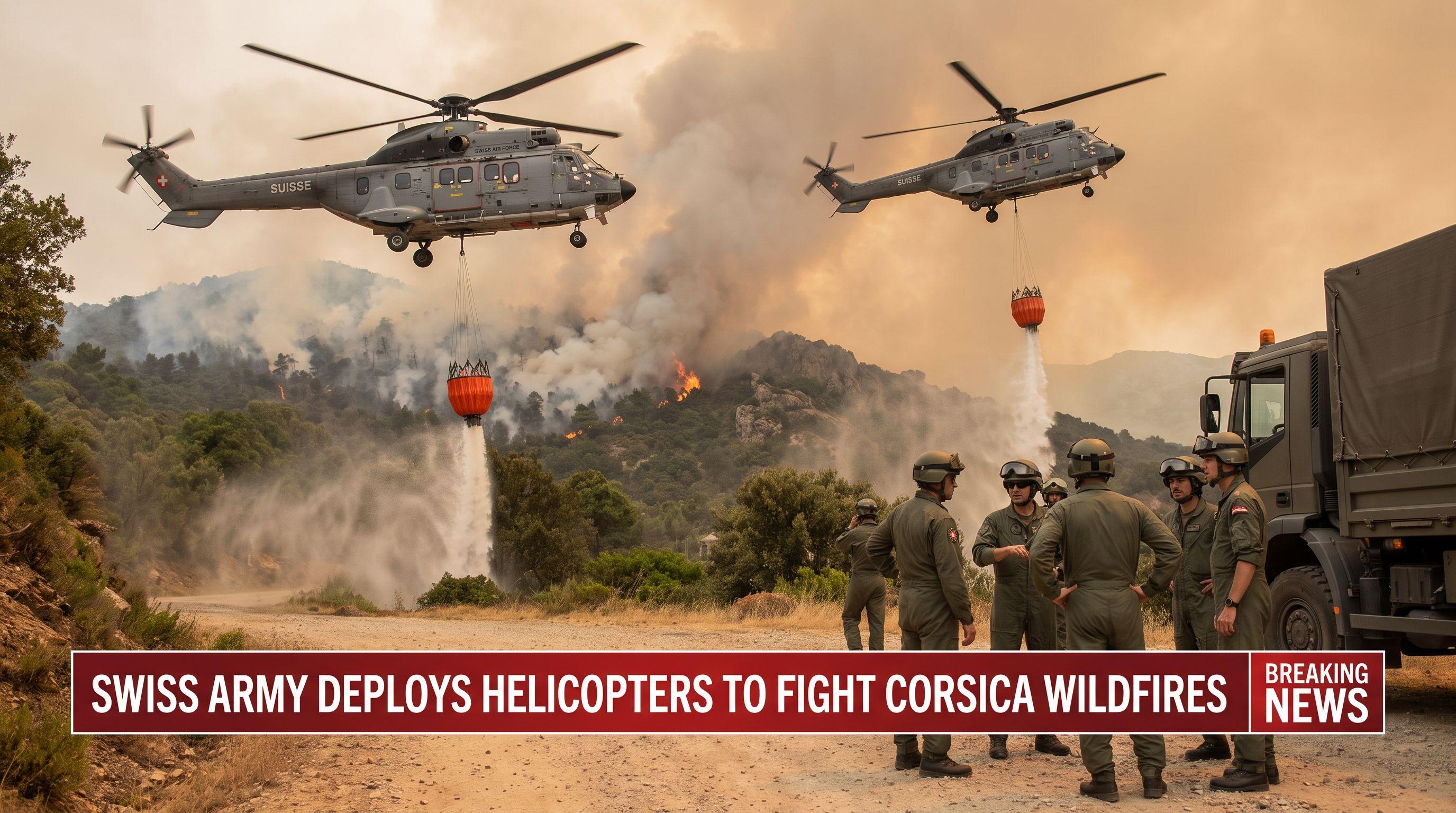
The Swiss Army has sent three Super Puma helicopters and a 22-person specialist team to help fight major forest fires on the French island of Corsica. The humanitarian aid mission demonstrates Switzerland's role in international disaster relief and rapid response efforts.
Switzerland Launches Aerial Assault on Corsican Infernos
Three heavy-duty Super Puma helicopters have roared into the skies from Locarno, signaling Switzerland's decisive entry into the battle against Corsica's devastating wildfires. This is not a drill; it is a high-stakes humanitarian intervention. As temperatures soar and flames consume the Mediterranean landscape, the Swiss Army is projecting power beyond its borders to stabilize a neighbor in crisis. The mission, sanctioned by the federal government, underscores a rapid-response capability that few nations can match. While the island of Corsica grapples with an escalating environmental catastrophe, the arrival of Swiss steel and expertise provides a critical lifeline to local emergency services. This deployment is a calculated strike against the elements, utilizing the full technical prowess of the Swiss Air Force to douse flames that threaten to spiral out of control. The operation officially commenced this Tuesday, with the first water-bombing runs scheduled to strike the heart of the blaze by Wednesday morning. It is a race against time as the heatwave intensifies, turning the island's lush forests into a tinderbox.
Precision Personnel Confront Unpredictable Elements
A specialized task force of 22 elite personnel is now on the ground, bringing a surgical level of expertise to the chaotic firefronts of Corsica. This team is no mere support crew; it is a sophisticated blend of firefighting specialists, military mechanics, and two high-ranking members of the Swiss Agency for Development and Cooperation (SDC). Head of operations Patrick Egli is clear: the greatest threat is the unknown. In an environment where a sudden wind shift can turn a controlled burn into a death trap, the Swiss team relies on years of experience forged in previous missions across Montenegro, Italy, and Greece. They are confronting a dual-threat scenario where extreme heat meets unpredictable terrain. The SDC’s rapid response unit operates with a level of autonomy that allows for real-time problem-solving as new threats emerge. This isn't just about dumping water; it's about the logistical mastery required to sustain an aerial campaign in a foreign theatre under duress. Every mechanic and specialist plays a vital role in ensuring these multi-million franc machines remain operational in the most punishing conditions imaginable.
Navigating the Danger Zone: Smoke and Steel
Visibility has plummeted to near-zero as thick, acrid smoke blankets the Corsican ridges, creating a nightmare scenario for Swiss pilots. Helicopter pilot Tobias Müller describes the mission as a supreme test of flying skill. The combination of intense thermal updrafts from the fires and the congested airspace—packed with local and international aircraft—demands absolute precision. The Swiss crews have a distinct advantage, however: the Corsican topography mirrors the rugged, mountainous terrain of the Swiss Alps. This familiarity allows them to navigate steep ravines and narrow valleys with a confidence that other international teams might lack. Yet, the heat is an unrelenting adversary. It saps engine performance and pushes the physical limits of the crew. Coordination is the primary weapon in this aerial dance; without it, the risk of mid-air collision or tactical failure surges. The Swiss Super Pumas are being utilized both for direct water drops and for the critical transport of local firefighters to inaccessible peaks, acting as the backbone of the island's defense infrastructure. Every flight is a calculated risk, balanced by the rigorous training that defines the Swiss military ethos.
Global Solidarity Defines Swiss Strategic Response
Switzerland’s commitment to France is surging, with the Corsican mission serving as just one front in a broader humanitarian offensive. While three helicopters dominate the skies over the Mediterranean, nearly 30 firefighters from Geneva are simultaneously battling infernos near Bordeaux on the Atlantic coast. This multi-pronged support highlights Switzerland’s role as a cornerstone of European disaster relief. The federal government has initially committed to a seven-day operation in Corsica, but officials have already signaled a willingness to extend the mission should the crisis deepen. The costs, covered by the FDFA and the DDPS, represent a significant investment in regional stability. This is diplomacy in action—not through words, but through concrete, high-impact aid. As the climate crisis intensifies the frequency of these 'mega-fires,' Switzerland is positioning itself as a premier provider of specialized aerial firefighting. The implications are clear: in an era of unprecedented environmental volatility, the Swiss Army's ability to deploy rapidly and effectively abroad is becoming a vital tool of foreign policy. The success of this mission will set the tone for future international collaborations in the face of a warming planet.