economy
Is Switzerland losing its competitive edge?
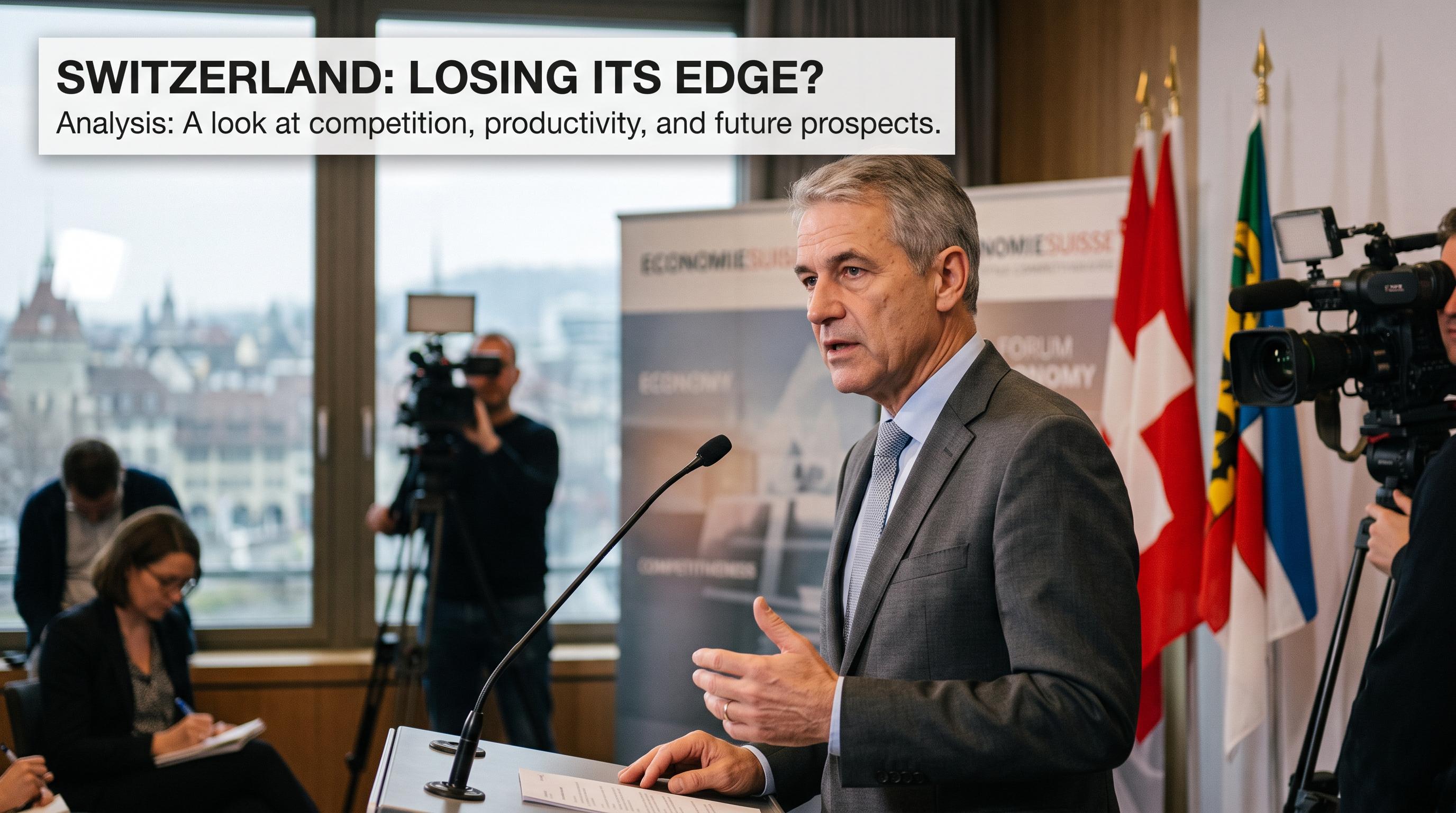
Outgoing economiesuisse chair Christoph Mäder says Switzerland is losing competitiveness to countries such as Ireland and Denmark. The article should test that warning against structural issues including regulation, labour costs, innovation, taxation and the strong franc, rather than treating it as a simple business lobby complaint.
Test the warning before Switzerland falls behind
Switzerland's competitiveness is no longer something business leaders want the country to take for granted. Christoph Mäder, who leaves the chairmanship of economiesuisse in September 2026, says rival economies such as Ireland and Denmark are gaining ground while Bern delays decisions that could protect the business environment.
His warning arrives as Switzerland faces a familiar set of pressures. Companies operate with high labour costs, a strong franc and demanding regulatory requirements. They also compete for skilled workers, investment and research projects against countries that can offer larger domestic markets or more aggressive tax and industrial policies. The source interview does not provide a new ranking or a quantified estimate of lost investment. That limits how far Mäder's claim can be tested from the available evidence. It does not make the policy question disappear.
Mäder's argument is directed at complacency. Switzerland still benefits from political stability, advanced infrastructure, research institutions and a reputation for quality. Those advantages can support high costs when firms see a clear reason to remain. Delayed reforms make that calculation harder, particularly for companies deciding where to expand their next operation.
Force Bern to confront the reform backlog
The reform backlog is Mäder's most concrete charge against the federal government. He says Bern has shown little appetite for measures that would strengthen the business environment, and he singles out pension policy as evidence of political hesitation.
Mäder calls the decision not even to discuss the retirement age in the next AHV reform package “irresponsible, to put it mildly”. His concern is economic as well as fiscal. Switzerland's ageing population will shape the supply of workers, the cost of social insurance and the tax burden carried by businesses and households. The source does not quantify the future financing gap or offer a detailed alternative. It does show how closely competitiveness is tied to decisions usually filed under social policy.
Regulation adds another layer. Swiss companies often navigate federal rules alongside cantonal and municipal procedures. Simplifying permits, digitalising public administration and setting clear priorities could reduce friction without lowering standards. Mäder's intervention gives no list of specific regulations to remove, so the accusation needs a case by case test. Business groups should identify the rules that delay investment, while the government should publish a timetable that distinguishes urgent reforms from lobbying wish lists.
Make innovation earn its premium
High costs matter most when productivity and innovation fail to keep pace. Switzerland pays comparatively high wages, and the franc raises the foreign currency price of goods and services produced here. That pressure can be absorbed by companies selling specialised medicines, machinery or financial expertise. It is harder for firms competing mainly on price.
The country has strong universities, established research centres and clusters in life sciences, precision engineering and technology. The competitiveness test is whether those strengths move quickly from laboratories into businesses that hire and export. Regulation, access to talent and the cost of scaling a young company all affect that process. Mäder's interview does not supply figures on patents, venture capital, productivity or research spending, so no responsible assessment can claim that Switzerland has already lost its innovation lead.
The strong franc also complicates the debate. A weaker currency could make exports cheaper, but it would reduce purchasing power and raise the price of imports. The Swiss National Bank cannot solve every structural problem through exchange rate policy. Businesses need productivity gains, efficient administration and predictable rules to counter currency strength. That is a longer programme than a single monetary adjustment.
Link migration policy to labour needs
The labour market exposes the political cost of weaker competitiveness. Switzerland has relied on immigration to fill vacancies and sustain sectors that need specialised workers. Mäder says labour migration has reached a critical level in recent years, while also arguing that demand for newcomers could fall if Switzerland becomes less attractive to employers.
That forecast cuts across the political argument. Mäder says asylum related migration represents only a small share of total immigration, yet it receives disproportionate attention in public debate. He urges policymakers to address the source of unease rather than treating all migration as one category. The distinction matters for companies recruiting engineers, healthcare staff, researchers and skilled tradespeople through labour channels.
Employers still face questions about housing, transport, childcare and integration, issues that shape whether workers can settle in Switzerland. Immigration cannot compensate indefinitely for weak productivity or slow training systems. Nor can restrictions create talent that the economy does not produce domestically. A serious competitiveness policy would connect labour migration with vocational education, higher education, housing supply and regional planning. The source gives no national vacancy or immigration totals, so claims about a turning point remain warnings rather than measured trends.
Measure the edge, then defend it
Switzerland can keep its edge only by measuring it against the strongest competitors. Mäder says Ireland and Denmark are making significant gains and warns against comparing Switzerland merely with its immediate neighbours. That standard would force policymakers to publish clearer evidence on business formation, investment, productivity, innovation, tax competitiveness, labour supply and the time required to obtain permits.
Tax policy belongs in that comparison, although Mäder's reported remarks do not set out a specific tax reform. Cantonal competition has long shaped Switzerland's economic model, while international rules limit how far jurisdictions can compete through company taxation alone. Lower rates may attract activity, but firms also value skilled workers, reliable infrastructure, research capacity and access to European markets. A tax debate detached from those factors will produce slogans rather than strategy.
Mäder hands the issue to Silvan Wildhaber as economiesuisse's next chair. The incoming leadership will need to turn a broad warning into measurable demands, with costs and trade-offs made public. The federal government, cantons and business groups should then be judged by delivery: faster decisions, stronger productivity and an economy that can retain talent without depending on automatic advantages.