cycling
Why cycling is twice as dangerous in Switzerland as in the Netherlands
A study of more than 86,000 police-recorded incidents finds that cycling accident rates per kilometre are twice as high in Switzerland as in the Netherlands. Public-transport stops, tram tracks and interactions with other road users emerge as particular danger points.
Measure the Risk on Swiss Streets
Swiss cyclists face twice the accident rate recorded in the Netherlands when the figures are measured against kilometres travelled. A study published in the specialist journal Journal of Safety Research examined more than 86,000 police recorded cycling accidents between 2019 and 2022. It found an average of 0.19 accidents per 100,000 kilometres in Switzerland, compared with 0.09 in the Netherlands.
The comparison measures exposure to risk rather than simply counting crashes. That matters in a country where cycling levels, urban layouts and travel patterns differ sharply from the Netherlands. The researchers, from the University of Twente and ETH Zurich, used police records to identify where and how cycling collisions occur.
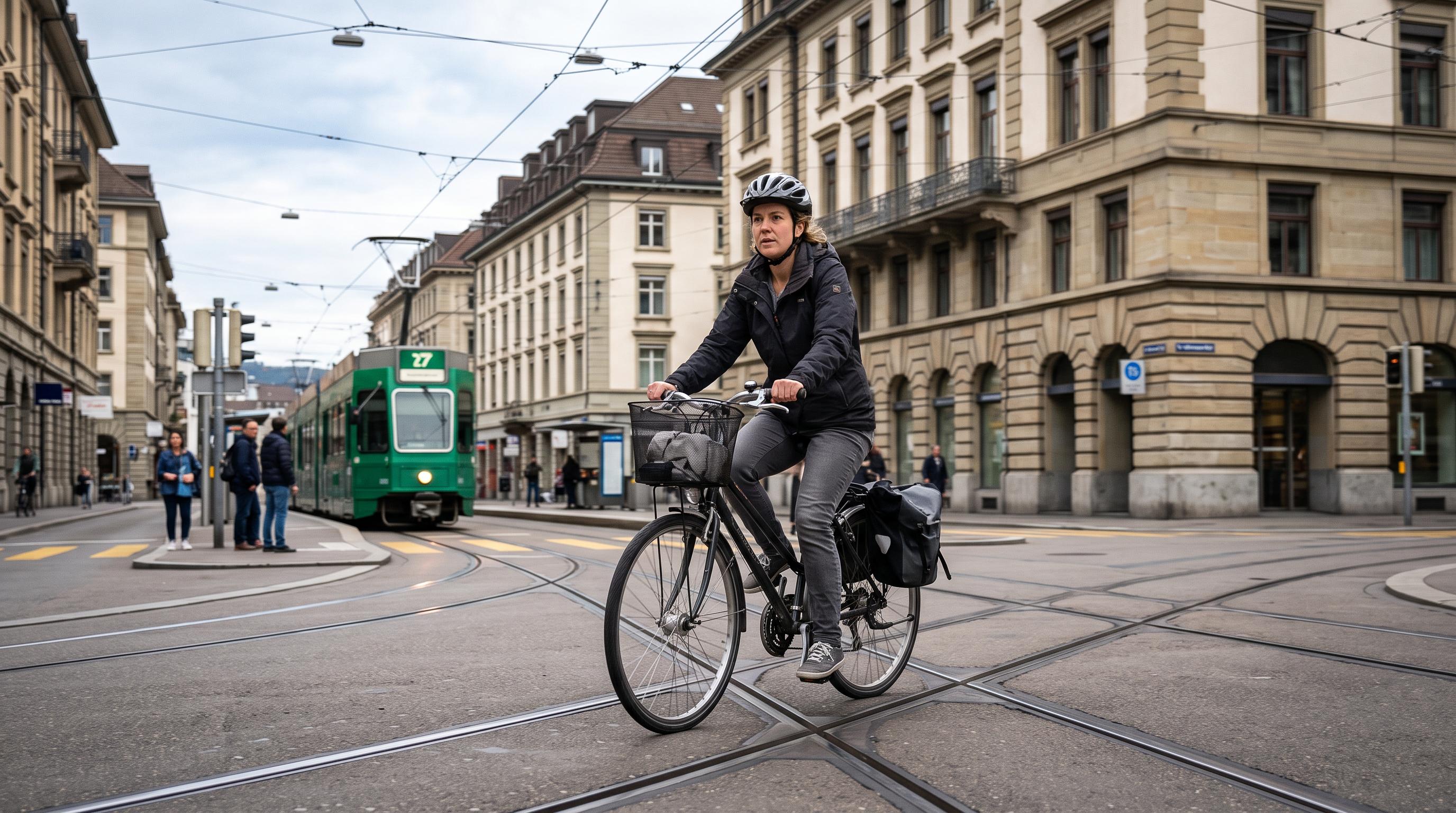
Their findings point to specific weaknesses in Swiss street design. Public transport stops, tram tracks and junctions repeatedly place cyclists in conflict with buses, pedestrians, cars and rails. The report arrives as cycling accidents in Switzerland have increased by 50% over ten years, according to a related Swissinfo.ch report published in March 2025.
The figures do not suggest that every Swiss cycling journey is dangerous. They show that the places where cyclists must negotiate several forms of traffic deserve urgent attention from city planners and transport authorities.
Move Cycle Paths Behind Stops
Public transport stops are a central danger point because Swiss cycle lanes often run directly through the space used by passengers and buses. A cyclist passing a stop may encounter people stepping into the lane, a bus pulling in or doors opening beside the route. The same design can force cyclists towards moving traffic when they try to avoid the obstruction.
Lead author Georgios Kapousizis said Dutch cities commonly place cycle paths behind public transport stops. That layout separates cyclists from passengers boarding buses and trams, while also keeping bicycles away from vehicles stopping at the kerb. It reduces the number of decisions that road users must make in the same few metres.
The difference is visible in the street geometry. A protected cycle path behind a stop creates a predictable crossing point for pedestrians. A cycle lane between a bus and the pavement creates a moving corridor beside a vehicle that may stop without warning.
Kapousizis argues that Swiss cities can adopt the Dutch approach without developing an entirely new transport model. The proposal has direct relevance for urban areas such as Zurich, Basel, Bern and Geneva, where cycling routes increasingly share narrow corridors with extensive public transport networks.
Fix Junctions and Tram Tracks
Junctions and tram tracks expose a second layer of risk, bringing cyclists into close contact with turning vehicles and difficult road surfaces. The study found that accident risk at junctions was significantly higher in Switzerland than in the Netherlands. Intersections require cyclists to read signals, turning movements and lane changes at the same time, often without physical protection.
Tram rails create a separate hazard. A bicycle wheel can catch in a rail, particularly when the track crosses the cyclist’s path at a shallow angle or when wet conditions reduce control. The danger increases when cyclists must move across tracks to avoid parked cars, traffic lanes or a tram stop.
The researchers recommend protected cycle lanes and dedicated cycle traffic lights at junctions. Those measures give cyclists a defined route and reduce uncertainty about who has priority. Around tram lines, they call for structural solutions that prevent wheels from entering the rails.
Swiss cities face practical limits. Historic centres often leave little space for widening roads or separating every mode of transport. That makes design choices more important. Clear crossings, safer rail alignments and protected waiting areas can reduce conflicts without removing public transport from central streets.
Lower Speeds Where Separation Fails
Road speed changes the consequences of every conflict, and the study found almost three times the accident probability on 50 km/h roads compared with roads limited to 30 km/h. The finding strengthens the case for lower speeds where physical separation between bicycles and motor vehicles is not possible.
A 30 km/h limit does not remove the need for good design. It can, however, give drivers more time to react and reduce the force of a collision. In streets with tram rails, bus stops and frequent crossings, that difference can shape whether a mistake becomes a near miss or a serious injury.
The authors connect speed limits with the wider design problem. Swiss streets often ask cyclists, pedestrians, buses, trams and cars to share compact spaces. When engineers cannot create a protected cycle route, reducing vehicle speed becomes one of the available safety measures.
The finding also gives municipalities a measurable policy option. Authorities can identify routes with repeated interactions, review their speed limits and compare collision data before and after changes. That approach places responsibility on the street system as well as on individual road users, while preserving access for cycling and public transport.
Build the Safer Network Switzerland Needs
Switzerland has a tested model to study, and the researchers say cities should adapt proven Dutch solutions rather than wait for a wholly new approach. The Netherlands has built cycle routes that separate bicycles from buses, passengers and motor traffic at many of the locations highlighted in the Swiss analysis. Its experience offers design principles that Swiss municipalities can adjust to local streets and public transport systems.
Georgios Kapousizis said, “Switzerland and many other countries do not need to reinvent the wheel.” His recommendations are specific: route cycle paths behind public transport stops, install protected lanes and dedicated cycle signals at junctions, and redesign tram crossings so bicycle wheels cannot become trapped in rails.
For Switzerland, the challenge is likely to vary by city. A dense historic centre may require different measures from a suburban arterial road. The study provides a common framework for both: examine the points where modes meet, separate them where possible and reduce speeds where separation cannot be built.
The accident rate comparison gives local authorities a clear benchmark. Future investment can be judged against safety outcomes, including whether redesigned stops, junctions and tram corridors reduce police recorded cycling accidents per kilometre travelled.