Courts
Swiss court rejects tuba player’s challenge to public music ban
A court has rejected a Swiss tuba player’s request for an official noise measurement in his dispute over a ban on playing music in public. The Uster District Court said loudness alone does not determine whether a sound is unreasonable.
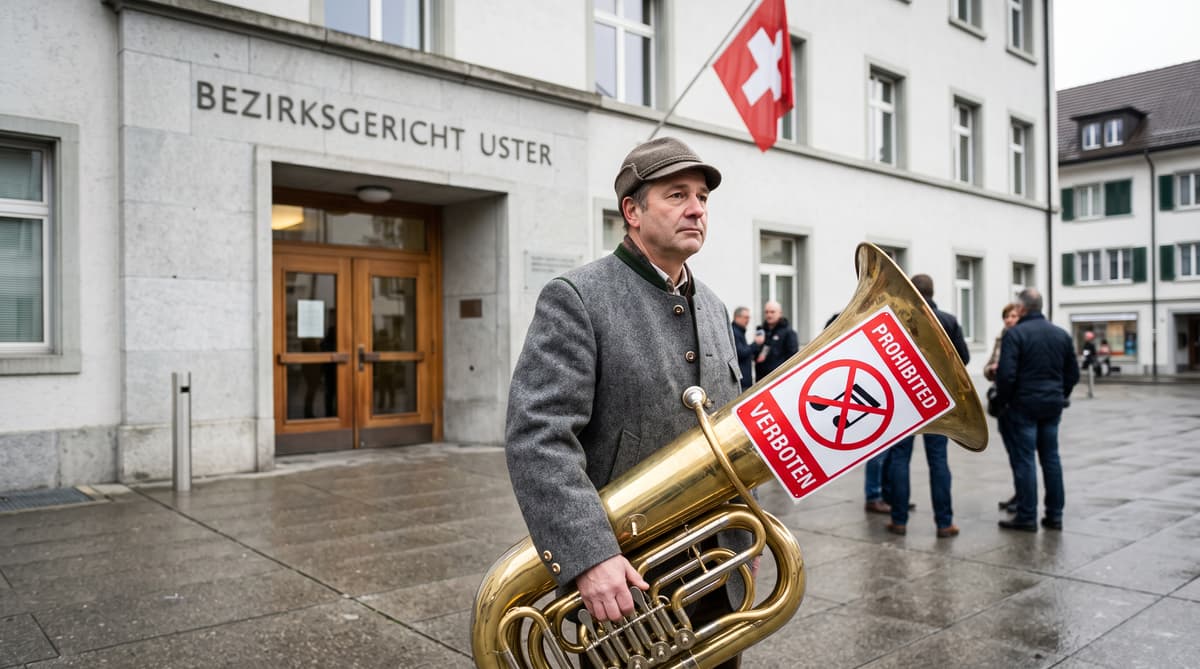
Uster District Court has rejected the tuba player’s bid for an official noise test, leaving his challenge to a public music ban without the measurement he sought. The court said loudness by itself does not decide whether a sound is unreasonable.
The dispute centres on the musician’s playing on public land in Zurich canton. The local council barred him from playing music there after complaints about performances outside a local shooting range. He asked the court to establish how loud his tuba was, arguing that an official reading could help determine whether the sound crossed the line into unreasonable noise.
The ruling turned on a broader assessment of sound than a volume reading alone, according to the court’s explanation. The musician’s appeal therefore did not persuade the judge to order another measurement. The case brings a familiar tension in Swiss communities into a very particular setting: public space is shared, but a sound that one person considers part of everyday life can be a persistent nuisance to someone nearby.
Challenge the Measure
An earlier test recorded a tractor and a woodpecker, but not the tuba, the musician told the court. The measurement had been conducted together with Suva, Switzerland’s accident insurance institution. He argued that the result failed to capture the sound at the centre of his dispute and sought an official assessment.
The court declined to make a new measurement the deciding step. Its reasoning was that volume alone cannot settle whether a particular sound is unreasonable. That distinction matters in a case where the musician says his instrument was quieter than other noises in the neighbourhood. A meter reading might describe intensity, but the court’s stated approach also considers whether a sound is acceptable in its setting.
The test’s reported mix of sounds gives the dispute an unusual detail, but the legal issue was not simply whether the tuba could be heard. The musician wanted the measurement to help define the boundary between ordinary public music and noise that warrants a restriction. The court rejected that request, leaving the council’s ban at the centre of the disagreement.
Trace the Public-Space Dispute
The complaints covered nearly eight months, from 1 August 2025 to 24 March 2026. During that period, the musician played outside a local shooting range, and the local council prohibited him from making music on public land. The case has since become a dispute over both the restriction and how authorities should judge the sound behind it.
In court, the musician said the complaints came from just one neighbour. He also maintained that the tuba was quieter than other noises in the area. Those were his arguments, not a finding that the court accepted as a reason to order a fresh test. The court instead rejected the idea that loudness alone could determine whether the sound was unreasonable.
The setting is significant to the dispute: the performances took place outdoors, near a shooting range, rather than in a concert hall or a private home. The council’s ban applies to music on public land. The case therefore turns on the practical limits of using shared outdoor space, where local residents and performers may experience the same sound very differently.