Science
ETH Zurich satellite aims to improve solar storm forecasts
ETH Zurich is developing a small research satellite, Ethos, to improve forecasts of how solar activity affects the upper atmosphere and satellites in low Earth orbit. The university says the mission is scheduled to begin in 2030.
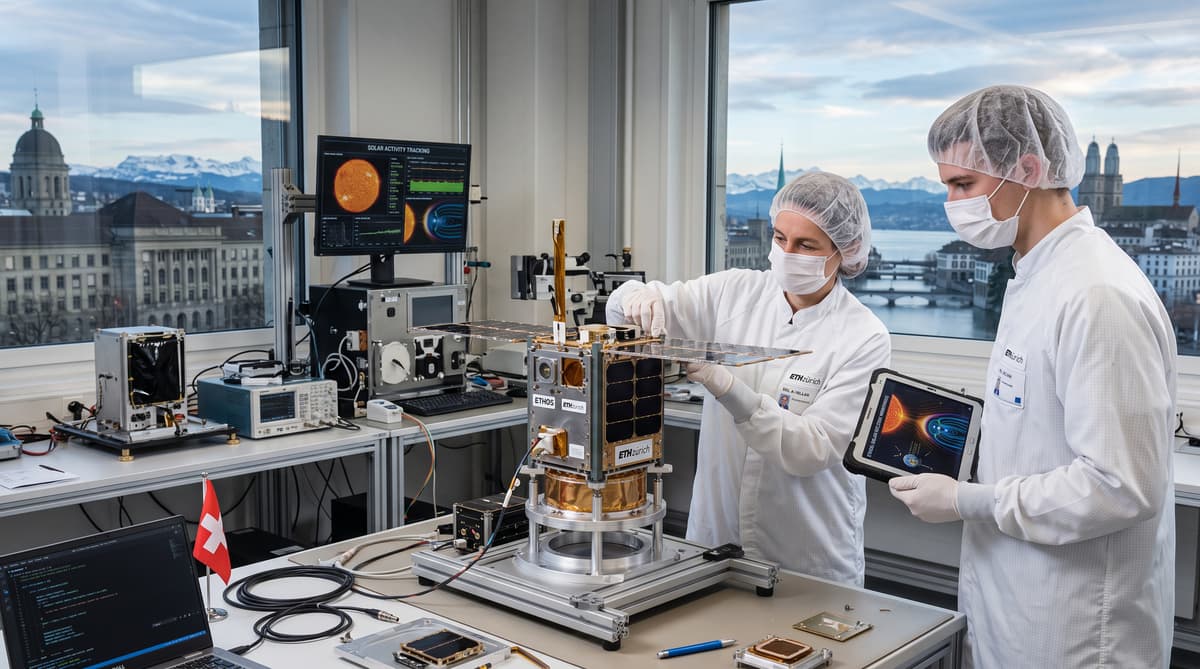
Solar activity can push low-orbit satellites off course. ETH Zurich is developing Ethos, a small research satellite designed to improve forecasts of how solar storms affect the upper atmosphere and spacecraft. The university announced the mission on November 2, 2026, and says it is scheduled to begin in 2030.
Powerful solar flares heat the upper atmosphere, causing it to expand. Satellites in low Earth orbit then encounter denser air and experience greater drag. They can lose altitude and drift from their planned trajectories, raising the risk of collisions with other satellites or space debris.
Forecasts of the atmosphere’s response to solar activity currently carry uncertainty, ETH Zurich says. Ethos will investigate the connection between solar radiation, changes in the ionosphere and atmospheric density. Better measurements could help satellite operators anticipate orbital changes and respond to the effects of space weather.
Measure the Sun and Atmosphere
Ethos will pair measurements of the Sun with observations of Earth’s upper atmosphere. The satellite, weighing around 25 to 30 kilograms, is to carry several scientific instruments. They will measure energy emitted by the Sun and capture X-ray and extreme ultraviolet radiation during solar flares.
Other instruments will monitor the ionosphere, the electrically charged layer of the upper atmosphere. Ethos will also determine its own orbit with high precision. Taken together, those observations are intended to help researchers trace how changes in solar activity affect the ionosphere and alter the density of the atmosphere above it.
That chain of effects matters for spacecraft close to Earth. When the atmosphere expands, satellites encounter more drag, which can slow them and change their altitude or trajectory. By measuring both the incoming solar radiation and the atmospheric response, researchers aim to improve their understanding of how solar events translate into orbital changes.
Turn Measurements into Forecasts
The mission is designed to connect solar fluctuations with the drag satellites experience. Ethos will combine measurements of solar radiation with observations of the ionosphere and precise orbital tracking. Researchers expect this data to show how changes in solar activity alter the ionosphere, affect the density of the upper atmosphere and influence drag on satellites.
That evidence could improve space weather forecasts and give satellite operators earlier warning of potential orbital changes. A more accurate picture of atmospheric conditions would help them assess how solar activity may affect the paths of spacecraft in low Earth orbit, where increased drag can reduce altitude and shift trajectories.
The satellite also has a longer-term research role. Its observations of solar radiation are intended to contribute to a continuous measurement record. ETH Zurich says the resulting data will also matter for climate research, linking the mission’s space weather work with long-term study of solar radiation.
Build a Continuous Solar Record
Swiss institutions are building the mission together as existing solar measurement missions near the end of their operating lives. ETH Zurich is working with the Davos Physical-Meteorological Observatory, the University of Bern and the Swiss Federal Institute of Technology in Lausanne, known as EPFL. The institutions are developing the scientific instruments, while a commercial provider is to supply the satellite itself.
Several existing missions that measure solar radiation are expected to reach the end of their operational lifetimes around 2030. Ethos is intended to help maintain the measurement series without interruption. That continuity would support research into solar radiation and provide data relevant to climate research, as well as to space weather forecasting.
The planned mission brings the work of Swiss research teams together around one compact spacecraft. Its measurements are intended to give researchers a clearer account of how solar activity changes the upper atmosphere, while helping operators of low-orbit satellites prepare for shifts in atmospheric drag.