Climate
UN reports warn of irreversible damage to glaciers
Two UN reports warn that warming beyond 1.5°C could cause irreversible damage to glaciers, sea ice and other frozen regions. The reports say some impacts are already visible in Switzerland.
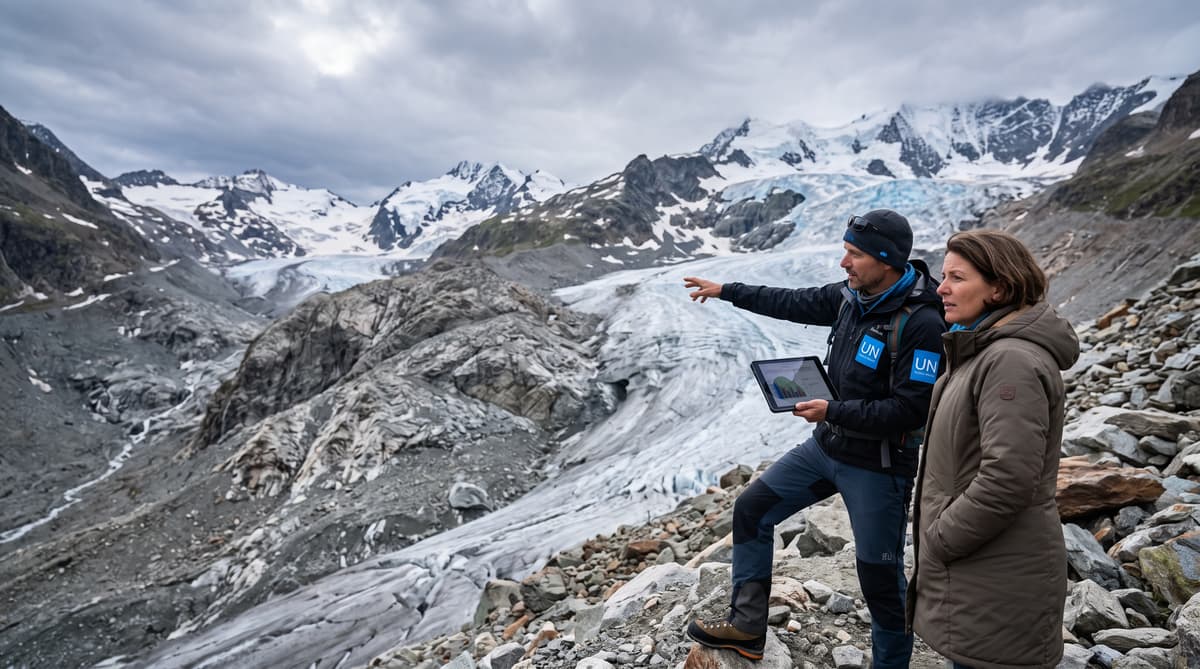
Two UN reports published on November 2 warn that crossing 1.5°C of warming could lock in damage to Earth’s frozen regions. Their warning reaches beyond polar ice: glaciers, sea ice and frozen ground all face consequences that may be difficult or impossible to reverse.
The cryosphere, the regions shaped by snow, ice and frozen ground, is already under pressure. Global warming has reached 1.37°C compared with pre-industrial levels. The European Copernicus network estimates that the 1.5°C threshold could be exceeded around 2030.
The reports link further warming to melting glaciers and sea ice, thawing permafrost and faster sea-level rise. Those changes can increase flood risk and bring economic and ecological damage, water shortages and hazards in mountain regions. The 1.5°C limit is the most ambitious temperature goal in the 2015 Paris Agreement. The reports argue that the speed of further warming matters: each additional fraction of a degree adds to the risks.
Track the Alpine ice loss
Switzerland has already lost 20% of its glacial mass, the reports say, making the global warning tangible in the Alps. That loss is one of the impacts already visible as temperatures rise, and it comes alongside growing risks in mountain areas.
The reports describe how continued ice melt can contribute to flooding, ecological and economic damage, water shortages and other mountain hazards. These risks matter to communities and infrastructure in alpine regions, where glaciers form part of a wider frozen landscape that also includes snow and frozen ground.
The reports also argue that the Paris Agreement’s 1.5°C limit is too high to keep the cryosphere within a safe range. They place a safer temperature closer to 1°C or lower. That does not change the agreement’s relevance, but it underscores how much the reports say is at stake for Switzerland as well as for polar regions. The country’s recorded ice loss is a clear sign that the effects are not confined to a distant future.
Prepare for a slow recovery
Recovery would be slow even if temperatures later fall below the threshold. Scientists warn that crossing climate tipping points could set changes in motion that are not quickly undone. The reports say some glaciers might partially recover if warming drops rapidly below an average of 1.5°C, or even 1°C. Arctic sea ice could also benefit.
But retreat and recovery do not run on the same timetable. Matthew England, an oceanographer and climatologist at the University of New South Wales, says recovery could take several decades or even centuries. Chen Zhao, a glaciologist specialising in Antarctica, warns that bringing warming back below 1.5°C would not undo the consequences of the period spent above it.
A second report examines a higher-warming scenario: if warming above 2.8°C persists into the next century, sea levels could rise by up to 5 cm a year by 2150, compared with 0.45 cm a year now. Thawing permafrost could also release annual CO₂ emissions on the scale of those produced by the United States.
Cut emissions to curb damage
Decisions made over the next few years will shape how much damage the cryosphere suffers. The reports call for temperatures to be brought well below 1.5°C as quickly as possible. James Kirkham, lead author of one report, says immediate political ambition, particularly to reduce fossil-fuel use, can still limit damage and its consequences for people and the planet.
The challenge is sharpened by the projected path of current commitments. A recent UN report says that even if countries meet them, warming could reach around 2.6°C by 2100. The two reports were published a week before COP31, where countries were due to discuss measures to tackle global warming.
For Switzerland, the already recorded loss of glacial mass gives the debate a direct Alpine dimension. Gunjan Silwal, a Nepalese glacier researcher, described the tragedy in Nepal as “just a foretaste” of the dangers linked to glacier and mountain collapse. The reports’ message is that limiting further warming can still reduce the scale of those risks, even where past ice loss cannot be reversed quickly.