Politics
Swiss election poll shows deepening political polarisation
A new election poll puts the right-wing Swiss People’s Party at 29. 9%, above its record result from 2015, while parties on the left also gain ground. The findings point to a shrinking political centre ahead of the 2027 federal elections.
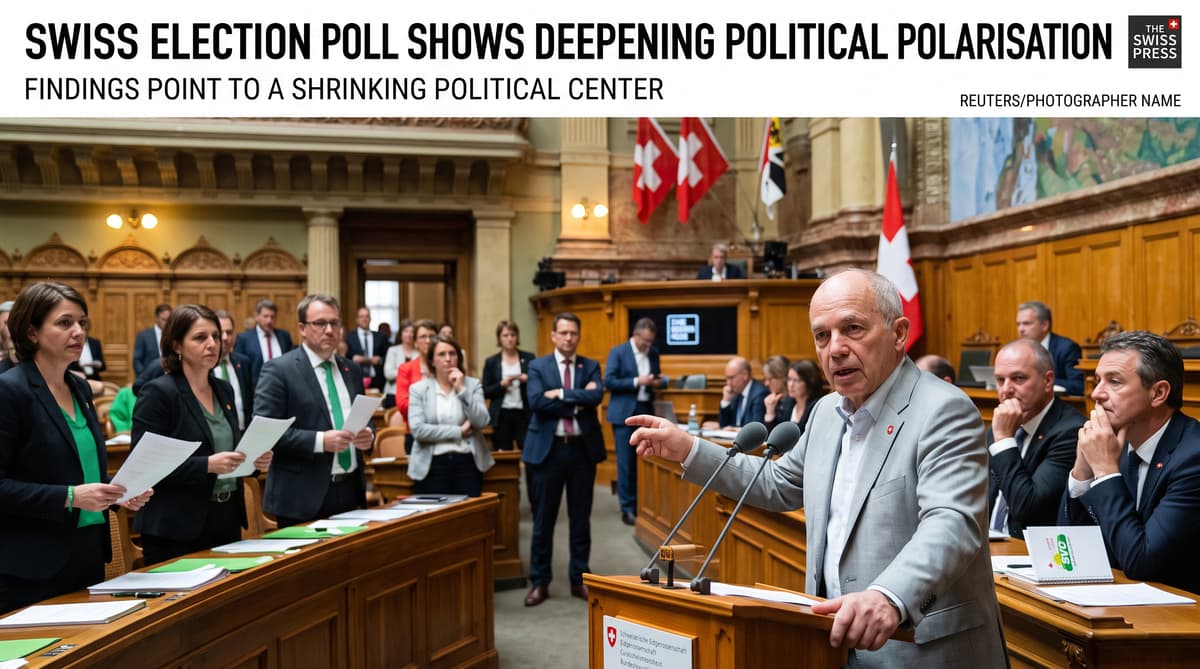
The People’s Party has reached 29.9%, according to a Sotomo election barometer published just over a year before Switzerland votes for the next National Council and Council of States on October 24, 2027. That figure would surpass the party’s record result of 29.4% in 2015.
The poll, commissioned by the Swiss Broadcasting Corporation, places the party led by Marcel Dettling well ahead of its rivals. Its support has increased by 2 percentage points since the 2023 federal elections, the strongest gain among the parties measured.
The numbers also show movement at the other end of the political spectrum. The Social Democrats have climbed to 19.3%, their strongest projected result since 2007, while the Greens are making a smaller advance. Together, the two left-wing parties would improve their position by 1.5 percentage points compared with 2023.
That combined growth leaves the political centre under pressure. The Centre Party and the Radical-Liberal Party, which have traditionally anchored Switzerland’s governing consensus, are both losing support. Their combined standing has fallen to 26%, four points below the People’s Party alone. The poll captures voting intentions more than a year before ballots are cast, but it already points to a sharper contest between the right and left.
Centre-right parties lose ground
The centre-right parties would together win 26%, according to the poll, but that total remains below the People’s Party’s projected share on its own. The figures mark a difficult period for two parties that have often shaped compromise across Switzerland’s multilingual political system.
The Radical-Liberal Party stands at 13.3%, down one point from 2023. Sotomo says that would be the party’s weakest result in the history of elections to the House of Representatives. It has nevertheless moved slightly ahead of the Centre Party compared with a similar poll in 2025.
The Centre Party is at 12.6%, a decline of 1.5 points since the last federal election. Its position reflects the challenge facing a party that seeks to combine socially conservative, economically moderate and regionally diverse constituencies.
Switzerland’s political system still requires parties to cooperate. The seven-member Federal Council is elected by parliament, and major legislation depends on shifting alliances rather than a single governing majority. A stronger People’s Party and a better-performing left could make those negotiations more contested, especially when the centre has fewer seats to broker agreements. The poll does not forecast the final distribution of seats, but it records a clear change in the balance of political support.
Health costs and climate shape voter priorities
Health insurance premiums rank as the top concern for 39% of respondents, while climate change follows at 36%. The priorities show that the People’s Party’s advance cannot be explained by migration alone, even though migration has traditionally been one of its strongest issues.
Climate change has returned prominently to the public agenda after the heatwave-hit summer of 2026. The share of respondents identifying it as a major challenge rose 9 percentage points in one year, according to Sotomo director Michael Hermann. The survey also found that 65% believe measures taken by politicians to address the consequences of climate change are insufficient.
The shift has not produced a comparable surge for the Greens. Their support has increased only marginally, while the centrist Liberal Greens have declined. Sotomo said the ecological parties’ position was “more positive than it seems at first glance”, because both had stabilised after a period of weaker support and retained an environmental profile.
The figures reveal a gap between concern and party choice. Climate policy has become more visible in voters’ priorities, yet the parties most closely associated with it have not captured a proportional share of the electorate. Household costs and environmental risk are both shaping the campaign environment more than a year before election day.
Left gains add pressure to the political middle
The Social Democrats are projected to reach 19.3%, their best result since 2007, giving the left a stronger position alongside the People’s Party’s advance. The result suggests that voters are moving toward parties with clearer ideological profiles while support for the traditional middle weakens.
The Social Democrats have gained 1 percentage point since 2023. The Greens have progressed only slightly, but their combined performance with the Social Democrats lifts the left by 1.5 points overall. That growth remains modest, yet it changes the arithmetic around parliamentary alliances.
Switzerland’s federal elections use proportional representation for the National Council, with seats allocated across cantons. Party support therefore translates differently across the country. Larger cantons provide more seats and can amplify national trends, while smaller cantons have fewer mandates and their own political traditions. The poll’s national figures cannot determine the result in any individual canton.
They do show where the campaign could become most competitive. The People’s Party can point to a projected record share, while the Social Democrats can argue that their support is recovering. The Centre and Radical-Liberal parties face the harder task of holding voters who may see a direct choice between the right and left as more consequential than incremental compromise.
Parties prepare for a more contested 2027 campaign
The next federal election is scheduled for October 24, 2027, leaving parties more than a year to convert poll support into votes. The Sotomo barometer offers an early measure of the political terrain, not a seat projection or a prediction of the final result.
For Marcel Dettling’s People’s Party, the immediate task will be to sustain support above its 2015 record while keeping attention on its core issues. Migration is moving down the list of voters’ stated priorities, and cost pressures and climate change are competing for space in the campaign.
The Social Democrats have a stronger starting point than in recent years, but the Greens’ limited progress shows that concern about climate change does not automatically translate into votes for ecological parties. The Centre and Radical-Liberal parties must defend their constituencies while continuing to present compromise as electorally relevant.
The coming campaign will test whether the poll’s pattern endures: a larger right, a modestly stronger left and a narrower centre. Switzerland’s consensus-based institutions will continue to require negotiation after the votes are counted. The balance inside parliament, however, may give the parties at the edges greater leverage over the issues that dominate the next legislature.