Extremism
How Swiss historians are tracing the far right’s media playbook
Swiss historians are examining postwar right-wing publications to understand how extremist movements build narratives and mobilise supporters—insights that may help explain the digital communication strategies of today’s far right.
The far right’s media playbook has deep roots
The far right is pairing old publishing habits with new digital reach. On September 23, 2026, Swiss historians were examining postwar journals to understand how extremist movements construct narratives, build networks and recruit support. Their work arrives as far-right actors use Instagram, social media and artificial intelligence to create what researchers describe as a counter-public sphere.
The connection became visible at the 2026 Remigration Summit on Portugal's coast. Representatives from Europe and the United States discussed aesthetics, memes, terminology and media work. A Swiss far-right activist told the magazine Republik that the gathering was largely organised from Switzerland. Gregory Bovino, who briefly served as the de facto commander-in-chief of the US Border Patrol, also addressed the event.
The summit's vocabulary sounds native to online culture. Its organisational logic has deeper roots. Long before platforms could distribute a post globally in seconds, far-right groups used periodicals to define enemies, circulate slogans and connect activists across borders. Swiss researchers are now reading those publications as records of political technique, not merely as historical curiosities. Their findings offer a way to track how extremist communication adapts while preserving familiar methods.
Magazines made extremist publishing accessible
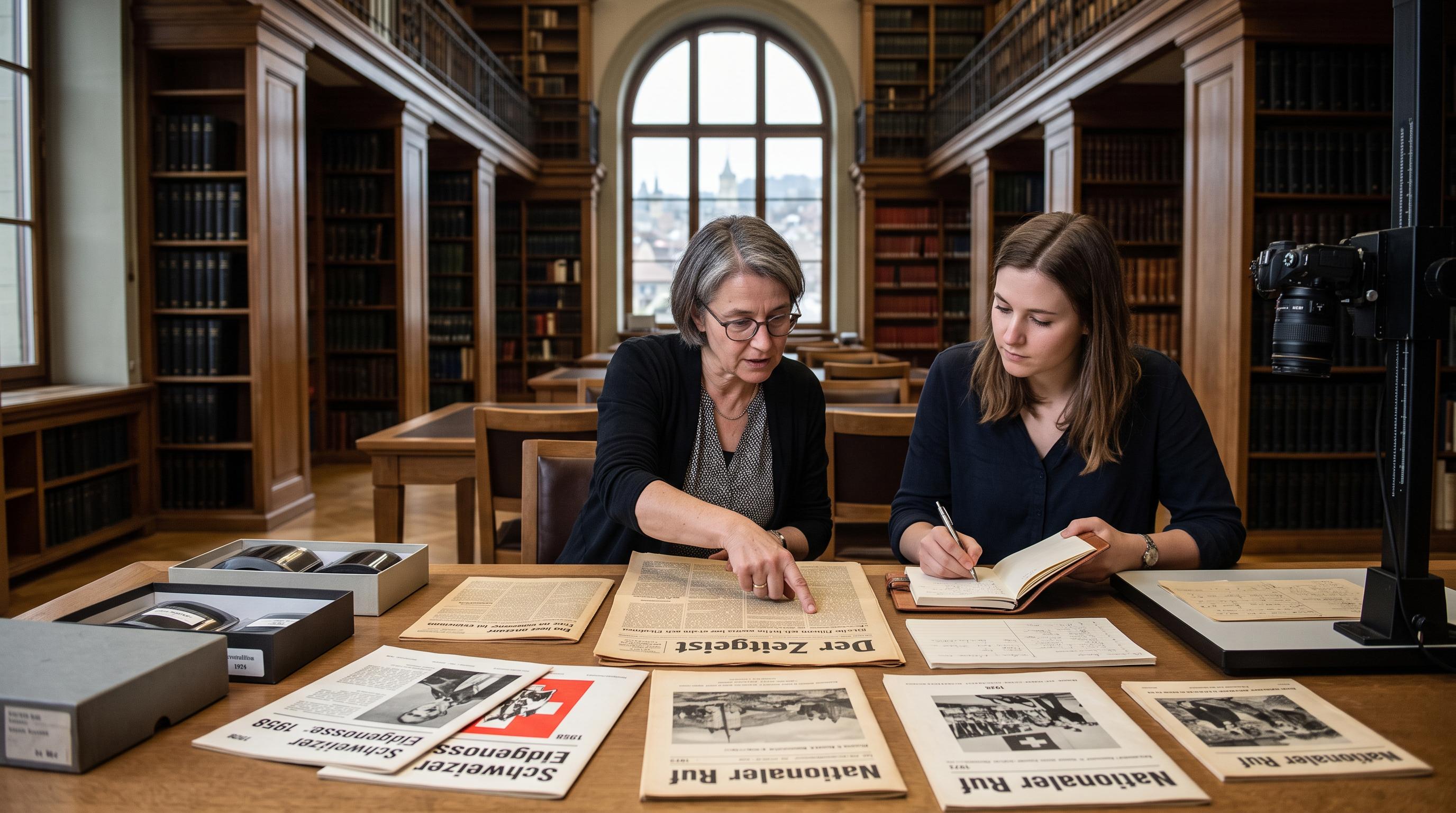
A magazine could give a small political circle a public voice. Historian Franca Schaad is investigating periodicals associated with the New Right, many of them founded in Germany and Switzerland from the 1960s onwards. Her focus includes how these publications represented masculinity, a subject that can reveal how movements shaped identity as well as opinion.
The format mattered. Magazines were faster and cheaper to produce than books, lowering the barriers to political publishing. Schaad says they were “the most exciting medium for political discourse” in the mid-20th century. A small organisation did not need the backing of a major newspaper or a publishing house to distribute its arguments. It needed contributors, a printing operation and a network of readers.
That structure created a durable communications model. Publications could repeat key themes, give supporters a shared vocabulary and present scattered groups as part of a wider cause. Researchers at the University of Fribourg and the Bern Academy of the Arts are studying these historical counter media to map those connections. The work also clarifies why today's online channels matter to extremists: they preserve the directness and speed of small-scale publishing while expanding its potential audience.
The right borrowed the left’s publishing style
The New Right learned from a movement it opposed. The 1968 student protests challenged established political and media structures in Germany, Switzerland and elsewhere. Right-wing groups treated the protesters as ideological enemies, yet they also studied the methods that made the movement visible.
Schaad says many right-wing magazines copied the do-it-yourself style of left-wing periodicals. Their pages used collages, stencil cut-outs and other forms of low-cost visual production. The look reflected both the political culture of the time and the technology available to small publishers. It helped transform a newsletter or journal into a marker of belonging.
The borrowing carried strategic value. A distinctive visual language could make a movement appear youthful, insurgent and independent from established institutions. It could also reinforce the claim that mainstream media excluded the publication and its readers. Researchers use the term counter media for outlets that define themselves against a media landscape portrayed as hegemonic or elitist. The term has also described progressive publications, including the West Berlin feminist magazine Courage. In far-right hands, the same media posture became a tool for anti-democratic and conspiracy-driven narratives.
Switzerland remains part of the network
Switzerland sits inside the story as a research base and a communications hub. The country has long played a role in European far-right networks, and the 2026 Remigration Summit showed that connection remains relevant. A Swiss activist's account of the summit's organisation places Switzerland within a wider ecosystem that links online messaging, political events and international contacts.
The historical record cannot predict every feature of today's extremist communication. It can show how movements work through repetition, shared formats and claims of exclusion from the mainstream. Digital platforms accelerate those processes. Social media lets groups publish without traditional gatekeepers, while artificial intelligence increasingly helps produce disinformation at scale.
That makes archival research useful to journalists, educators and policymakers in Switzerland. Old journals can expose recurring narrative patterns, visual conventions and networking practices before they are repackaged as memes or short videos. The research project led by the University of Fribourg and the Bern Academy of the Arts gives that work an institutional base. Reading the past closely can help Swiss observers recognise how a supposedly spontaneous online campaign may draw on decades of organised political publishing.