environment
Greenpeace Activists Protest Swiss-Based Firm's Deep-Sea Mining Plans
Environmental group Greenpeace staged a protest in Basel against Fribourg-based company Allseas, condemning its plans to engage in deep-sea mining in the Pacific Ocean and warning of devastating consequences for marine ecosystems.
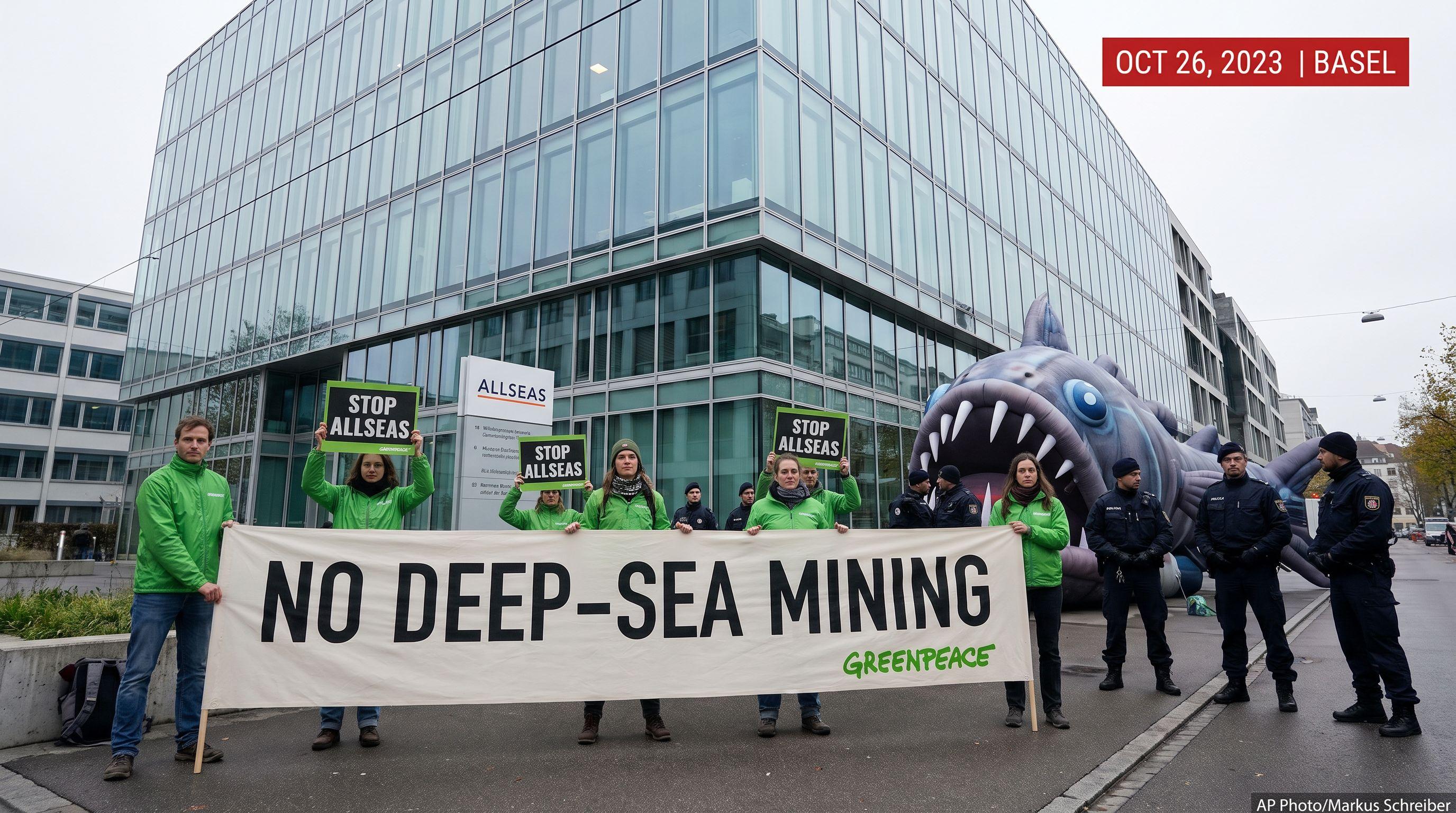
Activists Siege Basel in Midnight Stand-Off
At precisely 9:30 pm on a Saturday night, the historic banks of the Rhine in Greater Basel became a battlefield for the future of the planet. Greenpeace activists seized the narrative by projecting a high-definition film directly onto the facade of the Old University, transforming a symbol of Swiss academic tradition into a screen for environmental warning. This is not an isolated incident; it marks the third major escalation in a nationwide campaign that has already stormed Zurich and Chillon Castle in Vaud. The message is clear: the Swiss public will no longer ignore what happens thousands of meters below the ocean surface. The atmosphere was electric as the projection illuminated the dark water, forcing passersby to confront the industrial destruction occurring in the remote Pacific. This bold maneuver targets the Fribourg-based offshore giant Allseas, bringing a global ecological crisis directly to the doorstep of the Swiss establishment.
The Hidden Gem: A Corporate Titan Under Fire
Allseas, headquartered in Châtel-Saint-Denis, is deploying its massive 'Hidden Gem' vessel to spearhead a controversial partnership with the Canadian firm The Metals Company (TMC). This vessel is no ordinary ship; it is a floating industrial fortress equipped with a remotely operated submersible designed to vacuum metal-rich nodules from the seabed. While Allseas and TMC aggressively market this operation as a 'sustainable' solution for the green energy transition, critics call it a predatory extraction of the world's last untouched frontier. The scale of the operation is staggering, aiming to harvest minerals essential for battery production at the cost of total benthic disruption. By positioning themselves as pioneers of 'green' mining, these companies face a fierce backlash from scientists who argue that 'sustainable' deep-sea mining is a dangerous oxymoron. The corporate headquarters in the Canton of Fribourg now finds itself at the center of a global firestorm over the ethics of offshore heavy operations.
Regulatory Chaos: Mining Without Permission
The legal foundation of this venture is crumbling under scrutiny as Greenpeace levels a damning accusation: Allseas is operating without a mandate from the International Seabed Authority (ISA). Instead of waiting for a global consensus or a robust international regulatory framework, the company is allegedly leaning on a controversial executive order issued by former US President Donald Trump. This move bypasses the multilateral spirit that Switzerland typically champions on the world stage. The lack of ISA permission creates a dangerous precedent, suggesting that corporate interests can override international maritime law. This regulatory vacuum raises a critical question: Can a Swiss-based firm legally exploit international waters based on the decree of a foreign leader? The tension between corporate agility and international law has reached a breaking point, leaving the Swiss government in a precarious position as it balances economic interests against its reputation for diplomatic integrity.
Ecological Time Bomb: The CO2 Threat
A staggering environmental catastrophe is looming if deep-sea mining proceeds as planned. Greenpeace warns that interference with these fragile ecosystems will be 'devastating,' potentially releasing massive quantities of CO2 that have been sequestered in the seabed for millennia. The deep sea is one of the world's largest carbon sinks; disturbing it could accelerate the very climate crisis these minerals are supposed to solve. Furthermore, the process of collecting nodules destroys habitats that are home to species found nowhere else on Earth. The sediment plumes kicked up by submersibles can travel for miles, choking marine life and disrupting the food chain. This is not just about the seabed; it is about the health of the entire ocean. The irony is sharp: in the quest for 'clean' energy metals, we risk triggering an ecological collapse that could be irreversible. The scientific community remains alarmed as the industry moves faster than our understanding of the consequences.
Swiss Sovereignty and Global Responsibility
Switzerland now faces a moment of truth regarding corporate accountability. As a landlocked nation, the Swiss perspective on the high seas has often been one of distant neutrality, but the presence of firms like Allseas in Fribourg brings the ocean's plight to the Alps. The Swiss public is increasingly demanding that companies based on their soil adhere to the highest global standards, regardless of where their operations take place. This protest in Basel is a symptom of a larger shift: a demand for 'Responsible Business' that transcends borders. As the 'Hidden Gem' prepares for its next phase in the Pacific, the eyes of the world—and the Swiss electorate—are fixed on the outcome. The decision of how to regulate these entities will define Switzerland's role in the 21st-century global economy. Will the Confederation remain a safe harbor for controversial extraction, or will it lead the charge for a moratorium on deep-sea destruction? The answer will resonate from the Rhine to the depths of the Pacific.