Switzerland
Court overturns CHF18m Swisscom fibre-optic fine
The Federal Administrative Court has overturned an CHF18 million competition fine imposed on Swisscom over its fibre-optic network rollout. The court found that Swisscom did not hold a dominant position in the relevant market, although the ruling can still be appealed.
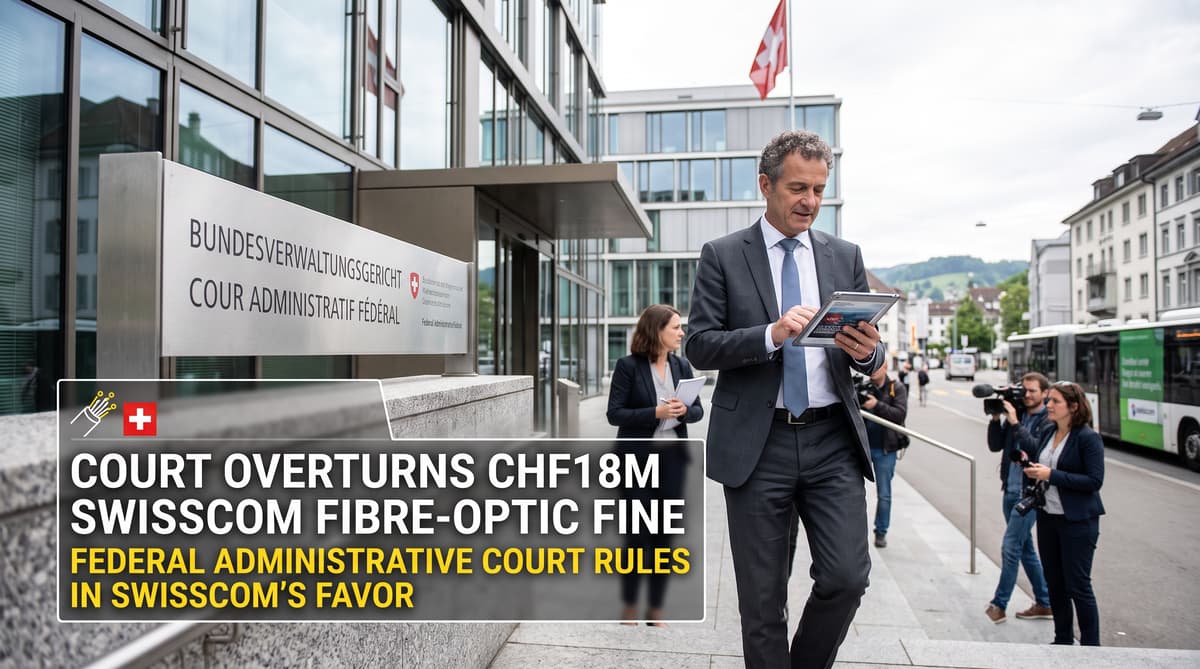
The Federal Administrative Court has cleared Swisscom of an CHF18 million competition sanction, delivering a major legal setback to the Swiss Competition Commission’s case. The court ruled that the telecoms group did not occupy a dominant position in the relevant market, meaning the commission had applied competition law on an incorrect basis.
The ruling concerns Swisscom’s fibre-optic expansion and does not yet close the dispute. The judgment remains open to appeal before the Federal Supreme Court, so the legal position could still change. For now, however, the court’s decision removes the fine imposed after an investigation into how Switzerland’s largest telecoms provider was building parts of its next-generation network.
The case matters beyond the penalty itself. Fibre infrastructure determines how households and businesses connect to high-speed internet, while access arrangements shape the room available to competing telecoms providers. Swisscom’s rollout model became the focus of regulatory intervention after the Competition Commission halted it through interim measures.
The court’s decision, published on October 14, 2026, resets the dispute around a central legal issue: whether Swisscom had sufficient market power for its network choices to constitute an abuse under Swiss competition law.
Challenge the Dominance Finding
The court rejected the Competition Commission’s conclusion that Swisscom held a dominant position in the relevant market. That finding undercuts the legal foundation for the CHF18 million fine and the commission’s assertion that Swisscom had breached competition rules.
The decision turns on market definition and market power. The source does not provide the court’s full reasoning or identify the competing operators included in its assessment. It does establish that the judges did not accept the commission’s view that Swisscom’s position was strong enough to trigger liability under the case brought against it.
The Competition Commission, known in Switzerland as Weko, had treated Swisscom’s network strategy as a competition concern. Its intervention included interim measures designed to stop the rollout while the authority pursued the case. The Federal Administrative Court has now overturned that outcome at the appeal stage.
The ruling illustrates the legal distinction between controlling essential infrastructure and operating a large network in a competitive market. Swisscom remains Switzerland’s biggest telecoms provider, but the court found that size alone did not establish the market dominance required for this sanction. The written judgment will be important for understanding how Swiss competition authorities assess control over telecommunications infrastructure.
Trace the Network Design
Swisscom introduced the disputed fibre technology in 2020, changing where competitors could access the network. Under the system, the company lays a feed line to a street manhole. The signal is then distributed from that point to individual households.
That arrangement differs from a model in which competitors lease a complete line from the network to the customer’s premises. According to the source, the new setup means competitors can no longer lease end-to-end lines. This technical design became the heart of the disagreement between Swisscom and Weko.
Fibre networks require substantial investment, particularly when operators extend connections through streets, buildings and residential areas. The way a network is divided between the main feed and the final connection affects how other providers can use it. It also influences the practical choices available to households seeking internet services.
Weko responded by imposing interim measures to halt the rollout, followed by the sanction in December 2023. The court’s ruling does not erase the technical dispute or settle every question about access to Swisscom’s network. It establishes that the commission could not sustain this particular competition case on the basis that Swisscom occupied a dominant position in the relevant market.