Weisshorn
Weisshorn glacier remains at risk of further collapse
A hanging glacier on the Weisshorn near Randa in Valais remains unstable after several collapses, and authorities warn that further break-offs are possible. The alert level has been raised and the danger zone is being monitored as poor weather complicates assessment of the glacier’s movement.
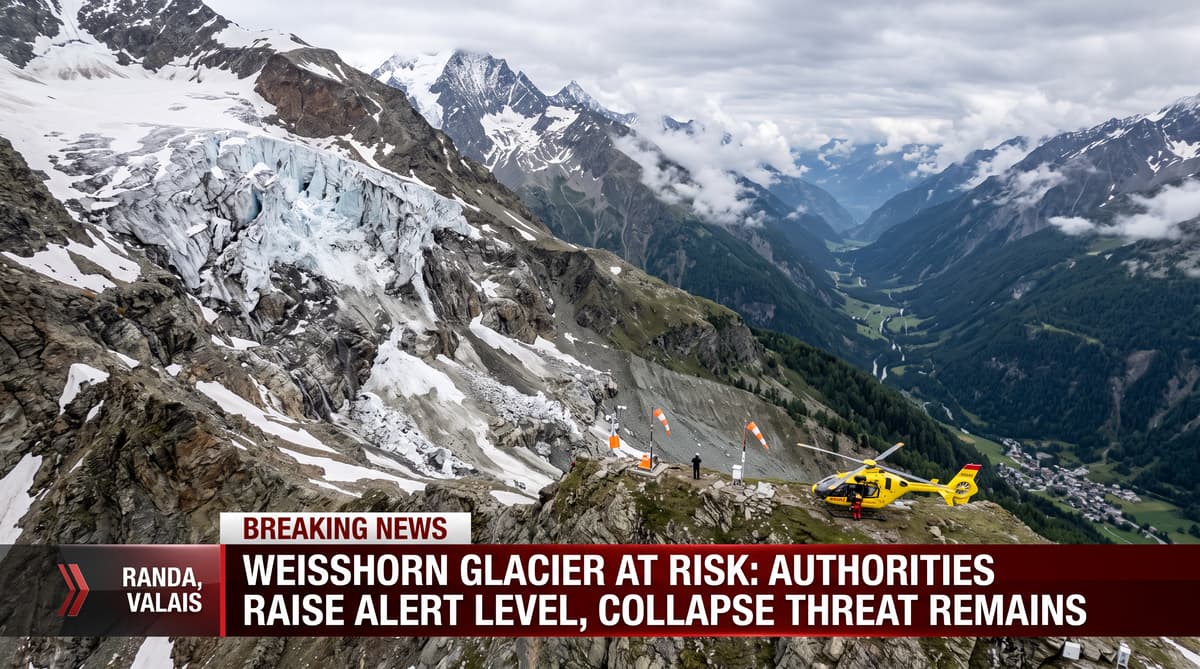
The Weisshorn is moving—and Randa is on alert. At least three rockfalls tore through the Weisshorn East hanging glacier on Monday, sending debris down the high mountain above the Valais municipality. The largest collapse occurred between 5pm and 6pm, according to the local authority. With the glacier’s movement accelerating, Randa has raised its alert level to 3, signalling a serious and continuing hazard.
The 4,505-metre Weisshorn dominates the Mattertal valley near Zermatt, but its latest instability reaches far beyond a dramatic skyline. Broken fragments remain lodged on the lower glacier plateau, and authorities warn that further pieces could break away. The defined danger zone is closed, while official routes for pedestrians and cyclists remain shut until further notice.
There is no evacuation order and no current indication that debris will reach Randa. That distinction matters—but it offers no reason for complacency. The municipality says ruptures remain possible in the coming days. For residents, mountain workers and visitors, the message is direct: stay outside the marked perimeter and follow official instructions as the mountain’s next move remains uncertain.
Radar Scans the Clouds as the Glacier Hides Its Next Move
Poor weather is now obscuring the evidence authorities need most. Officials say conditions currently prevent a reliable assessment of the avalanche debris volume, making it harder to determine how much unstable material remains on the glacier and how close it may be to another release.
The danger perimeter has been established and marked, but the assessment does not stop at a line on a map. Since the end of June 2026, specialists have tracked movements on the Weisshorn East hanging glacier. A specially installed interferometric radar is among the tools being used to measure changes and identify renewed acceleration. This technology can detect subtle surface movement even when direct observation becomes dangerous or visibility collapses.
That surveillance is crucial because a hanging glacier can change faster than traditional mountain inspections allow. Authorities are watching for signs that the increased risk is easing—or building towards another break-off. Until the data show a sustained improvement, the restrictions stay in place. In the high Alps, uncertainty is itself a hazard: when clouds hide the slope, responders must assume the mountain may still be active.
Randa Knows the Cost of a Mountain Breaking Apart
Randa has seen the consequences of mountain failure before. The largest historically documented Weisshorn glacier event struck in 1819, when an avalanche caused extensive damage in the village. Further glacier break-offs in 1972 and 1973 were less severe, stopping on a glacier field rather than reaching the valley communities.
The broader record is even more sobering. In 1991, a major triple rockslide on the nearby Längenfluhberg released nearly 50 million cubic metres of rock. The mass buried the railway and road, dammed the Vispa and destroyed 33 buildings. No people died, but livestock were killed and the valley’s transport lifelines were severed.
Those episodes explain why Randa treats the current Weisshorn activity with precision rather than panic. The danger zone, route closures and alert-level system are designed to create distance between people and an unstable slope. The fact that no evacuation has been ordered today does not erase the region’s exposure. It underscores the value of early warnings: authorities can act before a collapse becomes a catastrophe, provided the public respects the boundary.