Science
Swiss-Led Antarctic Study Reveals Isolation Breeds Mistrust and Conflict
An international study led by the University of Bern, which monitored a crew in an isolated Antarctic research station for ten months, has found that extreme living conditions significantly increase loneliness, mistrust, and conflict within a group.
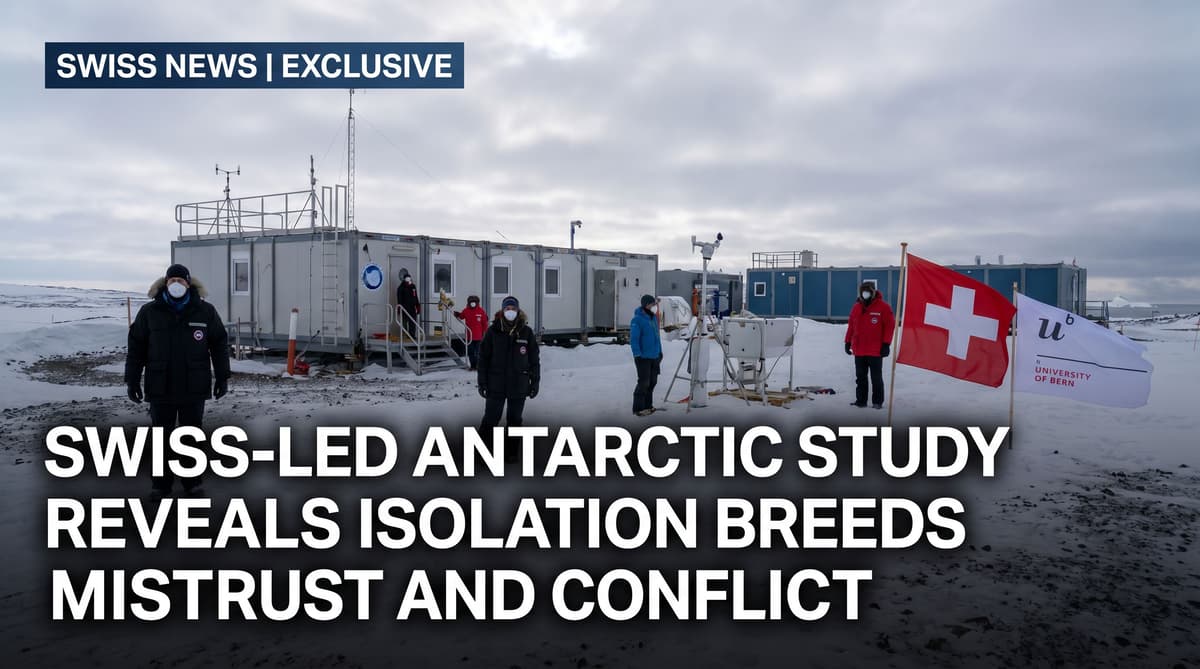
Ten months of total isolation in the world’s most hostile environment is enough to break even the most disciplined teams. A groundbreaking study led by the University of Bern reveals that extreme living conditions do not build character; they breed mistrust. Researchers monitored 12 crew members at the Concordia research station in Antarctica, a facility perched 3,000 meters above sea level where temperatures plummet to a lethal -80°C. This environment is so punishing that lead author Sebastian Walther describes it as more remote than the International Space Station. While we often romanticize the 'heroic' age of exploration, this data paints a darker picture of psychological decay. Over the course of the 300-day 'hibernation,' team cohesion did not just waver—it plummeted. Loneliness and paranoid thoughts surged as the crew grappled with the crushing weight of their confinement. This isn't just a story about cold weather; it is a critical look at the fragility of the human psyche when stripped of the social safety nets of civilization.
Proximity Fuels Paranoia and Conflict
Counter-intuitive data from wearable sensors has shattered the myth that 'spending time together' solves group friction. In fact, the University of Bern study found that more frequent and longer physical proximity actually catalyzed conflict and mistrust. The sensors, which recorded every movement and interaction, showed that as the mission progressed, the very act of being near one another became a source of stress rather than support. Subjectively perceived performance among the crew members crashed as the social environment soured. Instead of a tight-knit unit, the researchers observed a group of individuals retreating into themselves or engaging in hostile micro-interactions. This discovery confronts the traditional management philosophy that proximity equals collaboration. In the high-pressure 'pressure cooker' of Concordia, closeness became a liability. The study, published in the prestigious journal PNAS, proves that in confined spaces, the human brain begins to interpret neutral social cues as threats, leading to a surge in paranoid ideation that can jeopardize the entire mission's success.
Nationalism Divides the Frozen Frontier
National identity remains a powerful—and potentially dangerous—force even at the edge of the world. As the ten-month isolation wore on, the crew at Concordia split along national lines, with French and Italian members increasingly segregating themselves into their own cultural silos. This polarization created a 'us versus them' mentality that dramatically increased the risk of tension and undermined the collective goal. Even in a scientific environment dedicated to progress, the primal instinct to retreat into familiar tribal groups remains dominant. This finding is an alarming wake-up call for international organizations. When the external world disappears, internal differences become magnified. The study highlights that cultural homogeneity or deliberate cross-cultural integration strategies are not just 'nice-to-haves'—they are mission-critical requirements. Without active intervention, the natural tendency for groups to fracture into national cliques can lead to a total breakdown in communication, leaving a crew vulnerable in an environment where cooperation is the only thing keeping them alive.