Economy
Corporate Bankruptcies in Switzerland Surge to Highest Level Since 1994
The first half of 2026 saw corporate insolvencies rise by nearly 55%, the highest figure in over three decades. The trend is attributed to a combination of economic factors and a change in law requiring more rigorous debt enforcement by public creditors.
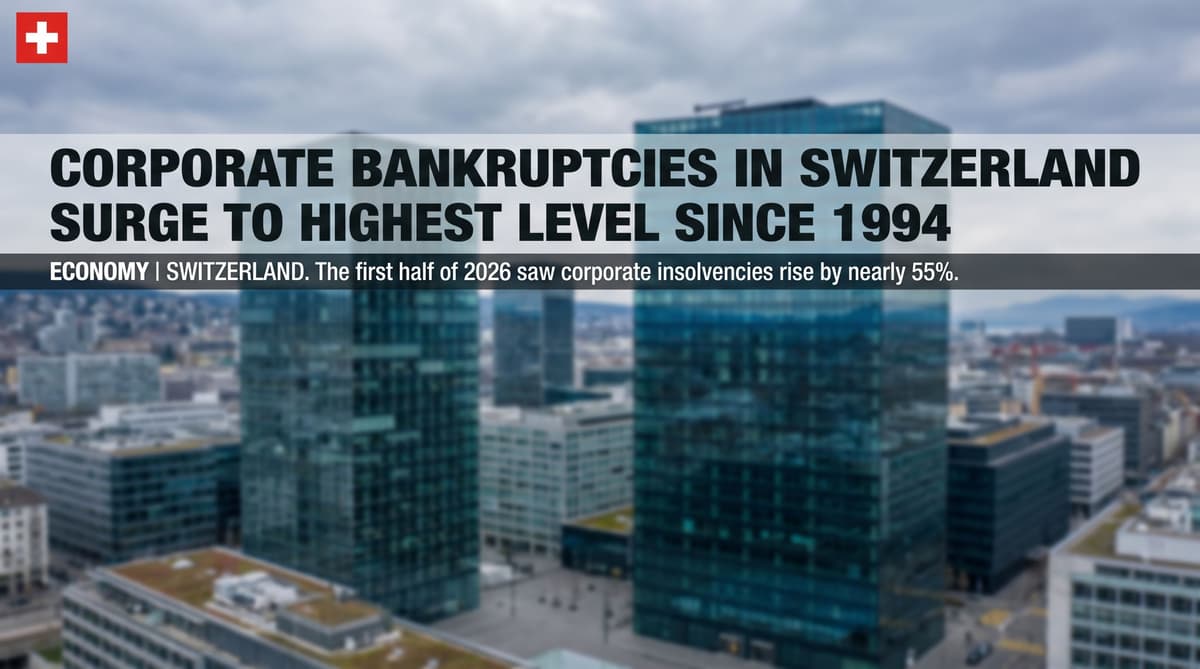
A staggering 55% surge in corporate bankruptcies has rocked the Swiss Confederation, marking the most volatile period for domestic business since 1994. In just six months, 7,496 companies have folded, leaving the economy grappling with a scale of failure not seen in three decades. This is not a slow leak; it is a flood. If the current trajectory holds, Switzerland confronts a record-breaking 15,000 insolvencies by year-end, dwarfing the 11,900 cases recorded in 2025. The stability that once defined the Swiss marketplace is being tested as the hospitality, retail, and skilled trade sectors bear the brunt of this financial storm. While the global economy remains fragile, the intensity of this spike suggests that internal pressures are reaching a breaking point, forcing a dramatic realignment of the nation's corporate landscape.
Legislative Crackdown Triggers Economic Reckoning
The rule of law is asserting itself with brutal efficiency. A pivotal legislative shift enacted in 2025 now compels public creditors—specifically tax and social security authorities—to enforce outstanding claims with uncompromising rigor. This 'systemic cleaning' of the market is unearthing thousands of 'zombie' companies that were previously shielded by more lenient debt recovery practices. Dirk Radetzki of Dun & Bradstreet notes that these figures are no longer comparable to previous years because the safety net has been pulled away. Businesses that once operated at their absolute economic limit are now being pushed over the edge by the very institutions that previously allowed them to linger. This policy shift, combined with the high cost of finance and weakening demand, has created a perfect storm that leaves no room for fiscal inefficiency.
Legacy Brands Crumble Under Financial Strain
Longevity is no longer a shield against insolvency. In a startling reversal of traditional market wisdom, established companies with more than a decade of history are failing at higher rates than their younger counterparts. The skilled trades lead the carnage with 1,053 bankruptcies, followed closely by 770 failures in the hospitality sector and 626 in retail. From the bustling streets of Zurich to the quiet valleys of the Grisons, the contagion is nearly universal. Only the canton of Schwyz managed to resist the trend, while every other region reported a sharp increase in business deaths. The data reveals a grim reality: the longer a company has been in the market, the greater its risk of becoming insolvent in this high-cost, high-pressure environment. These are not just startups failing to launch; these are the pillars of the Swiss middle class being dismantled.
Navigating the New Swiss Economic Reality
Switzerland stands at a critical crossroads as it confronts a systemic economic shift. The simultaneous collapse across virtually all sectors—printing, utilities, and transport included—signals that this is not a localized tremor but a full-scale tectonic shift. While the construction industry has shown rare resilience, the broader outlook remains cautious. The legislative reform is effectively 'flushing' the system, bringing to light cases that have long been operating on the brink. As we move into the latter half of 2026, the focus shifts to how the remaining players adapt to a landscape where public creditors are no longer silent partners. The coming months will determine if this surge is a necessary correction that paves the way for a leaner, more robust economy, or the beginning of a prolonged period of Swiss industrial contraction. The era of easy credit and deferred obligations is officially over.