Health
Investigation Uncovers Swiss Doctors Demanding Cash Payments Before Surgery
Patient advocacy groups are sounding the alarm after an investigation revealed a growing practice of some Swiss doctors demanding thousands of francs in cash before performing operations, sometimes without providing receipts, raising serious legal and ethical questions.
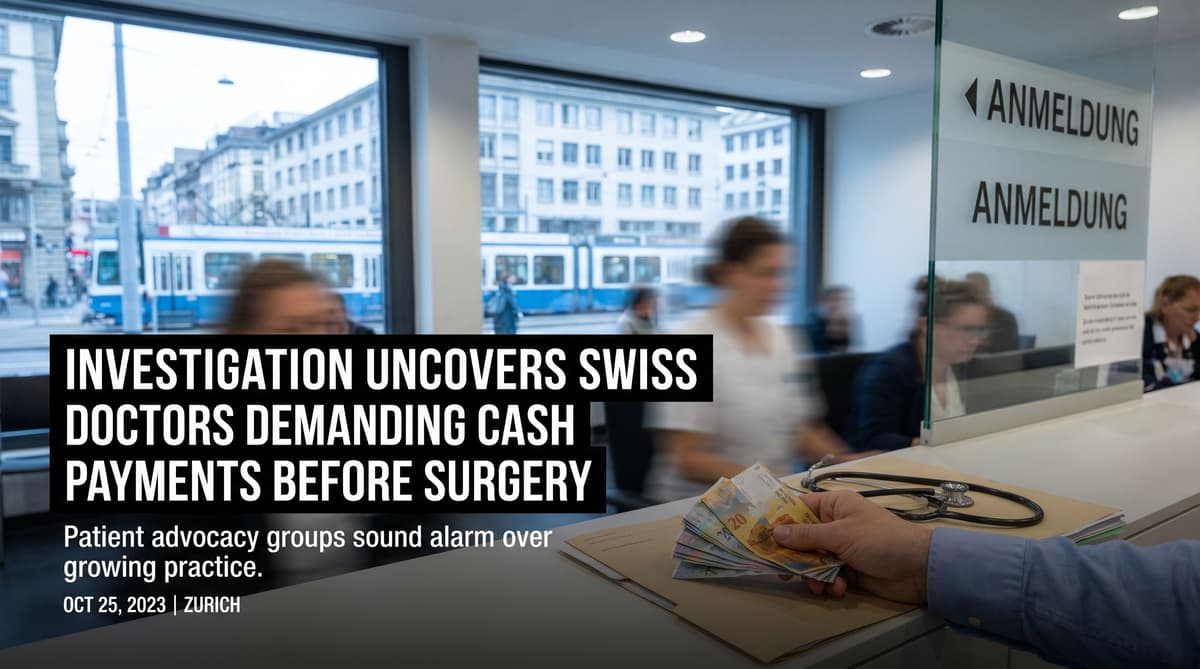
Switzerland’s reputation for healthcare excellence is facing a devastating blow as an investigation uncovers a shadow economy operating within sterile operating rooms. A staggering number of patients report being held to financial ransom, forced to pay thousands of francs in cash before surgeons will pick up a scalpel. This isn't a fringe occurrence; the Zurich Patient Centre has already documented more than 40 cases since the end of last year, signaling a systemic rot in medical billing. While Switzerland prides itself on transparency, these under-the-table demands bypass every regulatory safeguard designed to protect the public. The practice targets the vulnerable, often those in pain or facing urgent medical needs, turning the sacred doctor-patient relationship into a transactional shakedown. As the number of complaints surges, the medical community confronts a crisis of trust that threatens the very foundation of the Swiss health insurance system.
Envelopes of Cash Replace Official Invoices
Demands for cash are reaching unprecedented levels, with some surgeons reportedly asking for as much as CHF 12,000 in unmarked envelopes. In one alarming case, a patient seeking treatment for a painful cyst was told she must provide CHF 1,200 in cash—no invoice, no receipt, and no paper trail. When she requested documentation for her insurer, the gynecologist's response was chilling: 'Bring the money in cash in an envelope.' This occurs despite the fact that senior consultants in Switzerland already earn substantial salaries, often ranging from CHF 300,000 to over CHF 500,000 annually. The greed driving these off-the-books payments is not just a breach of ethics; it is a direct assault on the TARMED billing system. Doctors justify these 'speed fees' by claiming standard insurance reimbursements are insufficient, yet they are simultaneously billing outpatient procedures at inflated semi-private inpatient rates, effectively double-dipping into the pockets of patients and insurers alike.
Legal Loopholes and Ethical Failures
The legal reality in Switzerland is clear: additional charges are only permissible for clearly defined, extra-mandatory services. However, the line between 'enhanced care' and 'extortion' is being blurred. Franziska Sprecher, a law professor at the University of Bern, emphasizes that patients must be informed financially as well as medically. Any surcharge must be transparent, documented, and justified by services not covered by compulsory insurance. In contrast, the current investigation reveals a pattern of coercion where cash is demanded for 'faster access' to urgent procedures. Under Swiss tariff-protection rules, doctors are strictly prohibited from hiking prices simply because they find official reimbursement rates too low. This legal safeguard is being ignored by a segment of the medical elite who believe they are above the law. The implications are severe: if doctors can bypass fixed tariffs at will, the entire mandatory insurance model—the backbone of Swiss social stability—could collapse under the weight of unregulated greed.