education
ETH Zurich's Chinese Student Screening Sparks Controversy
Top Swiss university's security measures for foreign student applications, particularly affecting Chinese candidates, triggers international debate.
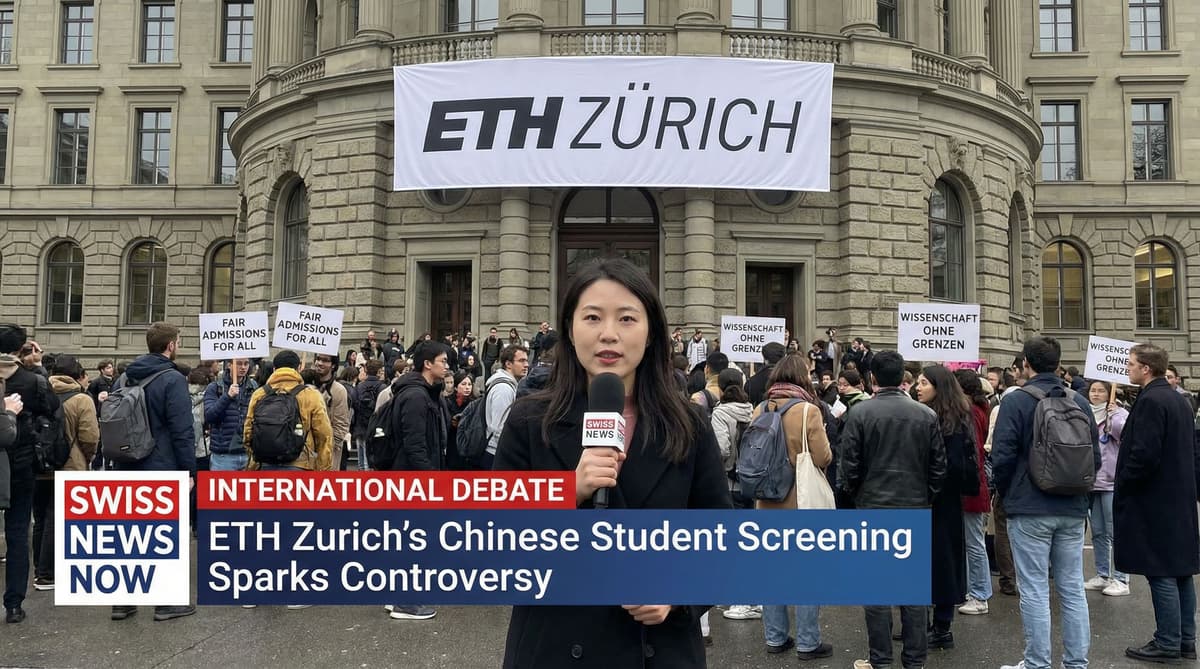
Switzerland’s premier academic institution has shattered the illusion of open borders in science. On October 24, ETH Zurich unveiled a rigorous security screening protocol that effectively places a target on the backs of applicants from specific nations. This is not a minor administrative tweak; it is a fundamental shift in Swiss educational policy that is sending shockwaves through the international academic community. The university is now actively screening foreign students to prevent the outflow of critical technology, specifically targeting nationals from "risk countries" including China, Russia, Iran, and Syria.
The move marks a dramatic departure from the traditional Swiss ethos of academic neutrality. ETH Zurich is grappling with a new geopolitical reality where research is a battlefield. The measures are designed to intercept knowledge transfer in sensitive fields such as GPS technology, drones, and surveillance systems. While the university frames this as legal compliance, the message to the global community is stark: access to Swiss innovation is no longer a right, but a privilege that is being heavily policed. The era of unquestioned academic mobility is over, replaced by a regime of suspicion and scrutiny that threatens to redefine Switzerland's standing as a global research hub.
The Four Pillars of Exclusion
The new screening mechanism operates on a ruthless four-point logic designed to filter out potential security threats before they set foot on campus. It is a dragnet of unprecedented specificity. First, the applicant's country of origin is scrutinized—nationality alone is now a primary flag for risk. Second, the institute digs into the applicant’s academic history: have they studied at an institution linked to military research? Third, the money trail is investigated to determine if scholarships are funded by sanctioned states. Finally, the specific field of study is analyzed for "dual-use" potential.
This is a bureaucratic fortress. Applicants looking to specialize in computational biology, aerospace, or advanced engineering face the highest hurdles. The guidelines explicitly reference the Swiss Federal Act on the Control of Dual-Use Goods, mandating that ETH Zurich minimize the risk of military-applicable knowledge falling into the hands of foreign powers. This is not merely a background check; it is an intelligence-style assessment of a student's entire biography. For thousands of prospective scholars, these four criteria represent a nearly insurmountable wall, transforming the application process from a meritocracy into a geopolitical vetting procedure.
Dreams Dismantled: The Human Cost
"Why is ETH Zurich taking such harsh decisions?" demands Huang Xiaoyu, a biotechnology student whose voice trembles with anxiety. His plight represents a growing legion of scholars facing a sudden, invisible wall. Huang has spent over a year mastering German and tailoring a master's proposal specifically for ETH Zurich, only to find himself potentially blacklisted by his passport and his previous university. The fear within the Chinese academic community is palpable and rising.
For students like Huang, the policy is devastatingly personal. He describes a sense of betrayal—a feeling that scientific passion is being criminalized due to international politics beyond his control. He has done everything right: excellent grades, language proficiency, and a transparent study plan. Yet, under the new regime, his affiliation with the University of Electronic Science and Technology of China could be the sole reason his future is derailed. This controversy highlights a critical tension: while Switzerland seeks to protect its intellectual property, it risks alienating the very talent pool that drives global innovation. The anxiety is not just about rejection; it is about the stigmatization of an entire nationality of researchers.