Federal Council
Céline Amaudruz launches bid for Swiss Federal Council seat
Swiss People’s Party vice-president Céline Amaudruz is seeking a seat on the Federal Council, arguing that the party should retain French-speaking representation. Her candidacy adds a regional and gender dimension to the contest to replace Guy Parmelin.
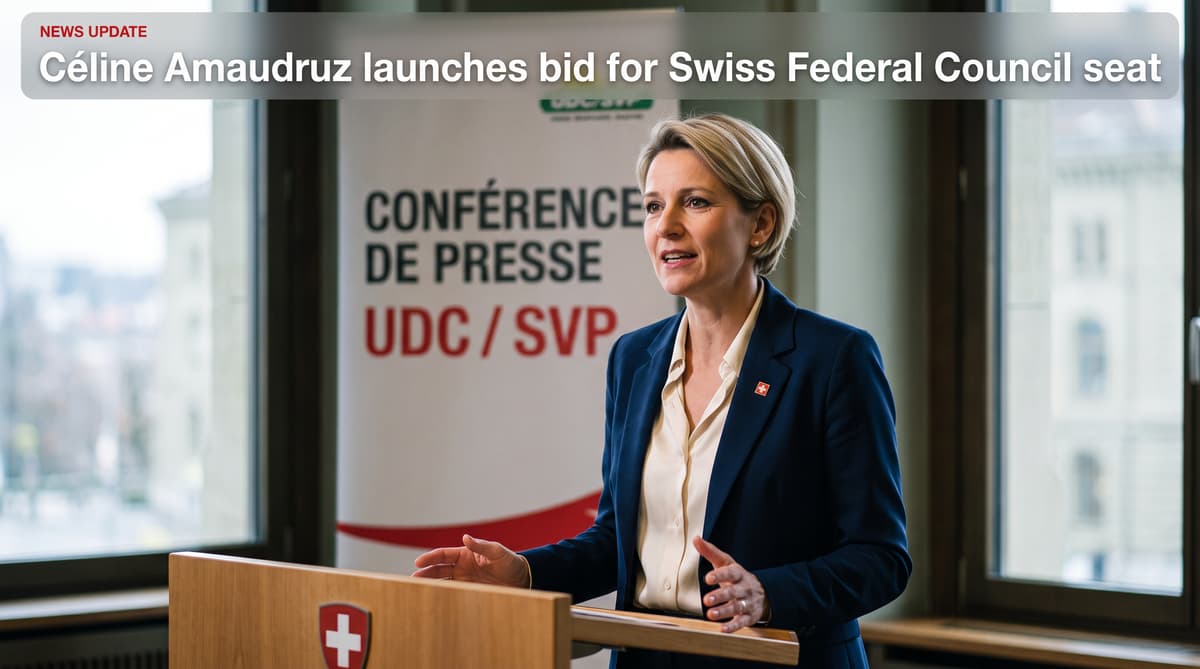
Céline Amaudruz has opened the race to replace Guy Parmelin, putting language, gender and party balance at the centre of Switzerland’s next Federal Council election. The 47-year-old Geneva politician announced her candidacy on Thursday, becoming the first person to formally seek the Swiss People’s Party seat.
Parmelin will leave the seven-member government on December 31, at the end of his second term as rotating president. The 66-year-old announced his resignation on October 2 after 11 years in government, telling RTS that his enthusiasm had faded and that he wanted to make room for fresh energy.
The seat is expected to remain with the SVP under Switzerland’s unwritten power-sharing formula. The SVP, Social Democratic Party and FDP each hold two cabinet seats, while the Centre holds one. Parliament will elect Parmelin’s successor on December 9.
Amaudruz has framed her candidacy around the party’s national reach. She argues that the SVP should retain a French-speaking voice in the cabinet, particularly as the party’s strongest electoral base lies east of the language divide. She also brings a profile that remains uncommon in the party’s federal ranks: she is a prominent woman from Geneva in a parliamentary group dominated by German-speaking men.
Put Regional Representation on the Ballot
Amaudruz’s candidacy confronts the SVP with a representation problem visible in both its elected ranks and its voter base. The party’s National Council delegation elected in 2023 was four-fifths male, while its support remained stronger among men than women. Thirty percent of male voters backed the SVP in 2023, compared with 24% of women.
The language divide is equally clear. The SVP won 31% of the vote in German-speaking Switzerland, its strongest regional result and a clear lead over its rivals. In French-speaking Switzerland, it received 20%, trailing the Social Democratic Party and narrowly edging out the FDP.
Amaudruz has been one of the most visible French-speaking figures in the party for years. She entered Parliament in 2011 and serves as an SVP vice-president. Her route to the cabinet would give the party a minister from Geneva, a canton that has had no representative on the Federal Council since Micheline Calmy-Rey left in 2011.
The regional argument is practical as well as symbolic. Amaudruz said she would speak for French-speaking Switzerland on transport and crime, two areas where decisions made in Bern carry direct consequences for cantonal governments and urban communities.
Force the SVP to Choose Its Balance
The SVP must now decide whether its shortlist should reflect the country’s linguistic map as closely as its electoral strength. Amaudruz has said the party would face a problem if it lost its French-speaking Federal Council presence. She wants at least one candidate from French-speaking Switzerland included on the final list presented to the parliamentary group.
Her argument carries particular weight because the succession is likely to preserve the existing party formula. The SVP is not competing for an open seat across the political spectrum. It is seeking to defend one of its two cabinet positions while choosing a figure capable of representing a party whose support and organisation are concentrated in German-speaking cantons.
Amaudruz declined to name a preferred ministry. “I am standing for the Federal Council, not for a particular department,” she told reporters, while acknowledging that she has preferences. She said she was ready to serve Switzerland and described her priorities as an economically and socially strong, open, sovereign and safe country.
Her entry also creates a clear gender test for the party. If elected as the official SVP nominee, she would become the first woman to enter the Federal Council with the party’s backing. The government would then have three women among its seven members.