Economy
US Imposes New Tariffs on Swiss Goods; UBS Holds Firm on Growth Forecast
The United States has implemented a new 12.5% tariff on select Swiss imports, citing concerns over forced labour. Despite the move, economists at UBS are maintaining their Swiss GDP growth forecasts, anticipating that a broader European recovery will offset the impact.
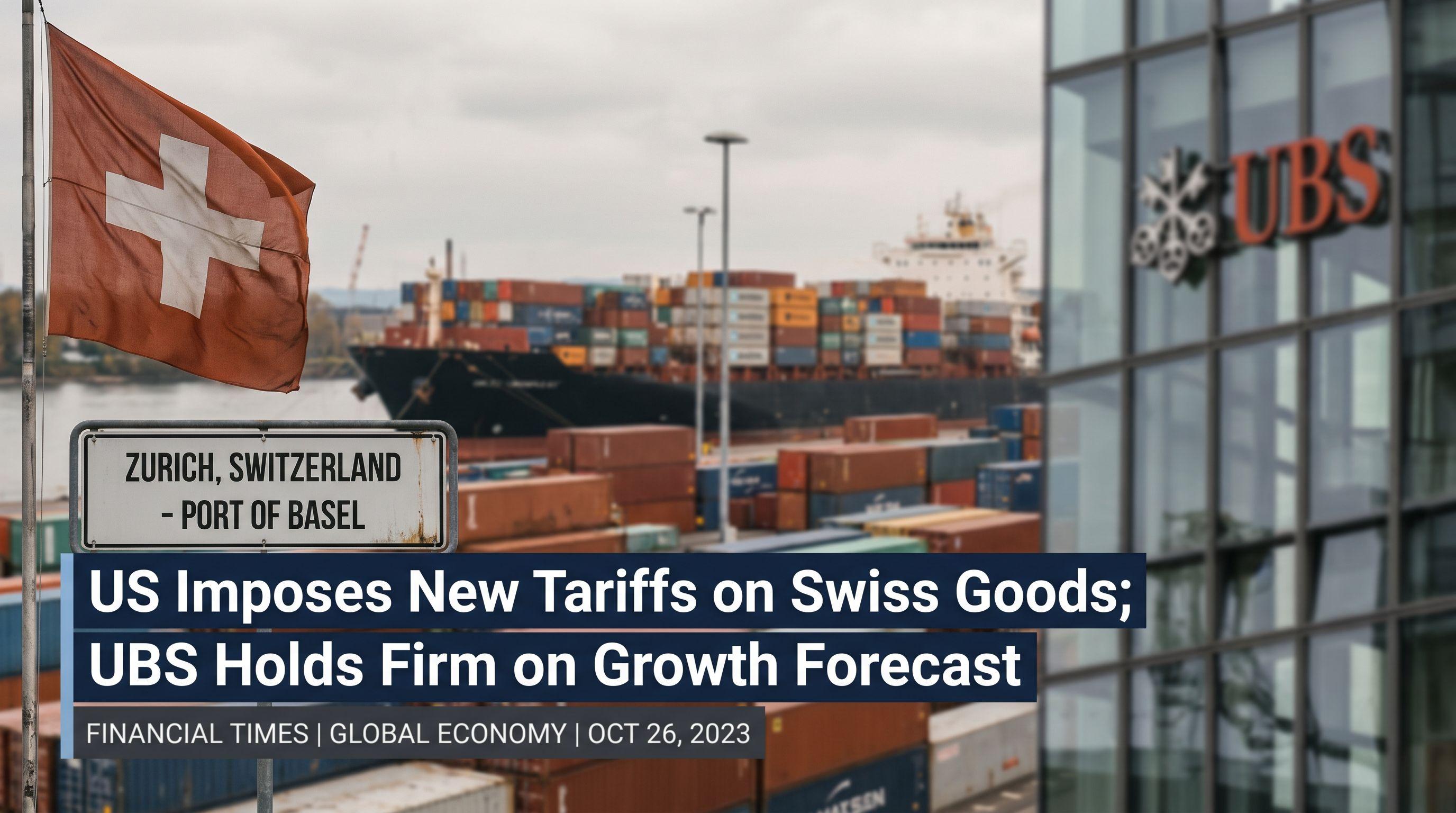
Washington Strikes Swiss Trade with 12.5% Levy
A staggering 12.5% tariff now hangs over Swiss exports as the United States aggressively pivots its trade strategy. Effective overnight, the White House has unleashed a new wave of duties targeting Switzerland and nearly 60 other trading partners. This move follows a February Supreme Court ruling that dismantled previous broad tariffs, forcing the U.S. administration to adopt a more surgical, statute-based approach. While the European Union and Japan face similar pressures, Swiss goods are being hit with a rate 2.5 percentage points higher than their EU counterparts. This discrepancy creates an immediate and painful competitive disadvantage for Swiss manufacturers. The U.S. remains a critical, albeit volatile, partner; even under previous 10% tariffs, Swiss exports to America surged by a massive 21% in the second quarter of this year. This growth dwarfs the measly 0.4% increase seen in exports to the European Union over the same timeframe. Washington’s 'tariff machine' is back in high gear, and Swiss exporters now find themselves directly in the crosshairs of a protectionist resurgence that shows no signs of slowing.
Swiss Industry Slams 'Unjustified' Forced Labor Claims
Economiesuisse is firing back, labeling the U.S. justification for these tariffs as 'unjustified and difficult to understand.' The White House claims these measures are necessary to combat forced labor, yet Swiss business leaders point to the nation's ironclad constitutional and criminal laws that strictly prohibit such practices. Swissmem, representing the tech and engineering sectors, warns that the 12.5% levy places local firms on a tilted playing field. By charging Swiss companies more than their European or British rivals, Washington is effectively taxing Swiss innovation. The stakes are rising as a separate U.S. investigation into 'industrial overcapacity' looms, threatening even more duties. Swiss industry groups are now demanding that Bern secure a deal with Washington to achieve parity with the EU. The tension is palpable: Swiss firms must now defend their reputation while simultaneously grappling with increased costs in their most lucrative growth market. This is no longer just a trade dispute; it is a direct challenge to the integrity of Swiss manufacturing standards.
UBS Holds the Line on Swiss Growth Forecasts
UBS is refusing to blink in the face of American protectionism. Despite the 12.5% tariff bombshell, economists at Switzerland’s largest bank are maintaining their GDP growth forecasts of 0.7% for this year and a robust 1.4% for 2027. The bank’s 'three keys' philosophy suggests that while the U.S. market is important, it is not the sole arbiter of Swiss prosperity. UBS argues that the expected recovery of the European economy in 2027 will act as a powerful engine, more than offsetting the drag from American tariffs. 'Exports to the United States are expected to contribute only very marginally to economic growth this year,' the bank stated, signaling a strategic focus on continental stability. However, the bank does concede that if tariffs escalate beyond the 15% mark—a very real possibility—the Swiss National Bank (SNB) might be forced to delay interest rate hikes. For now, the message from Zurich is clear: the Swiss economy is resilient enough to absorb the blow, provided the broader European recovery remains on track. Domestic demand continues to be a pillar of strength, shielding the nation from the worst of the trans-Atlantic trade storm.
Bern Navigates a High-Stakes Trade Minefield
The path forward for Switzerland is fraught with geopolitical complexity. While UBS remains optimistic, the reality on the ground is one of 'uncertain future developments.' The U.S. is currently tightening the screws on other nations as well, slapping a 25% tariff on Brazil and a massive 50% on Canada. Switzerland’s goal is to negotiate a trade ceiling similar to the 15% agreement the EU currently enjoys with Washington. Without such a deal, the Swiss economy risks being caught in a permanent state of trade limbo. The Swiss National Bank is watching closely; a delayed recovery could force a pivot in monetary policy, keeping interest rates lower for longer to stimulate growth. As Washington continues to use Section 301 investigations to probe everything from timber to tech, Bern must act decisively. The 'Trump-era' tariff philosophy has evolved into a multi-tentacled machine that threatens to thwart global trade patterns permanently. Switzerland’s ability to maintain its neutral but prosperous standing depends on its capacity to negotiate a 'level playing field' before the next wave of duties hits. The clock is ticking, and the cost of inaction is 12.5% and rising.