Nespresso
Nespresso Phases Out Its Compostable Paper Capsules
Nespresso is phasing out its compostable paper capsules after customers reported limited shelf life and problems with the product experience, leaving aluminium as the company’s preferred packaging for coffee quality.
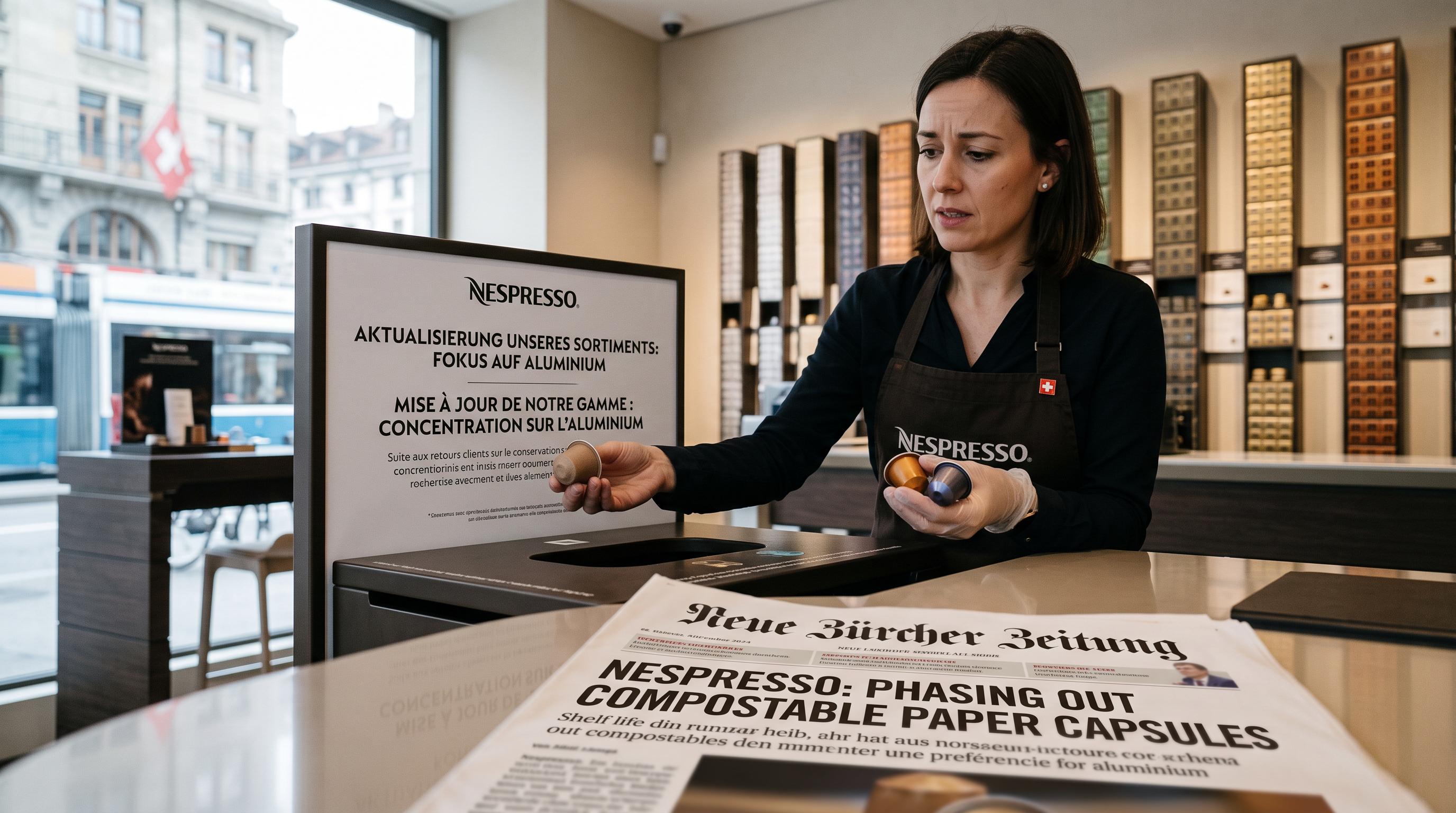
Nespresso Pulls Its Paper Experiment
Nespresso is withdrawing its compostable paper capsules, closing a short experiment in lower-impact coffee packaging that began in 2023. The Nestlé subsidiary confirmed the decision to the AWP news agency on September 30, 2026, after reports that customers had encountered a limited shelf life and an unsatisfactory overall product experience.
The withdrawal will happen gradually. Swiss customers can still find the capsules in some Nespresso boutiques for approximately one month, although availability will depend on remaining stocks. The company introduced the paper format as a pilot, giving consumers an alternative to its established aluminium system. It tested the product in 14 European markets.
Nespresso now plans to concentrate on aluminium, arguing that the material offers more dependable protection for the coffee's flavour and aroma. The move affects a product designed to address growing scrutiny of single-use packaging, particularly in a country where coffee machines and capsule systems are a familiar part of domestic life.
For Swiss consumers, the immediate consequence is practical. Anyone who preferred the paper option will need to use remaining supplies soon or return to aluminium capsules. Nespresso's next sustainability test will focus on how effectively it can collect and recycle that larger aluminium stream.
Shelf Life Sets the Limit
The paper capsules carried 82% paper packaging, but their design imposed tighter storage limits than aluminium. Nespresso recommended that customers use an opened pack within four weeks. Aluminium capsules, by comparison, can protect coffee from light, air and moisture for up to one year, according to the company.
Those differences matter in a product built around consistency. Coffee can lose aroma and flavour when oxygen, humidity or light reaches it. Customers may also buy capsules in bulk, keep several varieties at home and open a pack weeks before finishing it. A shorter window leaves less room for those habits and creates a more demanding product routine.
Nespresso spent three years developing the paper capsule before launching it in 2023. The pilot offered the company a way to test whether compostable packaging could meet the technical demands of portioned coffee at scale. Customer feedback ultimately pointed to problems with shelf life and the wider “product experience”, the company said.
The decision therefore rests on more than the material printed on the package. It reflects the relationship between packaging, storage, brewing and taste. Aluminium gives Nespresso a longer protection period and a familiar production system, while the paper format required customers to manage the product more carefully.
Carbon Numbers Narrow the Gap
Nespresso's own life-cycle figures show only a two-gram difference in carbon emissions per small espresso. The company cites 79 grams of CO₂ equivalent for a paper capsule and 81 grams for an aluminium capsule. It says the figures make the phase-out compatible with its sustainability goals, although the analysis was commissioned by Nespresso and the source provides no further methodological detail.
That comparison shifts attention away from the capsule material alone. A life-cycle assessment can include the production of packaging, coffee processing, transport and disposal. The final result depends on the assumptions used for each stage, including what happens after consumers finish their coffee.
Nespresso says it does not view the decision as a step backwards on sustainability. The company intends to invest more heavily in aluminium recycling and to move capsules increasingly through standard recycling schemes. That approach places greater importance on collection rates and processing infrastructure, because aluminium's environmental case depends partly on recovering the material rather than sending it to general waste.
For consumers, the numbers offer a narrow comparison rather than a complete environmental verdict. Paper packaging does not automatically produce a lower reported footprint, and aluminium does not remove the need for responsible disposal. The effectiveness of the system will be measured after the capsule leaves the coffee machine.
Switzerland Must Close the Recycling Loop
Switzerland recycles 73% of Nespresso capsules, according to the company, and Nespresso wants that share to rise. The target matters because the company's return to aluminium will increase the importance of collection points, sorting and recovery across the country.
France provides a comparison. Nespresso says 80% of the French population can already recycle its capsules through standard recycling schemes. The figures describe different measures, so they do not provide a direct country ranking. France's number refers to population access, while Switzerland's refers to the recycling rate reported by Nespresso.
Swiss consumers have traditionally had several ways to return used capsules, including collection arrangements linked to retailers and local recycling systems. The company's stated plan is to make standard schemes increasingly central. That could simplify disposal for households, provided municipalities and recycling operators accept the capsules and communicate the rules clearly.
The phase-out also creates a responsibility for Nespresso. Customers who chose paper because they wanted a compostable option may see aluminium recycling as a less intuitive replacement. The company will need to explain where capsules belong, how the material is recovered and how Swiss households can take part. A higher recycling rate will depend on convenience as much as on consumer willingness.
Swiss Coffee Returns to Aluminium
The paper capsule pilot will end with stock, not a single national cutoff date. Swiss boutiques are expected to sell the remaining products for around one month, with the exact timing determined by local inventories. Customers who want to continue using the format should check availability directly with their boutique rather than assume every store will carry it.
The change reinforces aluminium's long-standing role in Nespresso's system. The company says its wrappers provide protection for up to one year and preserve the flavour and aroma it considers central to the product. Nespresso will now direct its sustainability effort toward recycling that material more effectively.
For Swiss households, the choice will soon become simpler but narrower: aluminium will remain the standard Nespresso capsule, while the compostable paper alternative disappears. The environmental question will move from whether a capsule is labelled compostable to whether used aluminium reaches an effective recovery system.
That shift gives Nespresso a clear operational task. It must improve the 73% Swiss recycling rate, expand convenient collection and show consumers how the material is handled after use. The paper pilot demonstrated that a packaging alternative can attract interest while still failing on storage and product performance. The next phase will test whether a mature aluminium system can deliver both reliable coffee and higher recovery rates.