Crime
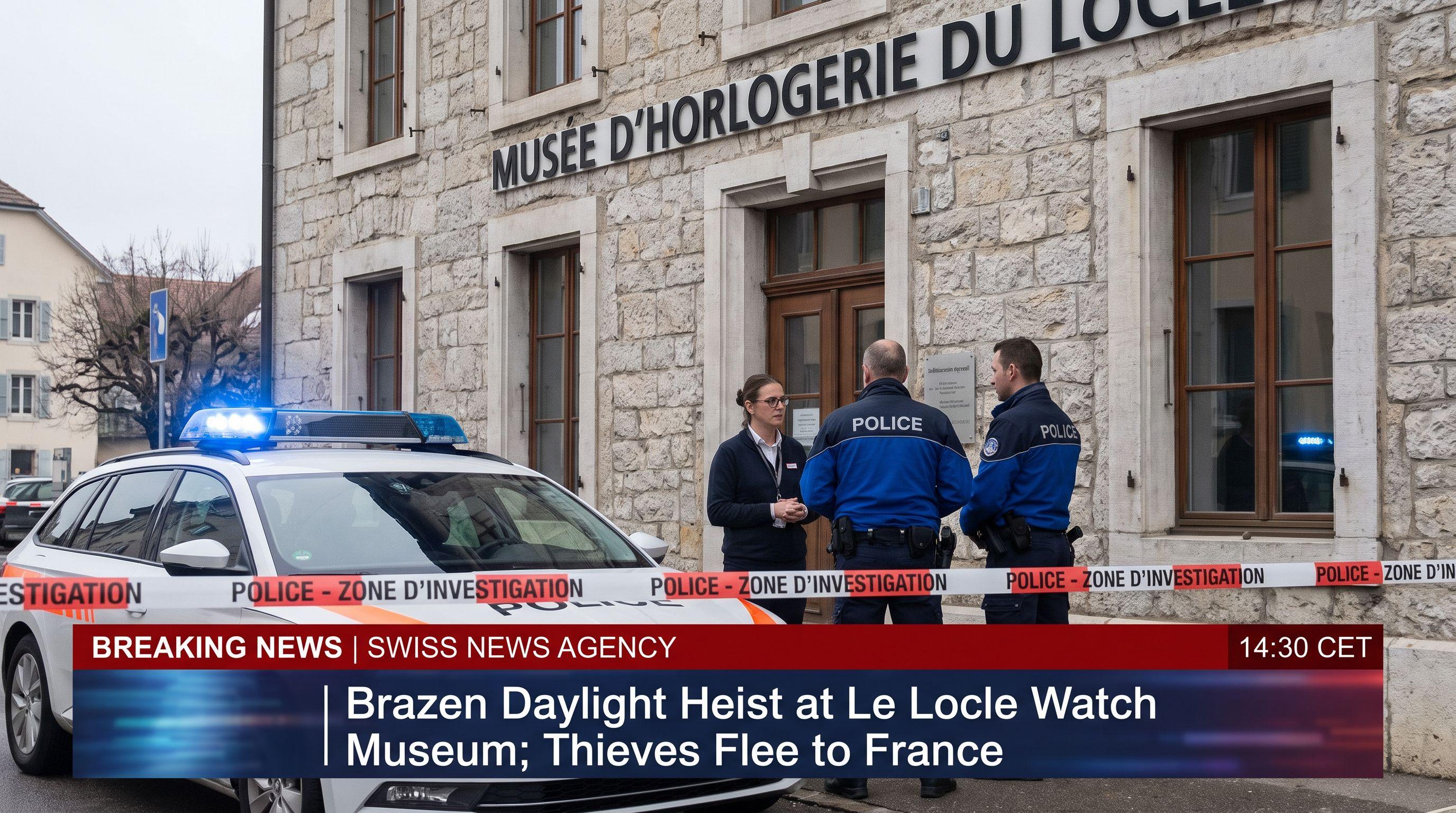
Brazen Daylight Heist at Le Locle Watch Museum; Thieves Flee to France
Four hooded criminals executed a swift raid on the Watch Museum in Le Locle, smashing display cases and stealing several valuable timepieces. The entire operation lasted less than five minutes before the thieves escaped in a high-performance car towards the French border.
Precision Crime Strikes the Heart of Horology
Switzerland’s watchmaking sanctuary has been violated. At exactly 6:15 AM, four hooded criminals shattered the morning silence of Le Locle, launching a surgical strike against the Watch Museum at the historic Château des Monts. This was no amateur burglary; it was a calculated assault on the very symbols of Swiss heritage. While the town slept, the gang forced open the north entrance, bypassing security measures with alarming ease. The target was specific, the execution flawless, and the message clear: even the most sacred vaults of time are not safe from the modern predator. This brazen raid confronts the Neuchâtel authorities with a terrifying reality—the global appetite for luxury timepieces has turned our museums into high-stakes targets. The value of the stolen goods is currently being assessed, but the damage to the sense of security in this UNESCO World Heritage region is already immeasurable. As the investigation unfolds, the industry grapples with the realization that its history is now as much a liability as it is an asset.
Five Minutes of Chaos at Château des Monts
Three hundred seconds was all it took to strip centuries of history. The Neuchâtel cantonal police confirm that the four suspects remained on the premises for less than five minutes, moving with a terrifying efficiency that suggests professional military or paramilitary training. They breached two separate rooms, focusing their aggression on the glass cases housing rare clocks and watches. Fewer than ten items were taken, yet these pieces represent the pinnacle of horological evolution. This 'smash-and-grab' methodology minimizes the window for police intervention, leaving authorities chasing shadows. While modern security systems are designed to detect, they often fail to delay such rapid-fire incursions. The thieves, clad in hoods and gloves, left behind a scene of devastation—shattered glass and empty pedestals—before the first sirens could even echo through the valley. The museum remained closed to the public following the incident, a somber reminder of the vulnerability of our cultural treasures in the face of ruthless criminal intent.
The Great Escape: Vanishing Across the Border
A high-performance saloon car is now the focal point of an international manhunt. Immediately following the heist, the criminals accelerated toward the French border, exploiting Le Locle’s geographic proximity to the frontier. The Federal Office of Customs and Border Security was alerted instantly, but the head start gained by the thieves proved critical. This escape route highlights a recurring nightmare for Swiss law enforcement: the 'commuter criminal' who strikes in Switzerland and vanishes into the European Union within minutes. French authorities are now assisting in a cross-border investigation, yet the trail is cooling rapidly. In contrast to local petty thefts, this operation bears the hallmarks of an organized syndicate capable of moving stolen luxury goods through black-market channels before the sun has even set. The speed of the getaway underscores the urgent need for tighter border coordination and real-time intelligence sharing between Bern and Paris. As the search intensifies, the high-performance vehicle remains the only tangible link to a group that seems to have vanished into thin air.
A Billion-Dollar Target: The Rising Cost of Swiss Excellence
The Le Locle heist is not an isolated incident; it is a symptom of a global epidemic. Luxury watches worth a staggering $1.1 billion are currently reported as stolen or missing worldwide. This surge in horological crime plummets the industry into a state of high alert. As the secondary market for prestige brands like Rolex, Patek Philippe, and Audemars Piguet soars, the incentive for high-risk robberies increases exponentially. In 2023 alone, the number of reported thefts saw a dramatic spike, and 2026 is on track to surpass those alarming figures. For Switzerland, the stakes are uniquely high. Our museums are not just tourist attractions; they are the guardians of the national identity. If these institutions cannot protect their collections, the very narrative of Swiss precision is at risk. The Le Locle raid serves as a critical wake-up call for museum curators and private collectors alike. Security must evolve from passive surveillance to active prevention. The future of Swiss watchmaking depends not just on the ability to create masterpieces, but on the strength to keep them.