Why is Switzerland “CH”? Behind the Swiss Country Code
Learn why Switzerland's country code is CH in this short story and learn more about Swiss culture.
Swiss ObserverUpdated
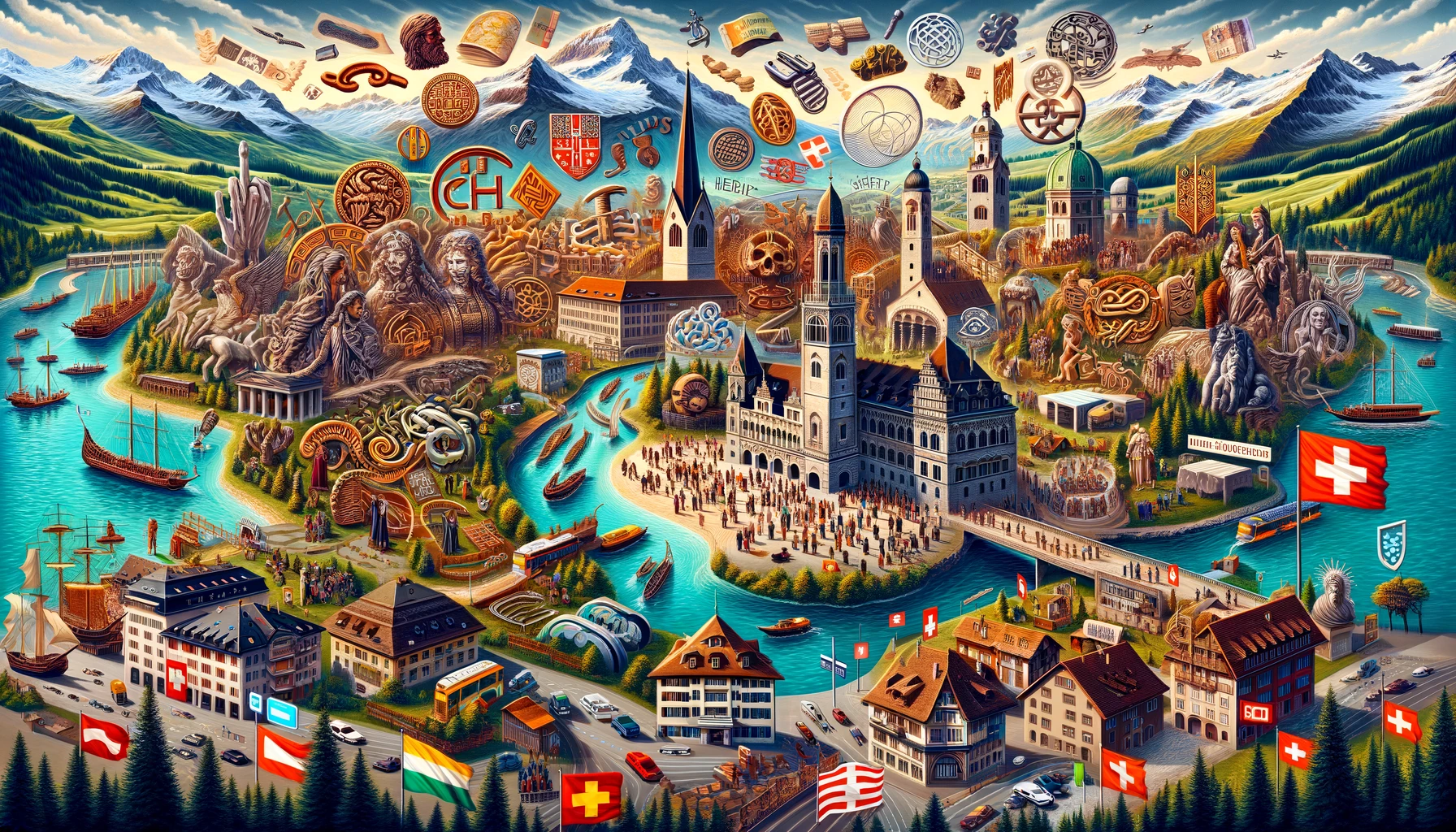
Switzerland evokes images of the Alps, delicious chocolate, and picturesque villages, but its “CH” abbreviation reveals a deeper story. This two-letter code stands for “Confoederatio Helvetica,” Latin for the Swiss Confederation, reflecting the country’s diverse history and cultural identity.
In this article, we will explore:
- The historical roots of “CH” and “Helvetia” dating back to ancient tribes and Roman times
- How the abbreviation is used today in domains, licenses plates, and money
- Switzerland’s blended culture across different language regions
- The economic prosperity and political neutrality that “CH” has come to represent globally
Understanding the meaning behind Switzerland’s shorthand “CH” sheds light on this multi-faceted nation, from its rich past to the principles it embodies today on the world stage.
Historical Roots of “CH” and “Helvetia”
The origins of “CH” date back to ancient times. The Helvetii were a Celtic tribe that inhabited the Swiss plateau before the Roman conquest in the 1st century BC. Their name lived on through the Latin term “Helvetia,” used to describe the region during the Middle Ages when Latin was the language of diplomacy and scholarship across Europe
Helvetia personified Switzerland, portrayed as a female allegory wearing flowing robes and armor while carrying a shield emblazoned with the Swiss flag. The Helvetic Republic adopted in 1798 also referenced this Latin name, emphasizing the country’s roots.
Modern Usage of “CH”
After the federal state was founded in 1848, the Latin name “Confoederatio Helvetica” came into use step by step. It appears on Swiss franc coins from 1879, on the Federal Palace in Bern from 1902, and on the official seal from 1948. As an abbreviation, “CH” became the standard country code, a neutral designation across Switzerland’s linguistic and cultural diversity.
Today, “CH” appears on Swiss domains (.ch), license plates, coins, and stamps. It represents Switzerland in the ISO 3166 standard and on the white oval sticker for cars abroad. The Olympics are an exception: there, Switzerland competes as SUI. The code encapsulates both the old and new: honoring ancient Helvetian heritage while symbolizing modern multicultural unity.
Switzerland’s Blended Culture
With four national languages – German, French, Italian, and Romansh – Switzerland embraces a rich regional diversity. The German-speaking majority resides in the central and eastern areas. French dominates the west. Italians cluster around the southern canton of Ticino. Romansh uniquely traces Latin roots.
This cultural blend stems from complex migration patterns and intermarriage over centuries. The varied linguistic regions cross religious lines as well, weaving Switzerland’s identity out of threads of history, topography, and politics.
Economic Prosperity and Political Neutrality
“CH” has come to signify Switzerland’s stability, prosperity, and neutrality on the global stage. Its dynamic economy exhibits low unemployment and robust GDP growth, paired with excellent infrastructure and a strong social safety net.
Long-held neutral foreign policy also allows Switzerland to play peacemaking roles in international conflicts. Though opening more to global cooperation like the UN, the country still guards its sovereignty. The Swiss model of direct democracy and local control yields cautious, moderate policies reflecting popular consensus.
In short, “CH” encapsulates the essence of Switzerland – rooted in the past yet forward-looking, independently minded yet internationally engaged. This simple two-letter code tells the richer story behind one of Europe’s most fascinating and enigmatic countries.
What does CH stand for? The short answer
CH stands for Confoederatio Helvetica, Latin for “Swiss Confederation”. Switzerland has four national languages, and its name is different in each: Schweiz (German), Suisse (French), Svizzera (Italian) and Svizra (Romansh). A Latin name does not favour one language region over another, so the country uses it for codes and symbols.
- Confoederatio means confederation. The cantons joined as a league of states, and the modern federal state still calls itself a confederation.
- Helvetica comes from the Helvetii, a Celtic people who lived on the Swiss plateau in pre-Roman times.
When did Switzerland start to use CH?
The two letters are older than the internet. These are the key dates:
| Year | Where CH or the Latin name appeared |
|---|---|
| 1848 | Federal state founded. Confoederatio Helvetica comes into use step by step. |
| 1879 | The Latin name appears on Swiss franc coins. |
| 1902 | The name is carved on the Federal Palace in Bern. |
| 1909 | CH is introduced as the international vehicle registration code. |
| 1948 | The Latin name is used on the official federal seal. |
| 1974 | CH becomes Switzerland’s ISO 3166-1 alpha-2 country code. |
| 1987 | The .ch internet domain is introduced (20 May 1987). |
Why is Switzerland not SW or SZ?
A code from the English name would not work well. Most of the obvious letters belong to other countries in ISO 3166-1:
- SE is Sweden.
- SZ is Eswatini (formerly Swaziland).
- SI is Slovenia.
A code from one of the four national languages would also pick a side. CH avoids both problems.
Where you see CH today
- Websites: Swiss domains end in .ch. Since 2015 Swiss businesses can also register .swiss domains.
- Cars: the white oval sticker for driving abroad says CH.
- Money: the currency code for the Swiss franc is CHF, and the Latin name is on Swiss coins.
- Post and business: Swiss postcodes are often written with a CH- prefix (for example CH-3003 Bern), and “CH” marks Swiss products.
- Type design: the Helvetica typeface, made in Switzerland in 1957, takes its name from the Latin name for the country.
Frequently asked questions
Is CH the same as CHF?
No. CH is the country code for Switzerland. CHF is the currency code for the Swiss franc: CH for the country plus F for franc.
Why does Switzerland use Latin and not English?
Switzerland has four national languages. Latin is neutral between them, and it was already the language of Swiss coins and seals.
What is the Swiss country code for phone calls?
The international dialling code is +41. CH is used for codes and symbols, not for phone numbers.
Is Switzerland CH at the Olympics?
No. The International Olympic Committee uses its own three-letter codes, and Switzerland competes as SUI.
Related reading
- The four Swiss languages explained
- Facts about Switzerland
- Can you use euros in Switzerland?
- 11 reasons why Switzerland is the best country in the world
Sources
- Swiss Federal Archives: The Confederation before 1798: Switzers, Swiss and Helvetians
- Wikipedia: Name of Switzerland, citing the Historical Dictionary of Switzerland
- Wikipedia: ISO 3166-1 alpha-2 and .ch
- Wikipedia: Switzerland at the Olympics
- swissinfo.ch: Why is Switzerland CH? Fun facts about the Swiss identity