Transport
Switzerland releases jet-fuel reserves to protect Zurich Airport supplies
Switzerland has authorised the release of up to 30 million litres of jet fuel from compulsory reserves to address a supply shortage at Zurich Airport. Disruptions to river and rail freight have affected deliveries to the country’s main aviation hub.
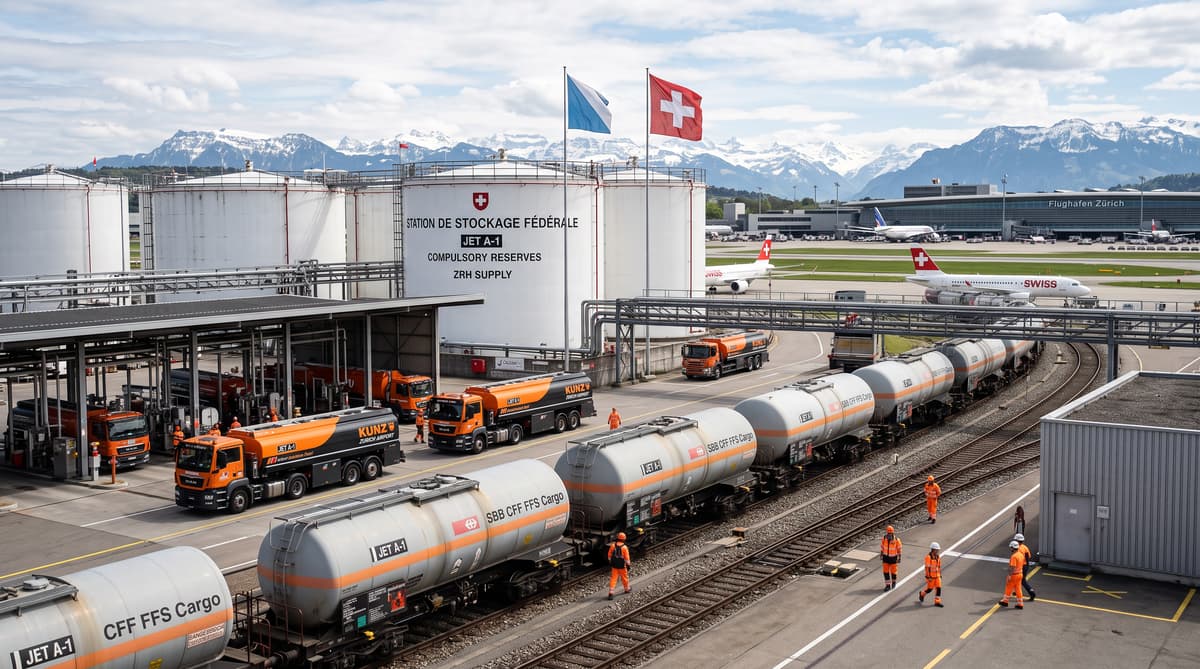
Up to 30 million litres of jet fuel will be released from Switzerland's compulsory reserves over the next two weeks, after freight disruptions threatened deliveries to Zurich Airport. The federal decision gives the country's main aviation hub additional cover while normal supply routes remain unreliable.
The intervention represents 6.5% of Switzerland's aviation-fuel reserves. It was approved after severe delays and cancellations on rail routes from Germany interrupted fuel deliveries. Low water on the Rhine added pressure by forcing barges to reduce their loads, with some services cancelled altogether.
Zurich Airport has not reported a refuelling shutdown. Swiss, the national flag carrier, said its aircraft refuelling continued without disruption and that the airport had imposed no restrictions. Geneva Airport also continued operating without reported limits.
The reserve release is therefore a preventive measure designed to keep aircraft supplied while freight operators work through a bottleneck. For passengers, the immediate effect should be limited, provided replacement deliveries reach the airport before the released stocks are exhausted. The decision also shows how quickly a disruption far from Swiss runways can affect the country's air transport system.
Freight Bottlenecks Hit the Supply Chain
The Rhine and Germany's rail network form the critical link behind the airport's fuel supply. Switzerland imports much of the energy it consumes, and Zurich depends on a chain of barges, rail freight and storage infrastructure extending beyond the airport perimeter.
Low Rhine water levels have reduced the amount each barge can carry. Some services have been cancelled, leaving more freight to travel by rail. That shift has collided with an already congested network in Germany, where delays and cancellations interrupted the movement of aviation fuel towards Switzerland.
The disruption illustrates the vulnerability of a landlocked country whose major transport nodes rely on cross-border corridors. A problem on the river can quickly become a rail problem, then an airport supply problem. The affected routes do not need to enter Zurich for the consequences to reach the tarmac.
Officials have not identified a failure inside the airport's fuel system. The pressure lies in replenishing supplies at the required pace. Releasing compulsory stocks gives importers time to restore deliveries, while the Rhine, rail operators and fuel terminals absorb the effects of the freight disruption.
Airlines Keep Flying as Officials Act Early
Swiss flights continued to refuel normally when the government approved the release. The airline reported no disruption to aircraft refuelling and no restrictions at Zurich Airport. Geneva Airport likewise remained free of reported fuel limits.
That operational picture matters because Zurich handles Switzerland's largest concentration of international air traffic. A shortage would have raised the prospect of schedule changes, tighter fuel planning or aircraft taking additional fuel before arriving in Switzerland. None of those measures had been reported in the available information.
The absence of immediate disruption does not make the supply issue irrelevant. Aviation fuel moves through a continuous replenishment system. Airlines can continue normal operations while storage levels fall, but the margin narrows if replacement cargoes remain delayed. The federal release is intended to protect that margin.
Passengers should therefore distinguish between current operations and the condition of the supply chain behind them. Zurich flights were still operating and refuelling, while authorities acted before the transport disruption forced restrictions at the airport. The measure protects continuity without indicating that flights have already been cancelled because of fuel.
Global Refinery Disruption Raises the Stakes
Fuel logistics are facing pressure beyond Switzerland's immediate freight disruption. The wars in the Middle East and Ukraine have added uncertainty to refined petroleum markets. Crude oil remains available on world markets, according to the cited Reuters analysis, but refining capacity in the Gulf was not yet fully operational.
Ukrainian attacks may also have affected about half of Russia's refining capacity, according to S&P Global. Russia is a major supplier of diesel and jet fuel, while the European Union has banned imports of Russian refined petroleum products. Disruption at Russian refineries therefore adds pressure to a market already adjusting its supply routes.
The International Energy Agency has urged member states to release some reserves to prevent further shortages. Switzerland's decision fits that wider response, although the immediate trigger was the disruption of river and rail deliveries into the country.
Federal figures showed that petrol, diesel and heating-oil availability had deteriorated from the previous week. Officials still assessed supplies as secure nationwide. The aviation-fuel release is a targeted intervention, aimed at a specific transport bottleneck rather than a declaration of a general fuel emergency.
Reserves Buy Time for Switzerland
Switzerland's compulsory stocks are designed for precisely this kind of supply interruption. The country maintains reserves of essential goods because it is landlocked and depends heavily on imports. The federal government decides which goods must be held and in what quantities, while private companies own and maintain the stocks.
The jet-fuel release demonstrates how that system works under pressure. Companies can draw on stocks authorised by the government while river and rail deliveries recover. The released volume is limited to 30 million litres and the authorisation covers two weeks, keeping the response focused on the current disruption.
The next test will be the speed of replenishment. Rhine water levels, German rail capacity and international refining conditions will determine whether ordinary deliveries return before the temporary release runs its course. Authorities will also continue watching petrol, diesel and heating-oil availability, which has weakened from the previous week even though national supplies remain secure.
For Zurich Airport, the immediate priority is continuity: keep fuel moving, keep aircraft refuelling and avoid operational restrictions. For Switzerland, the episode provides a clear measure of the value of reserves when a cross-border logistics problem reaches a national transport hub.