Road safety
Swiss police deploy drones to catch speeding on mountain roads
St Gallen police are using drones to identify speeding on a mountain pass, calculating vehicle speed from aerial video. Officials say the targeted checks are intended to improve road safety, although only two offences were detected in six operations this year.
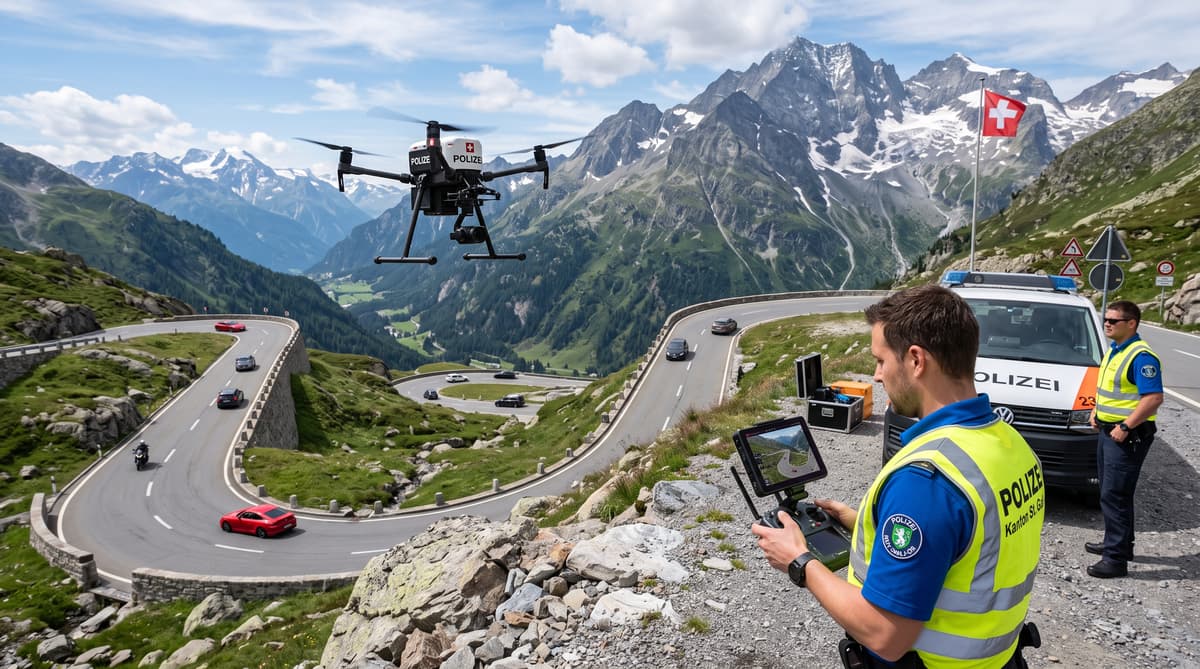
Six targeted operations have put aerial speed monitoring on a live stretch of Swiss mountain road. Since the beginning of 2026, St Gallen cantonal police have used drones on the Hulftegg pass, a route connecting Toggenburg with Zurich’s Tösstal valley. The checks focus on sections where officers have indications that drivers are exceeding the limit.
The figures released so far are limited but clear: police conducted six drone checks and identified two speeding offences. The operations form part of the canton’s road traffic enforcement and are intended to improve safety in a setting where road layout, gradients and bends can make speed difficult to assess from the roadside.
St Gallen police presented the drone use as a targeted method rather than a blanket operation across the canton. The technology gives officers an aerial view of vehicles moving through the monitored section, allowing them to examine speed over a measured distance.
The report, published by Keystone-SDA on October 16, 2026, does not give the speed limits on the Hulftegg road, the speeds recorded, or details of penalties issued. It does establish that the canton has added aerial video to its enforcement tools on one of its mountain routes.
Measure Speed from the Sky
Police calculate speed from distance and time recorded in aerial video. The method allows officers to follow a vehicle’s movement across a defined section of road and determine how long it takes to cover that distance. The source report identifies this as the basis for the St Gallen checks.
A drone can observe the road from above while keeping the full stretch in view. That perspective is particularly relevant on the Hulftegg pass, where bends and changes in elevation can limit what a patrol positioned at one roadside point can see. The available account does not specify the drone model, the length of the measured section, the equipment used to verify the footage, or how officers communicate with drivers after an offence is recorded.
Those details matter because aerial monitoring depends on accurate positioning, clear video and a reliable link between the footage and the vehicle being measured. St Gallen police have so far disclosed the operational principle and the number of checks, rather than a full technical description.
The approach also allows the canton to concentrate enforcement where police have identified a suspected speeding problem. That makes the Hulftegg road a test case for how Swiss cantonal authorities may use unmanned aircraft alongside conventional traffic patrols.
Read the First Results Carefully
Two offences emerged from six drone operations, giving the initiative a modest but concrete first result. The figure does not show how many vehicles police observed, how long each operation lasted, or whether the checks were concentrated on particular days or times. It does show that the drone deployments have produced recorded speeding cases during their first year of use.
The low number of detected offences should be read in that limited context. St Gallen police say the operations are targeted at road sections where there are indications of speeding, rather than carried out continuously. A small number of checks cannot establish a broader speeding rate for the Hulftegg pass or for mountain roads across the canton.
The initiative comes amid wider attention to dangerous driving involving vehicles connected to Switzerland. In a separate case reported in September, French police stopped a Porsche driver travelling at 312 kilometres per hour on a motorway southeast of Geneva, where the limit was 130 kilometres per hour. That incident is unrelated to the St Gallen drone checks and involved different authorities and road conditions.
Together, the cases illustrate the range of traffic enforcement facing Swiss and neighbouring police, from focused monitoring on a mountain pass to high-speed intervention on a motorway.