pharmaceuticals
Pharma companies disclosed CHF234 million in Swiss healthcare payments
Pharmaceutical companies disclosed CHF234 million in payments to doctors, hospitals and other healthcare groups in Switzerland in 2025, CHF28 million less than the previous year. The reported decline was largely linked to fewer major research collaborations.
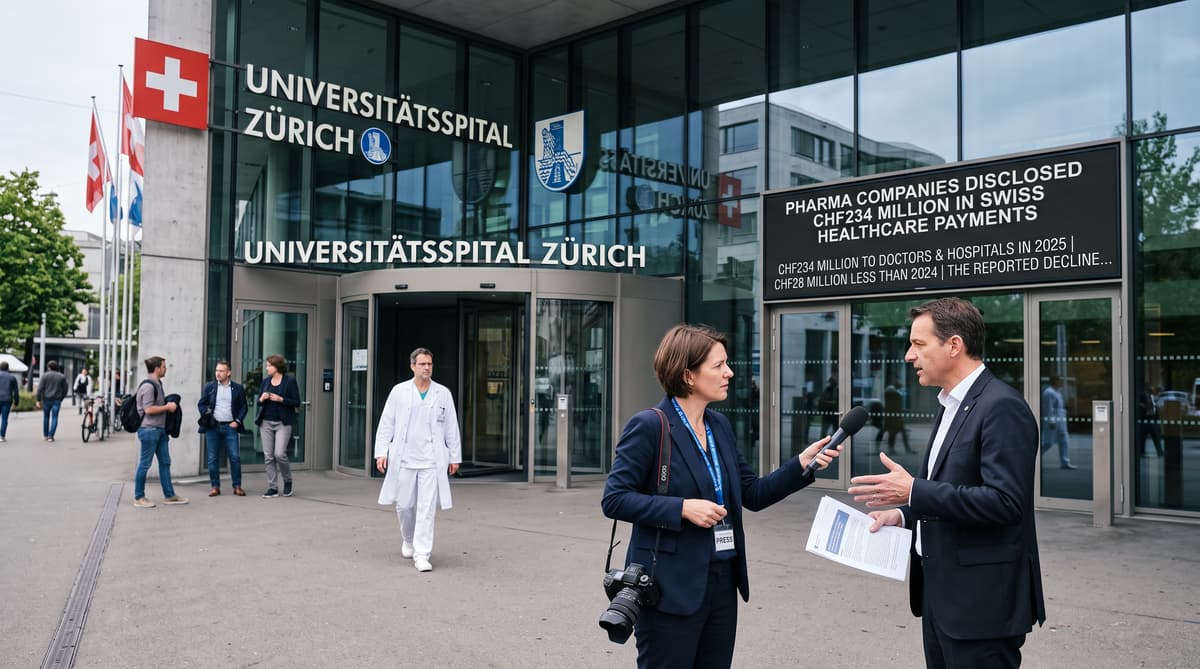
CHF234 million flowed from pharmaceutical companies to Swiss healthcare groups in 2025, covering conference attendance, accommodation, fees and consultancy work. The total was CHF28 million below 2024, a drop Der Beobachter linked mainly to fewer major research collaborations.
The payments reach doctors, hospitals, networks of doctors, professional bodies and patient groups. More than 60 companies publish figures under an industry self-regulatory scheme agreed in 2014. Since then, disclosed payments have reached CHF2.1 billion.
The annual decline therefore sits within a much larger stream of company support for Swiss healthcare. The money takes several forms, from research partnerships to expenses and professional fees. Those categories matter because the disclosure system records transfers across a broad network, while public concern often centres on whether company funding can influence treatment decisions.
Compare the biggest company payments
AstraZeneca was Switzerland’s largest disclosed payer in 2025, with CHF27.4 million. Novartis followed at CHF26.4 million, then Roche at CHF25.6 million. The three leading totals were close, each above CHF25 million.
AstraZeneca has more than doubled its payments over five years. The Anglo-Swedish group has said it aims to bring 30 new cancer treatments to market by the end of 2027. Its position as the top payer has held for the past two years, according to Der Beobachter.
Pfizer’s payments moved in the other direction. The US company’s reported Swiss total fell by half, from CHF21.3 million the previous year to CHF11.3 million in 2025. Der Beobachter attributed the cutback largely to reduced involvement in major research collaborations. At the same time, the publication said Pfizer’s payments to individual doctors have increased in recent years. The figures show how a company’s overall total can shift alongside changes in the form of its funding.
Examine the link to prescribing
The concern is whether sponsorship can shape prescribing. Der Beobachter reports that doctors who receive support tend to prescribe expensive branded medicines more often than cheaper generics containing the same active ingredient. They also write prescriptions for a greater number of medicines and, statistically, depart more often from official impartial medical guidelines.
Those patterns place the payment disclosures in a clinical context. A transfer may cover conference attendance, accommodation, consultancy or research, but the wider debate focuses on the relationship between company funding and medical decisions. Switzerland’s medicines legislation says treatment choices must rest on scientific and objective criteria, rather than financial incentives.
The reported prescribing patterns do not establish that every sponsored doctor changes a treatment decision. They do, however, explain why payments to healthcare professionals attract scrutiny: decisions about brands, generics and the number of medicines prescribed affect care at the point where patients and clinicians meet. Transparency makes the financial relationships visible, while the statutory standard sets out how treatment decisions should be made.
Track the rules and oversight
The disclosure system is an industry commitment, while compliance with treatment rules is not monitored by the main public and professional bodies named in the report. The scheme began in 2014 as a self-regulatory effort to improve transparency in a sector some regard as opaque. More than 60 companies now disclose payments through it.
Der Beobachter says neither the Federal Office of Public Health nor professional associations or other trade organisations monitor whether doctors comply with the requirement that treatment decisions remain free of financial incentives. The distinction matters: publishing payments lets the public see the scale and recipients of company funding, while the legislation sets the standard for clinical choices.
For Switzerland, the CHF2.1 billion disclosed since 2014 shows the scale of the relationships recorded under the scheme. The CHF234 million reported for 2025 adds another year to that total, even as the annual figure fell. The debate over transparency therefore continues alongside questions about research partnerships, professional payments and the independence of prescribing.