Switzerland
Fireworks initiative leads in first poll ahead of November votes
A first national poll ahead of Switzerland’s November 29 votes shows strong early support for an initiative to restrict noisy fireworks, while many voters remain undecided on other proposals. The survey also finds no clear majority yet for measures on pension funding and war-materiel exports.
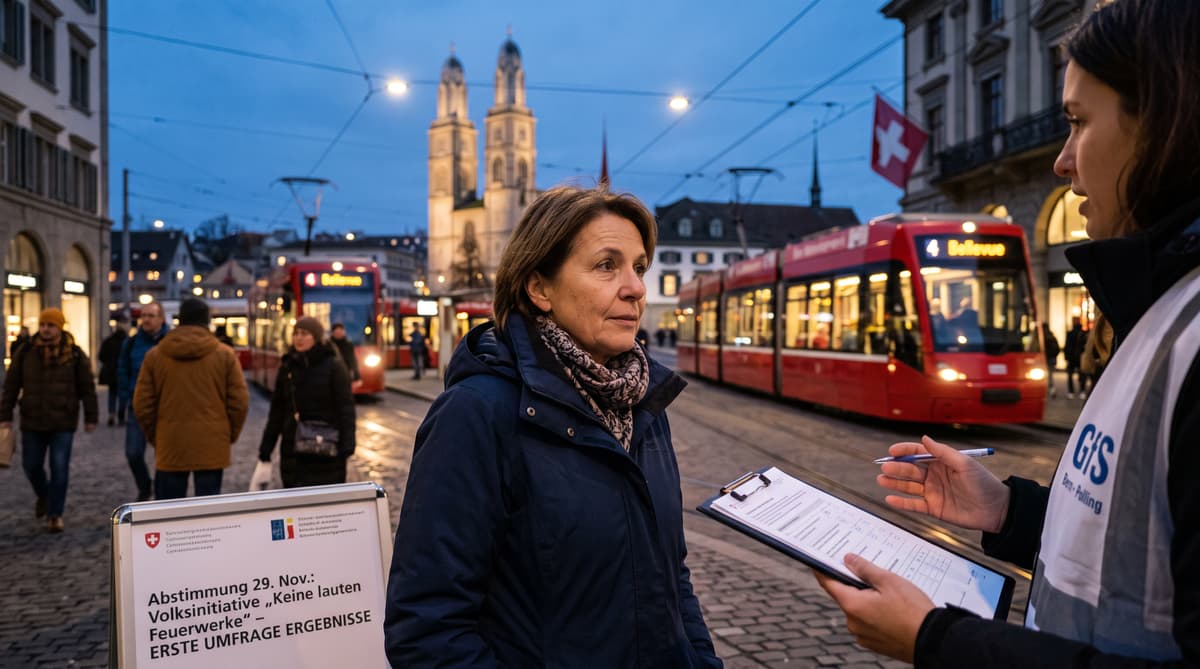
A poll taken on October 11 puts one of Switzerland’s four November 29 proposals well ahead. Nearly 70% of respondents said they would approve the Fireworks Restriction Initiative, which seeks to limit the sale and use of noisy fireworks. Just 2% were undecided, giving the yes camp a 40-point lead in the first national survey by gfs.bern for the Swiss Broadcasting Corporation.
The other proposals have yet to command a clear majority. The poll found widespread indecision over the taxation of married couples, while neither the plan to fund the 13th state pension payment nor the proposal to ease war-materiel export rules had clear majority support.
The campaign is still taking shape, gfs.bern said. Voters are at an early stage of forming opinions, particularly Swiss citizens living abroad, who are generally less exposed to political debate than residents. The fireworks proposal is the exception so far: three-quarters of respondents said they had already decided how to vote.
Track the fireworks vote’s cross-party lead
The fireworks initiative leads across every political group listed in the poll. Support is highest among Green Party supporters at 91%, followed by Social Democrats at 83% and Green Liberals at 80%. A majority of Centre Party voters, at 67%, and Radical-Liberals, at 59%, also back the proposal. Support reaches 53% among Swiss People’s Party voters.
The division by gender is also clear: 76% of women support the initiative, compared with 60% of men. More than 80% of respondents agreed with the yes camp’s arguments that fireworks pollute the environment, distress animals and increase accident risks. Safety concerns appear to be the most persuasive factor behind support.
The findings give the campaign a strong starting position, but the vote is still weeks away. gfs.bern described the initiative as entering the main campaign phase “from a position of strength”. Its early backing extends across language regions and political camps, making it the most settled of the four proposals in the first poll.
Follow the age divide over pension funding
The pension funding proposal divides voters most sharply by age. The plan would increase value added tax to pay for the 13th payment from the old-age and survivors’ insurance system, due to be paid for the first time in December. Only just over half of respondents had made up their minds, leaving considerable room for the campaign to shift opinion.
Among voters aged 18 to 39, 56% opposed the measure. Support stood at the same level among people over 65, the group that stands to benefit directly from the additional payment. Income made little difference in the poll. “Purchasing power does not come into play here,” said Lukas Golder, a political scientist at gfs.bern.
Party preferences follow a familiar pattern. Support reached 60% among Social Democrat voters, 58% among Green and Centre voters, and 56% among Green Liberals. Opposition was strongest among Swiss People’s Party supporters at 68%, followed by Radical-Liberals at 54%. Golder described the political split this way: “The centre-left is cautiously positive, while the right is more critical.”
Watch undecided voters shape the other proposals
The first poll leaves three proposals exposed to a campaign still in its opening phase. The married-couples taxation proposal has widespread undecided voters, while measures to finance the 13th pension payment and ease war-materiel export rules have yet to show a clear majority. For each, the survey offers an early snapshot rather than a settled verdict.
That uncertainty is especially relevant for Swiss citizens living abroad, who are generally less exposed to the political debate than voters living in Switzerland. Across the electorate, gfs.bern says opinions are still forming. The fireworks initiative stands apart because three-quarters of respondents have already decided how they will vote, and its support crosses language regions and party lines.
The November 29 ballot therefore begins with sharply different levels of voter commitment. The fireworks campaign starts with a substantial lead, while the other proposals have room to gain or lose support as voters engage with the debate. The poll’s clearest immediate signal is that early attention is concentrated on the proposed restrictions on noisy fireworks.