Drought
Switzerland Reels Under Record Heat and Worsening Drought
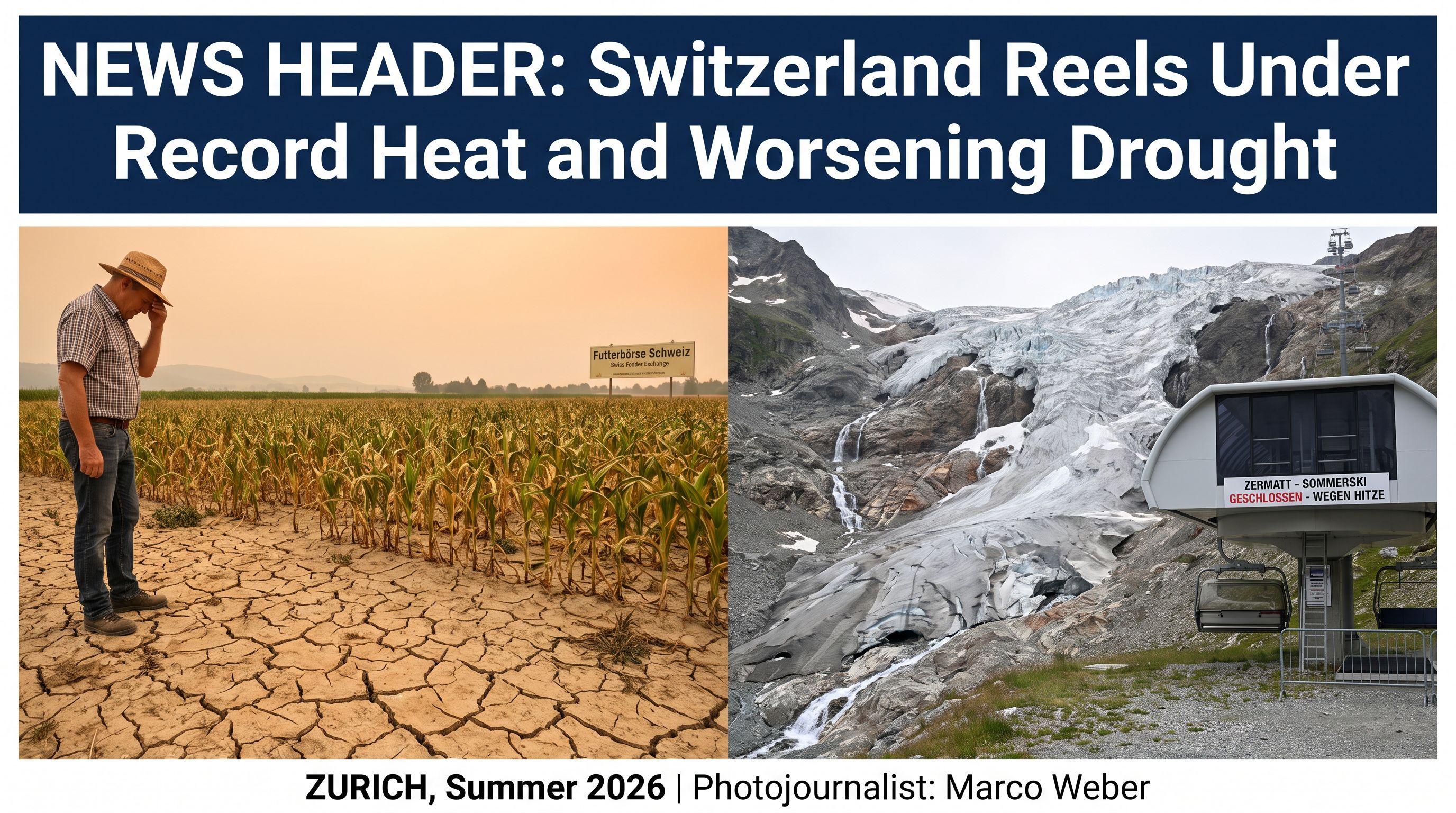
From suspending summer skiing on Zermatt's melting glacier to farmers launching emergency online fodder exchanges, the persistent high temperatures and lack of rain in summer 2026 are causing widespread disruption across Switzerland.
Switzerland Scorches Under Unprecedented Heat Siege
The summer of 2026 is officially rewriting the record books as a relentless heatwave parches the Swiss Confederation. Data from MeteoSwiss confirms an alarming reality: temperatures are now matching or even surpassing the infamous 2003 'summer of the century.' While 2003 was once considered a statistical outlier, these extreme conditions have become our new, brutal baseline. Unlike previous years where heat peaked in August, 2026 saw record-shattering maximums as early as June. The Federal Office of Meteorology warns that several measuring stations have already recorded more 'hot days' than during the entire 2003 season. This isn't just a warm spell; it is a systematic overheating of the Alpine ecosystem that threatens the very fabric of Swiss life. From the lowlands to the highest peaks, the lack of nighttime cooling is preventing the environment from recovering, creating a cumulative thermal debt that is now coming due.
Glacial Collapse Ends Summer Skiing Era
The iconic Theodul Glacier has surrendered to the sun, forcing Zermatt Bergbahnen to take the radical step of suspending summer skiing as of August 1. This is no mere seasonal adjustment; it is a surrender to physics. The persistent heat has compromised the structural integrity of the ice, rendering ski lifts and pylons dangerously unstable. While elite Swiss-Ski teams scramble to train on 'degraded' slopes for a few hours a day, the public is barred from the melting ice. Experts like geomorphologist Christophe Lambiel are sounding the death knell for the industry, stating bluntly that summer skiing is 'doomed' in the long term. As the ice turns dark and brittle, the Swiss national team is already looking toward the southern hemisphere—New Zealand and South America—to find the winter conditions that were once guaranteed at home. The retreat of the glaciers is no longer a slow-motion tragedy; it is an immediate economic and cultural amputation for the Valais region.
Agricultural Crisis Sparks Digital Fodder War
Swiss agriculture is in a state of high alert as pastures wither into dust. In a desperate bid to save livestock, the Zurich and Schaffhausen Farmers’ Associations have launched an emergency online fodder exchange. The situation is critical: grass has stopped growing, forcing farmers to dip into hay reserves meant for the winter. Without this intervention, many face the grim prospect of sending their herds to the abattoir prematurely. In the Schwyz Alps, the crisis is even more acute. Over 15,000 head of cattle are currently stranded on high-altitude pastures where water and feed have vanished. Already, five farms have been forced into an early 'descent from the alps,' a move that places even more pressure on depleted valley resources. To keep animals alive, some municipalities are resorting to transporting water by road or laying emergency pipes across the rugged terrain. This digital marketplace represents a fundamental shift in Swiss farming—a move toward survivalist cooperation in the face of a disappearing climate.
Water Rationing Grips the 'Water Tower of Europe'
A staggering 151 municipalities across Switzerland have now implemented strict water rationing, shattering the myth of the country as an inexhaustible 'water tower.' From banning the filling of swimming pools to prohibiting garden irrigation, the restrictions signal a historic shift in resource management. Despite Switzerland's high density of lakes and rivers, the 2026 drought has depleted local reservoirs to levels not seen in half a century. The 'drought of the century' from 50 years ago is no longer the benchmark—2026 is setting a new, more terrifying standard. The scarcity is forcing a confrontation between residential, agricultural, and industrial water needs. In Canton Schwyz, the cantonal crisis management team has been activated to assist municipalities struggling to maintain basic supply. As the ground hardens and the rain remains absent, the reality is sinking in: even in a country defined by its Alpine springs, water is no longer a guaranteed right, but a finite, dwindling commodity that must be policed.
Adapting to a Permanent State of Emergency
Switzerland stands at a crossroads, facing a future where 'extreme' is the new normal. The events of summer 2026—from the death of summer skiing to the rationing of Alpine water—are not isolated incidents but symptoms of a rapidly warming nation. Switzerland is warming twice as fast as the global average, placing it among the ten fastest-warming countries on Earth. The implications are profound: our tourism models, agricultural practices, and infrastructure must be completely reimagined. The shift to intermediate fodder crops and the evacuation of alpine pastures are just the beginning of a long-term retreat. As the Swiss national ski team prepares to fly across the globe just to find snow, the rest of the country must grapple with a landscape that is becoming increasingly unrecognizable. The 'water tower' is leaking, the glaciers are vanishing, and the time for incremental change has passed. Switzerland must now lead in climate adaptation, or risk losing the very environment that defines its national identity.