Environment
Heat, Drought, and Emptied Rivers: Switzerland Grapples with a Summer of Extremes
A severe heatwave and persistent drought are reshaping the Swiss summer, forcing the cancellation of music festivals, threatening Alpine farms, bringing an end to summer skiing on the Zermatt glacier, and paradoxically boosting tourism to cooler mountain railways. This article explores the widespread consequences of the extreme weather across the country.
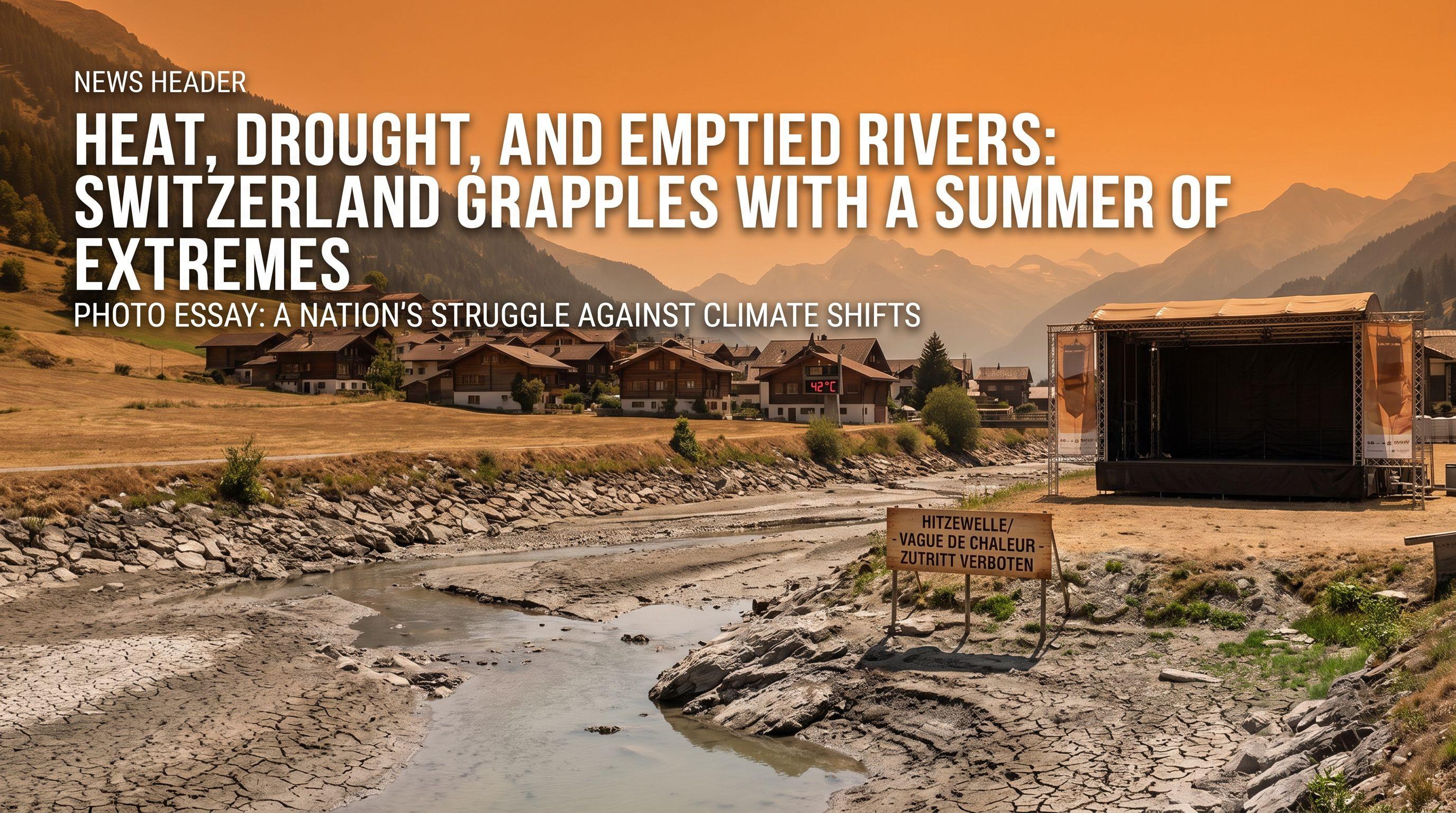
Switzerland Suffocates Under Unprecedented Heat
Switzerland is grappling with a climate reality that was once a distant warning. A staggering heatwave has gripped the Confederation, turning the 'water tower of Europe' into a landscape of parched earth and receding ice. This is not just a warm spell; it is a systemic shock. From the lowlands of Basel to the peaks of Valais, the country confronts a summer of extremes that is rewriting the national identity. As temperatures soar, the traditional Swiss summer—defined by lush green pastures and year-round snow—is being replaced by a dusty, arid environment that demands immediate adaptation. The urgency is palpable as 151 municipalities have already been forced to ration water, banning the filling of swimming pools and the watering of gardens to preserve dwindling reserves.
Glacial Collapse Ends the Era of Summer Skiing
August 1, 2026, marked a dark milestone for Alpine sports: the day summer skiing died in Zermatt. The melting of the Theodul Glacier has become so aggressive that lift infrastructure has lost its stability, forcing an indefinite suspension of public skiing. While the Swiss national team clings to degraded training strips under a special agreement, the message from experts is clear: the end is near. Geomorphologist Christophe Lambiel warns that summer skiing is 'doomed' in the long term. The glacier is darkening and shrinking, no longer able to support the weight of industrial tourism. This collapse forces elite athletes to look toward the southern hemisphere, fleeing to South America and New Zealand to find the winter conditions that were once guaranteed on Swiss soil. The economic and cultural fallout for high-altitude resorts is unprecedented.
Alpine Agriculture Battles a Parched Frontier
Over 15,000 head of cattle in Canton Schwyz are currently at the center of a desperate struggle for survival. The ongoing drought has decimated fodder supplies, forcing an early descent from the high pastures for many herds. In the Alps of central Switzerland, the situation is critical; water and grass have simply vanished. Farmers are resorting to extraordinary measures, including transporting water by road and laying emergency pipes to keep livestock hydrated. Mario Bürgler, head of the Office for Agriculture, confirms that five farms have already abandoned their summer pastures weeks ahead of schedule. The goal remains to keep animals on the heights as long as possible to protect the valley's winter hay reserves, but as the ground cracks, the principles of animal welfare are being tested to their limit.
The Great Escape: Tourism Surges in the High Peaks
While the lowlands swelter, the mountain railway industry is witnessing a massive 29% surge in visitor numbers compared to the five-year average. This 'escape from the heat' has turned the Swiss Alps into a sanctuary for urban dwellers desperate for relief. The Bernese Oberland leads the charge with a 24% increase in traffic, fueled by a full-capacity Schilthornbahn. Even Graubünden has seen an 11% rise as tourists flock to cooler altitudes. However, the boom is domestic; geopolitical tensions in the Middle East and Asia have caused a decline in long-haul visitors. This vacuum is being filled by Swiss and German travelers who are redefining summer tourism. For the mountain railways, the heatwave is a double-edged sword: a revenue windfall today, but a harbinger of a volatile climate future.
Cultural Silence: Festivals Wither in the Dust
The silence in Gelterkinden is deafening. The Raina Rock open-air festival, a staple of the Basel-Landschaft summer, was cancelled outright due to the 'highest risk level' of drought. It is not alone; the Zig open-air cinema and the Dietisberg Festival have also fallen victim to the parched conditions. Safety regulations have become insurmountable: with a total ban on fires and even electric barbecues prohibited outside built-up areas, the logistics of a festival are impossible. More alarmingly, the risk of a single spark from a car exhaust igniting the parched grass in parking areas was deemed too high a threat to public safety. As cultural events are erased from the calendar, the social cost of the climate crisis becomes as visible as the physical one. The festival circuit, once a celebration of the Swiss summer, is now a casualty of its volatility.
A Nation Redefining Its Relationship with Water
Switzerland is at a crossroads. The 'drought of the century' in 2026 has exposed the fragility of a nation that once took its water wealth for granted. As 151 towns impose rationing, the myth of infinite Alpine water is evaporating. The future demands a radical shift in energy consumption and urban design; Swiss homes, built to retain heat for winter, are now becoming ovens in the summer, straining the electricity grid as residents scramble for cooling solutions. The implications are clear: Switzerland must adapt or wither. From the way we farm the Alps to the way we power our cities, every aspect of Swiss life is being interrogated by the heat. The summer of 2026 is not a one-off anomaly; it is the blueprint for a new, harsher reality that the Confederation must now navigate with characteristic precision and unprecedented urgency.