Environment
A Swiss Paradox: Water Rationed in 151 Towns as Government Cuts Forest Conservation Funds
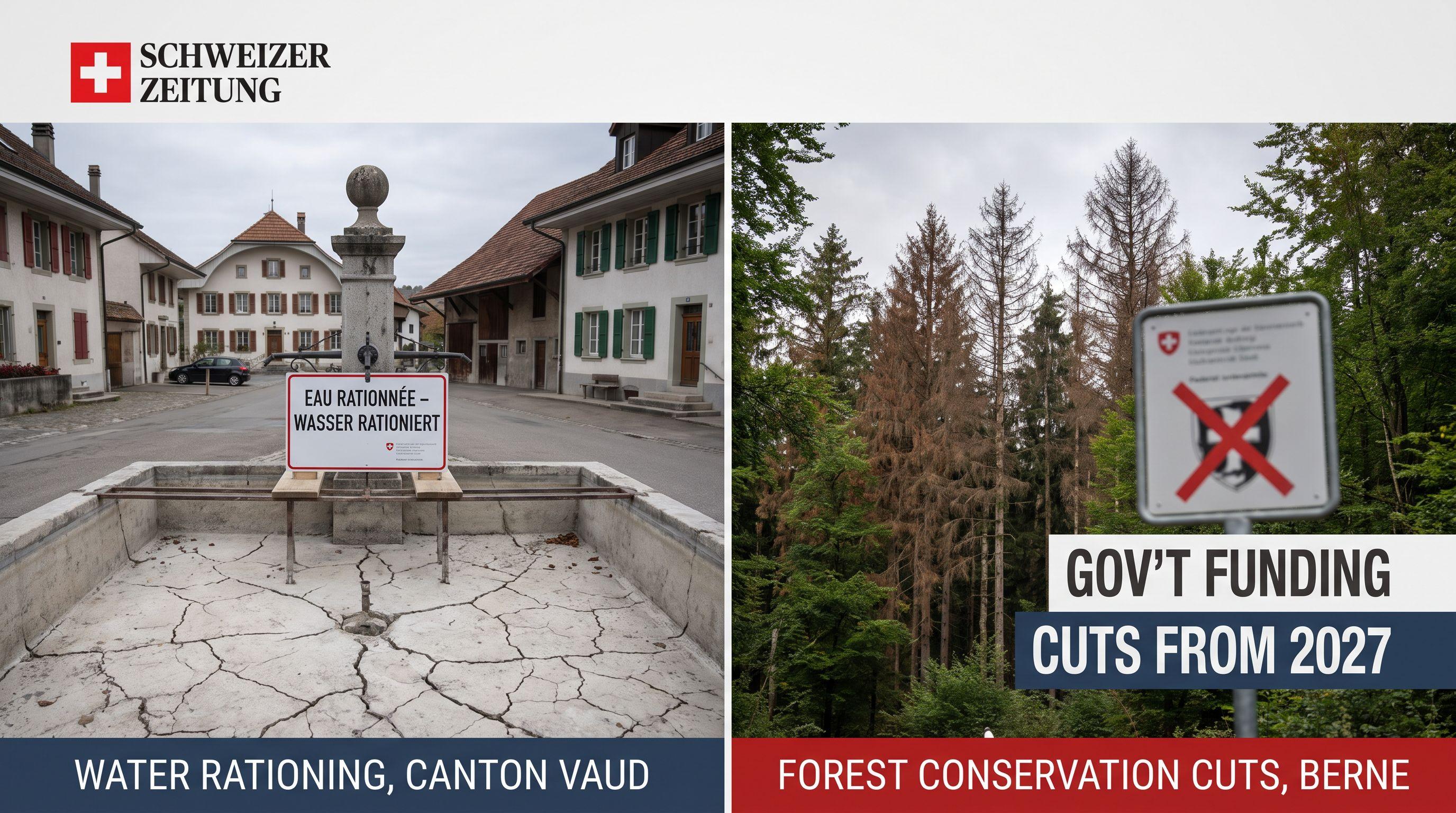
While at least 151 Swiss municipalities are rationing water due to drought, the federal government plans to cut funding for forest conservation programs from 2027. These programs are vital for helping forests adapt to climate change and mitigate drought effects, creating a controversial policy clash.
The Great Thirst Grips the Water Tower
A staggering 151 Swiss municipalities have officially declared war on water waste, imposing enforceable bans that carry fines of up to CHF 2,000. While Switzerland is historically celebrated as the 'water tower of Europe,' the reality on the ground in 2026 is a grim paradox of scarcity. From the peaks of Vaud to the valleys of Ticino, residents are being ordered to abandon their gardens and leave their swimming pools empty. This is no longer a suggestion; it is a mandate enforced by local law. The crisis has escalated so rapidly that over 194 towns have issued urgent appeals for conservation, struggling to keep taps running as local springs—the lifeblood of mountain communities—simply vanish. The contrast is jarring: while the glaciers melt at record speeds, the infrastructure designed to capture that wealth is failing to meet the demands of a blistering summer. We are witnessing a systemic failure to bridge the gap between national abundance and local survival.
A Policy of Parched Earth
In a move that has sparked immediate consternation across the political spectrum, the Federal Council is planning to completely sever funding for forest climate adaptation by 2027. Environment Minister Albert Rösti has reportedly scrubbed these vital funds from the government’s long-term financial planning, effectively abandoning the very ecosystems that mitigate drought. This follows a 2020 parliamentary commitment of CHF 100 million that was already slashed by a third in 2023. To withdraw support now, as 151 towns ration water, is a policy of parched earth. The Conference on Forests, Wildlife and Landscape (CFP) warns that this decision ignores the critical role forests play in the water cycle. By cutting the budget for heat-resistant tree species, the government is not just saving money; it is sacrificing the natural infrastructure that keeps Switzerland cool and hydrated. The timing could not be more catastrophic as the nation grapples with the most severe heatwaves in half a century.
The Localized Crisis of Plenty
Switzerland’s water crisis is a lottery of geography. While deeper groundwater reservoirs remain stable, communities reliant on local springs are seeing their supplies plummet within days of a dry spell. In the village of Rossinière, authorities have been forced to ban garden watering entirely, warning that even a passing thunderstorm is insufficient to refill their depleted springs. Meanwhile, just a few kilometers away, neighboring towns may have no restrictions at all. This fragmentation is exacerbated by a total lack of a national database; Switzerland’s 26 cantons operate in silos, leaving the federal government blind to the true scale of the shortage. In Canton Fribourg, a staggering 40% of municipalities are currently under some form of water alert. The disparity is not just environmental but economic—towns like Pfungen are forced to buy expensive water from neighbors to cover consumption peaks, driving up costs for residents while the federal government retreats from environmental investment.
Forests on the Frontline
The risk of forest fires is surging north of the Alps, transforming the Swiss landscape into a tinderbox. Stefan Müller of the Centre Party emphasizes that heatwaves are causing unprecedented damage to forest health, resulting in skyrocketing management costs that cantons simply cannot bear alone. Forests are the primary defense against soil erosion and are essential for groundwater recharge; their decline directly accelerates the water shortages seen in 151 towns. Without the federal funds to plant resilient species, the iconic Swiss woods are at risk of a permanent regime shift. The current policy trajectory suggests a dangerous decoupling of environmental reality from fiscal planning. As the trees die, the soil loses its ability to hold moisture, creating a feedback loop that will only intensify future droughts. The government’s retreat from forest conservation is, in essence, a retreat from the long-term stability of the Swiss water supply.
The High Cost of Inaction
Switzerland stands at a critical crossroads where fiscal austerity meets environmental emergency. The paradox of rationing water in a water-rich nation while simultaneously cutting the funds meant to protect that water is a wake-up call for the Confederation. If the 2027 cuts proceed, the burden of climate adaptation will fall entirely on the shoulders of local municipalities and cantons—many of which are already struggling to manage the current 151-town crisis. This shift threatens to create a two-tier Switzerland: wealthy urban centers with robust infrastructure versus rural mountain communities left to wither. The federal government must reconcile its financial planning with the undeniable data of a warming climate. As we look toward 2027, the question is no longer whether we can afford to protect our forests, but whether we can afford the catastrophic cost of their disappearance. The taps are running dry, and the safety net is being pulled away just when it is needed most.