Science
Swiss Supercomputer Safeguards NASA Climate Data Amid US Funding Fears
In a proactive move, Swiss researchers are copying vast amounts of NASA's public climate and environmental data onto a supercomputer. The effort aims to preserve critical information for AI modeling and protect it from potential US funding cuts, positioning Switzerland as a key custodian of global climate science.
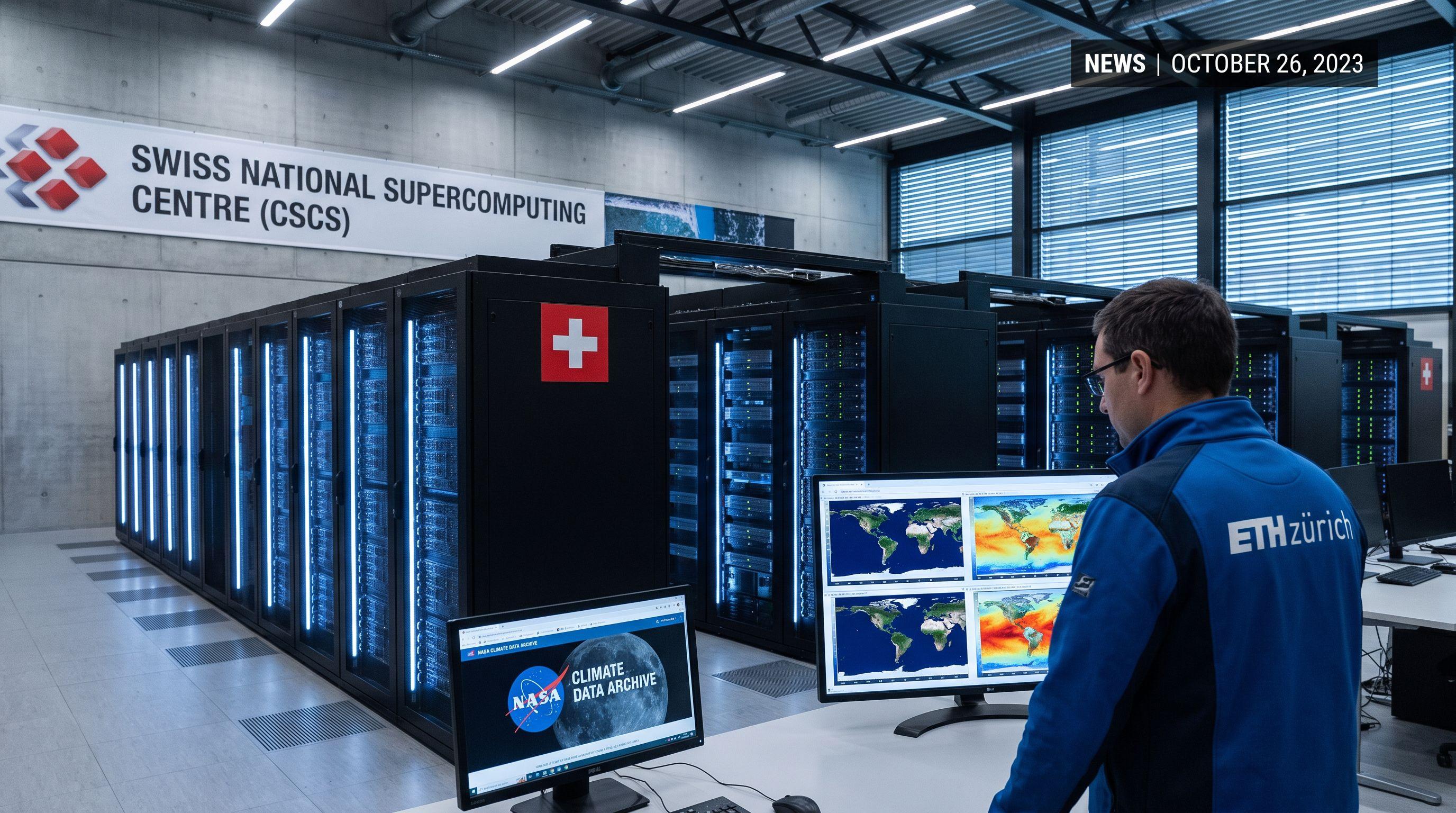
Switzerland Secures Global Climate Legacy
Switzerland has officially become the world's digital vault for climate science. In a massive, year-long operation, researchers at ETH Zurich have successfully transferred a staggering 100 petabytes of NASA’s public climate data to the Swiss National Supercomputing Centre (CSCS) in Lugano. This is not merely a backup; it is a strategic seizure of the most critical environmental records on the planet. As the United States grapples with shifting political priorities and potential funding cuts to Earth-observation programs, Switzerland is stepping into the breach. By securing roughly six billion files—a volume equivalent to 20 million feature-length movies—the Alpine nation ensures that decades of greenhouse gas measurements, cloud patterns, and ice sheet data remain accessible to the global scientific community. This proactive move positions Switzerland as the ultimate custodian of planetary health data at a time when scientific stability is under threat. The operation, led by former NASA chief scientist Thomas Zurbuchen, signals a bold shift in how climate data is managed internationally, moving from centralized US control to a more resilient, distributed global model.
Mining the New Gold: 100 Petabytes of Intelligence
Data is the new gold, and Switzerland just struck the motherlode. Reto Knutti, professor of climate physics at ETH Zurich, describes this massive trove as the essential fuel for the next generation of Artificial Intelligence. While traditional climate models rely on grueling mathematical equations to simulate the atmosphere, new 'foundation models' learn directly from this vast historical data. The results are transformative. These AI-driven systems are not just accurate; they are nearly 1,000 times faster than the physics-based models used for the last thirty years. Where a global weather forecast once took hours of intense computation, the integrated power of the CSCS can now generate a multi-day global outlook in roughly sixty seconds. This speed is a matter of life and death. Faster forecasting means earlier warnings for floods, landslides, and storms, providing Swiss authorities and global partners with a decisive edge in disaster response. The 100 petabytes now sitting in Lugano represent more than just numbers; they are the blueprints for surviving a warming world.
Alps Supercomputer Outpaces Traditional Science
At the heart of this operation lies 'Alps,' one of the most formidable supercomputers ever built. Housed in Lugano, this machine provides the raw horsepower necessary to turn 100 petabytes of raw data into actionable intelligence. The integration of NASA’s archives with Alps allows Swiss researchers to identify patterns in global precipitation and ice melt that were previously invisible. The sheer scale of the data—six billion files—would overwhelm any standard infrastructure, but Alps is designed for this specific burden. By hosting this data locally, ETH Zurich eliminates the latency of fetching files from across the Atlantic, allowing for real-time analysis of environmental shifts. This infrastructure allows Switzerland to lead the 'C2SM' (Center for Climate Systems Modeling) initiative with unprecedented authority. While other nations struggle with aging hardware, Switzerland’s investment in the CSCS ensures that the world’s most advanced climate simulations are 'Swiss Made.' The goal is clear: to move beyond simple data storage and into a realm where AI can predict natural hazards with a level of precision that was unthinkable just five years ago.
Defending Science Against Political Volatility
The decision to 'hoard' this data was fueled by a sobering reality: the fragility of US federal funding. Since returning to office, US President Donald Trump has pursued aggressive cuts to climate science and Earth-observation budgets. While access to NASA data remains open for now, the Swiss scientific community is taking no chances. Thomas Zurbuchen, who previously oversaw NASA’s science programs, understands better than anyone that political winds can shift overnight. 'Decisions in the US administration are sometimes quick, and not completely obvious,' warns Reto Knutti. By mirroring these datasets now, Switzerland creates a 'Svalbard Global Seed Vault' for digital information. This move safeguards international monitoring networks against potential censorship or the sudden shuttering of US data portals. Furthermore, the Swiss team is already planning to expand their archive by copying datasets from the National Oceanic and Atmospheric Administration (NOAA). This is a defensive maneuver for the sake of global stability, ensuring that even if Washington pulls the plug on climate research, the world’s researchers will still have a home for their data in the neutral territory of Switzerland.
A New Era of Swiss Digital Sovereignty
This massive data transfer marks a turning point for Swiss digital sovereignty. By becoming the primary repository for NASA and NOAA climate archives, Switzerland is no longer just a consumer of global science—it is a critical infrastructure provider. This move has profound implications for Swiss agriculture, hydropower, and insurance sectors, all of which rely on high-precision climate modeling to manage risk. As AI continues to redefine the boundaries of what is possible, having 100 petabytes of 'gold' stored on domestic soil provides a massive competitive advantage for Swiss tech startups and academic institutions. The mission is far from over; the 'heavy job' of making sense of this data has just begun. However, the message to the world is loud and clear: Switzerland is ready to lead. In an era of global uncertainty, the Alpine nation has proven that it has the technical grit and the political foresight to protect the most valuable resource of the 21st century. The climate data is safe, the supercomputers are humming, and the future of environmental science has a new, Swiss-guaranteed home.