Politics
Swiss election poll signals stronger right and growing polarisation
The Swiss People’s Party is on course for its strongest projected result since 2015, while the political centre is losing ground, according to a new election poll. The findings point to increasing polarisation ahead of the 2027 federal elections.
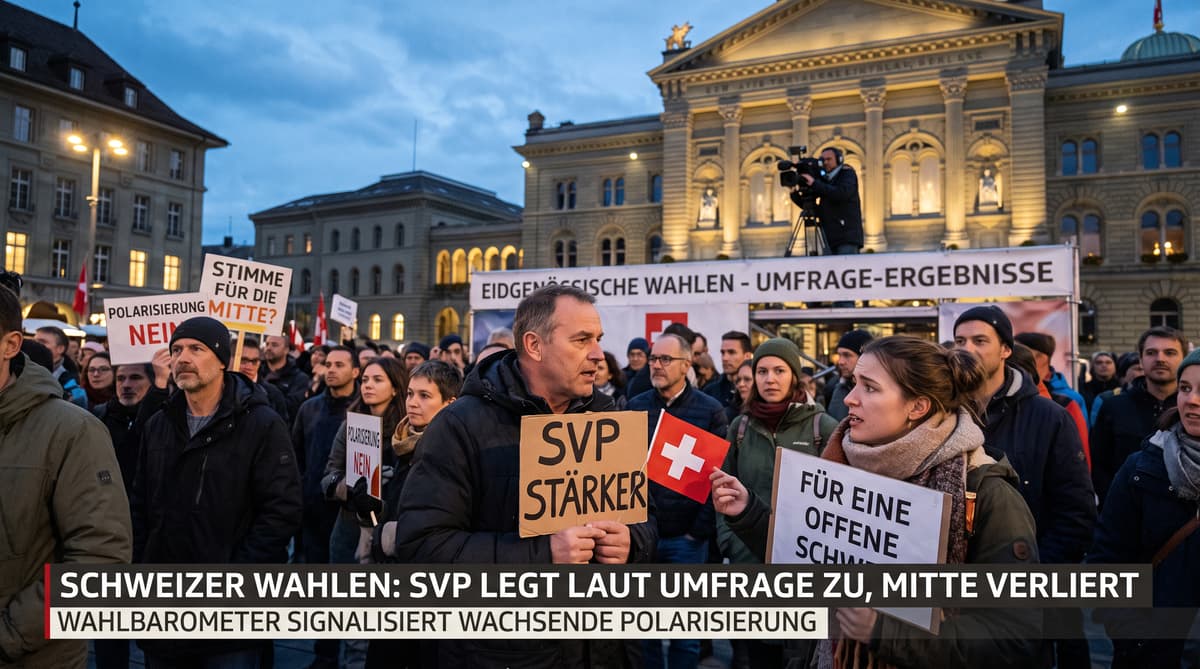
The People’s Party is polling at 29.9%, a level that would set a new high for Switzerland’s strongest national party. The figure comes from the Sotomo election barometer, commissioned by the Swiss Broadcasting Corporation and published on October 16, 2026, just over a year before voters choose a new Federal Assembly on October 24, 2027.
The result would edge past the party’s previous House of Representatives record of 29.4%, recorded in 2015. It also represents a 2 percentage point gain since the 2023 federal elections, the largest increase among the parties highlighted in the survey. Marcel Dettling, the People’s Party president, therefore enters the next campaign with a stronger electoral base and a clear lead over every rival.
The poll points to a more divided party system. The Social Democrats and Greens are making modest gains on the left, while the Radical Liberal Party and Centre Party are losing support. The centre right parties remain essential to Switzerland’s governing arithmetic, yet together they now command a projected 26%, four points less than the People’s Party alone.
The figures do not predict the final result. They do show where the campaign begins: with the right consolidating its position, the left recovering some ground, and the political centre under pressure.
Centre Right Loses Ground
The two centre right parties would collect 26% between them, while the People’s Party would take 29.9% on its own. That arithmetic captures the scale of the shift recorded by Sotomo.
The Radical Liberal Party stands at 13.3%, down one point from 2023. Sotomo says that result would be the party’s weakest in the history of elections to the House of Representatives. The party did move slightly ahead of the Centre Party compared with a similar 2025 poll, but that short term improvement has not reversed its longer decline.
The Centre Party is projected at 12.6%, a loss of 1.5 points since the last federal election. Switzerland’s traditional conservative parties have long played a central role in coalition building and in the country’s consensus driven political culture. Their combined decline gives the People’s Party more room to define the national debate, even though it still needs partners to pass legislation and shape parliamentary majorities.
The movement also complicates the Federal Council’s familiar balance. A stronger People’s Party can press harder on migration, sovereignty and the cost of living, while the weakened centre must decide whether to compete on those issues or defend its moderate profile. The poll offers no guarantee of seats, since Switzerland’s proportional voting system produces different outcomes across cantons. It does establish a clear national direction.
The Left Finds Openings
The Social Democrats are projected at 19.3%, their best result since 2007 if the poll’s numbers hold. The party has gained 1 percentage point since 2023, helping the left increase its combined strength by 1.5 points alongside a slight improvement for the Greens.
The result gives the Social Democrats a stronger platform on issues that reach beyond traditional ideological divides. Health insurance premiums rank as voters’ most urgent concern, cited by 39% of respondents. Household budgets have become a central political test in a country where compulsory health insurance premiums continue to shape monthly spending for families and pensioners.
Climate change follows at 36%, a nine point rise in one year. Sotomo linked the increase to the heatwave-hit summer of 2026. The shift brings an issue associated with the 2019 green surge back into the campaign conversation, although the poll does not show a repeat of that breakthrough.
The Greens have advanced only marginally, while the Liberal Greens have slipped. Their weaker electoral movement despite rising climate concern illustrates the limits of issue ownership. Voters may rank climate policy highly without automatically backing the parties most closely associated with it. The Social Democrats could benefit if they connect environmental policy to premiums, rents and purchasing power, while the Greens face pressure to convert concern into votes.
Climate Returns to the Agenda
Six in ten respondents, or 65%, say politicians have not done enough to limit the consequences of climate change. That broad dissatisfaction sits alongside a divided electorate, with perceptions of urgency and support for new measures varying sharply by party affiliation.
The finding gives environmental issues renewed political weight after a period in which migration and other concerns dominated the national agenda. Yet it also exposes a gap between public concern and party performance. The Green Party has made only a marginal recovery, and the Liberal Greens have lost support despite the rise in climate anxiety.
Sotomo described the ecological parties’ position as “more positive than it seems at first glance”. The institute said both had “at least managed, thanks to environmental branding, to pull themselves out of the dip they were in”. Those cautious gains still leave the parties far from the strength they showed during the 2019 green wave.
Michael Hermann, Sotomo’s director, said climate change had seemed to have “gone out of fashion in recent years”. The heatwave-hit summer has changed the salience of the issue, but the poll suggests that voters are weighing it alongside immediate financial pressure. Parties that link climate measures to insurance costs, energy bills and resilience may have the clearest route from concern to support.
Campaign Lines Take Shape
The October 24, 2027 election is more than a year away, but the early numbers already set the campaign’s main lines. The People’s Party has the strongest projected result in its history, the Social Democrats are recovering, and the centre right is losing ground on both sides.
Swiss elections will ultimately be decided canton by canton. Voters cast ballots under a proportional system for the House of Representatives, and seat allocation will depend on local contests, lists and turnout. A national poll cannot capture every regional variation or predict how tactical alliances will affect the final distribution of seats.
It can show which parties have momentum. The People’s Party has gained two points since 2023. The Social Democrats have gained one. The Centre Party and Radical Liberals have lost 1.5 and one point respectively. Those movements leave the political centre facing a strategic choice before the campaign intensifies: defend its established consensus role, or respond more directly to the issues driving voters toward the poles.
For the electorate, the priorities are concrete. Health insurance premiums lead at 39%, climate change follows at 36%, and migration has moved down the list. The next year will test whether party leaders can turn those concerns into credible programmes, and whether the centre can hold enough ground to remain decisive in Bern.