Switzerland
Rare-earth rivalry puts Swiss high-tech supply chains at risk
Competition between China and the United States for rare-earth minerals is raising supply risks for Swiss high-tech manufacturers that depend on powerful magnets. The issue puts pressure on companies to secure access to materials used in advanced industrial products.
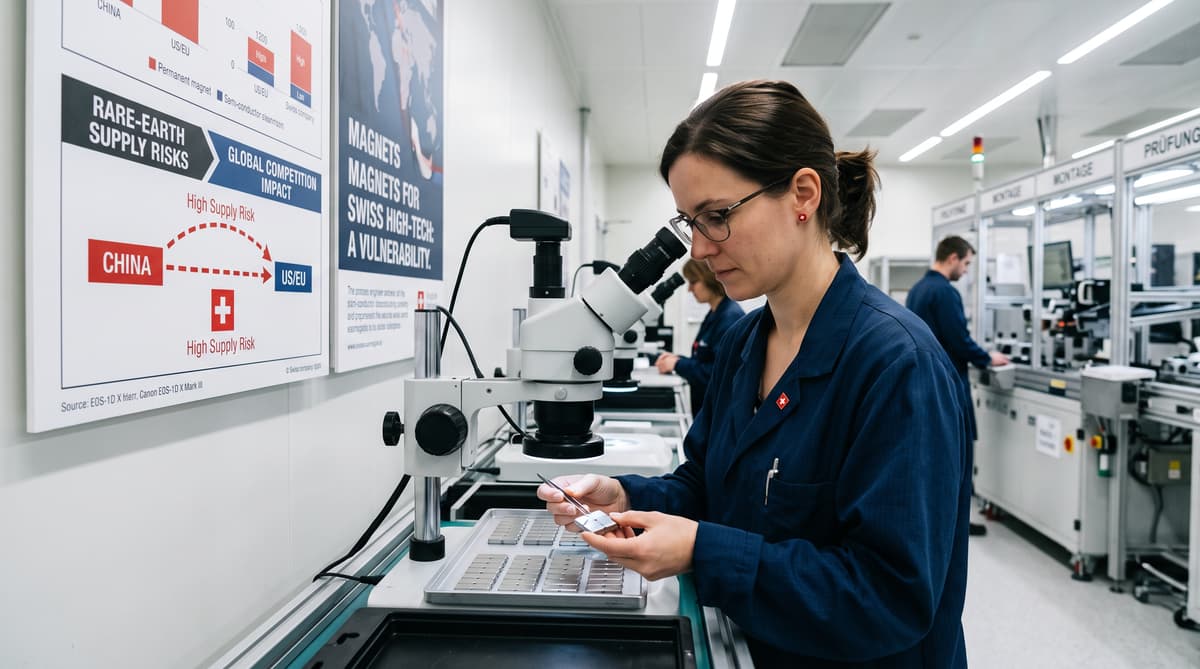
A repeated call for magnets in Pennsylvania points to a supply-chain concern with a Swiss address. In July, US President Donald Trump urged a room of defence investors to make magnets, calling attention to the materials behind products ranging from weapons to wind turbines and watches. Rare-earth elements are essential to many high-tech magnets, and control over their supply has become part of the contest between Washington and Beijing.
The effects reach beyond the two powers. Switzerland’s manufacturers rely on secure access to critical materials, while trade tensions bring the prospect of tariffs and export controls. One direct link runs through Lupfig, Aargau, where Arnold Magnetic Technologies makes samarium-cobalt magnets from samarium sourced in China. The mining region of Ganzhou lies about 12,500 kilometres from Pennsylvania, but its materials feed production in Switzerland. That connection puts a global industrial rivalry inside a Swiss supply chain, with consequences for companies making precision technologies.
Track China’s grip on processing
China’s strength lies across the rare-earth chain, from mining to refining. The country spent decades building large-scale capacity in extraction, separation and processing. By 2024, China accounted for about 60% of global rare-earth mine output and 90% of separation and refining capacity, according to figures cited by Swissinfo from the International Energy Agency.
That concentration matters because rare earths do not reach manufacturers as finished magnets straight from the ground. Samarium from mines around Ganzhou in southern China is processed into alloys and shipped internationally. In Lupfig, Arnold Magnetic Technologies converts the material into samarium-cobalt magnets used in aerospace, industrial motors and other precision technologies.
Rare earths are not scarce, but China’s role in the stages that prepare them for industrial use gives the country significant weight in the supply chain. For Swiss producers, reliance on those established links leaves operations exposed to shifts in trade policy. Tariffs or export controls can turn access to materials into a strategic concern for manufacturers far from China’s mining regions.
Build more routes into Aargau
Arnold Magnetic is trying to widen its sourcing options without assuming China will disappear from the market. In late 2025, the company announced partnerships with firms in the UK and Belgium to secure what it described as reliable, Western-origin rare-earth materials. The move adds alternative links to a supply chain that currently connects Chinese raw materials to magnet production in Aargau.
CEO Matt Blake told Manufacturing Today Magazine that the supply-security challenge would last, while China would remain an important part of the global industry. Arnold Magnetic’s response, he said, includes diversifying its sourcing strategies. That approach reflects the complexity of replacing a supplier network built around China’s substantial mining and processing capacity.
The company describes its existing trade with Chinese raw-material producers as a “mine-to-magnet” supply chain. Its new partnerships with UK and Belgian companies offer a way to broaden access to materials while it continues operating in a market where Chinese supply remains central. For a Swiss manufacturer, resilience means managing both realities at once.
Keep Swiss supply lines open
The US-China contest has made magnet supply a strategic issue as well as an industrial one. Trump’s appeal to defence investors reflected US interest in building capacity for high-tech magnets and the rare earths used to make them. The same materials serve civilian industries, including wind turbines, industrial motors and watches. That broad reach links the rivalry to manufacturers well beyond the defence sector.
For Switzerland, the immediate exposure is visible in companies such as Arnold Magnetic Technologies, whose Lupfig operation depends on materials moving through a supply chain dominated by China. The prospect of tariffs and export controls adds uncertainty to those links. Arnold Magnetic’s partnerships in the UK and Belgium show one response: seek additional sources while recognising that Chinese suppliers will remain part of the market.
Swiss high-tech producers therefore face a practical balancing act. They need access to materials that support precision manufacturing, while navigating a supply chain shaped by geopolitical competition. The choices made by magnet makers and their suppliers will help determine how securely those materials reach Swiss factories.