Politics
Green Party Demands Environment Minister's Ouster Over Heatwave Policy
Green Party President Lisa Mazzone is demanding that Environment Minister Albert Rösti be stripped of his portfolio, accusing him of failing to protect the population and actively setting back the country's climate policy amidst the ongoing severe heatwave and drought.
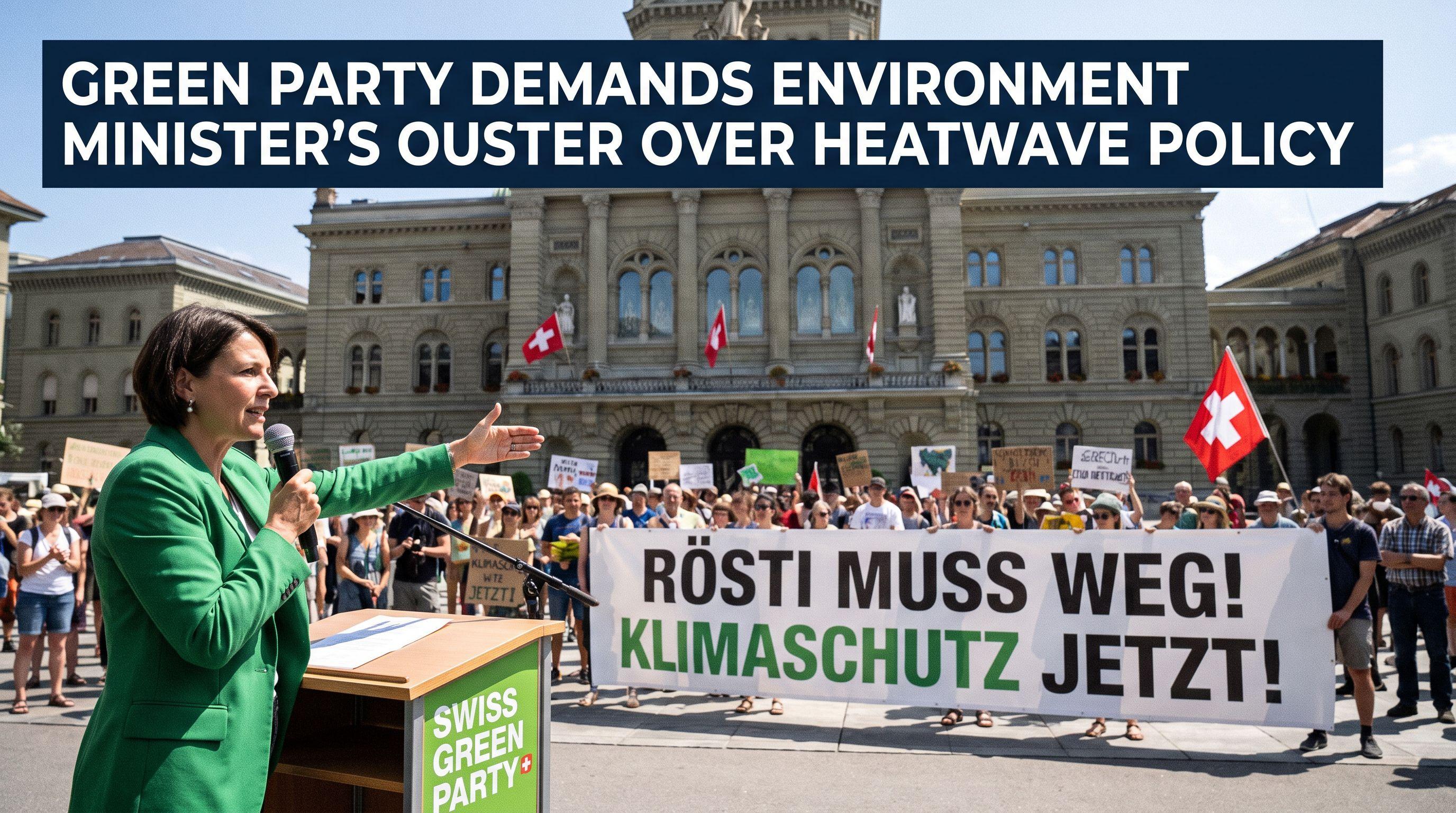
Mazzone Declares War on Climate Inaction
Switzerland is suffocating under a relentless heatwave, and the political temperature in Bern has just hit a boiling point. Green Party President Lisa Mazzone has launched a blistering offensive against Environment Minister Albert Rösti, demanding his immediate removal from the environmental portfolio. Mazzone’s ultimatum is clear: Rösti has not only failed to protect the Swiss population but is actively dismantling the nation’s climate progress. While the mercury soars to unprecedented levels, the Greens argue that the leadership at the Department of the Environment, Transport, Energy and Communications (DETEC) has become a liability. 'I am convinced that any other government minister would be better than Albert Rösti in this department,' Mazzone declared, signaling a total breakdown in confidence. This isn't just a policy disagreement; it is a full-scale assault on the status quo of the Federal Council. The Greens are framing this as a matter of national survival, contrasting the urgency of the climate crisis with what they describe as a lethargic and regressive ministerial agenda.
Drought Parches the Heartland While Bern Stalls
The statistics of this summer’s environmental toll are staggering, and the human cost is already mounting. Before July has even concluded, Switzerland is recording heatwave victims and witnessing a desperate cry for help from the agricultural sector. Rivers are dropping to dangerously low levels, leading to mass fish die-offs that threaten local ecosystems. Mazzone’s critique is sharp: 'We are in the midst of a crisis, and the Swiss government is on holiday.' The Green Party is demanding an immediate emergency plan, including aggressive greening initiatives, mandatory building refurbishments, and robust workplace protections to shield laborers from extreme heat. In contrast to the government's perceived hesitation, the Greens envision a Switzerland that pivots toward decarbonization with wartime speed. The drought isn't just affecting the fields; it is exposing the cracks in a climate policy that Mazzone claims Rösti is systematically ruining. The demand for his ouster is fueled by the sight of cracked earth and empty reservoirs—a visual testament to a policy failure that the Greens say can no longer be ignored.
Political Crossfire Shatters Federal Consensus
Despite the urgency, Mazzone finds herself standing largely alone in the halls of power. While the Social Democrats (SP) and Green Liberals (GLP) share her frustration, they stop short of calling for Rösti’s head. SP parliamentarian Hasan Candan acknowledges that current measures are failing to protect the environment, yet the tradition of the Federal Council’s stability remains a powerful deterrent against forced resignations. Meanwhile, GLP President Jürg Grossen slammed the government for acting 'far too hesitantly,' specifically pointing to the stalled decarbonization of transport. However, Grossen maintains that how the Federal Council organizes its portfolios is a matter for the government itself, not outside pressure. The Centre Party’s Stefan Müller-Altermatt warned that such personalized attacks threaten the very institution of the Federal Council, suggesting that the Greens are merely engaging in the same 'tit-for-tat' politics as the SVP. This political deadlock creates a dangerous vacuum: while parties argue over protocol and decorum, the climate continues its relentless shift, leaving the Swiss public caught between ideological warfare and environmental reality.
The High Stakes of a Warming Alps
The implications of this political standoff reach far beyond the federal offices in Bern. As the SVP’s Marcel Dettling dismisses the Green Party’s demands as a mere 'attention grab,' the reality of a warming Switzerland remains undeniable. The Alps are warming at twice the global average, and the policy decisions made—or avoided—today will dictate the country’s resilience for decades. If Rösti remains at the helm of DETEC, the Greens fear a continued rollback of environmental protections in favor of traditional energy interests. Conversely, if the government ignores the call for a plan of measures, they risk a public backlash as the heatwaves become more frequent and severe. The current crisis has moved climate change from a future threat to an immediate political survival test. Whether through a departmental reshuffle or a radical shift in Rösti’s own agenda, the Swiss government must now confront the fact that the 'business as usual' approach is evaporating as quickly as the mountain glaciers. The coming weeks will determine if Switzerland can forge a unified response or if it will remain paralyzed by partisan friction while the heat rises.