Culture
Yodelling Innovator Nadja Räss Wins Prestigious Swiss Music Grand Prix
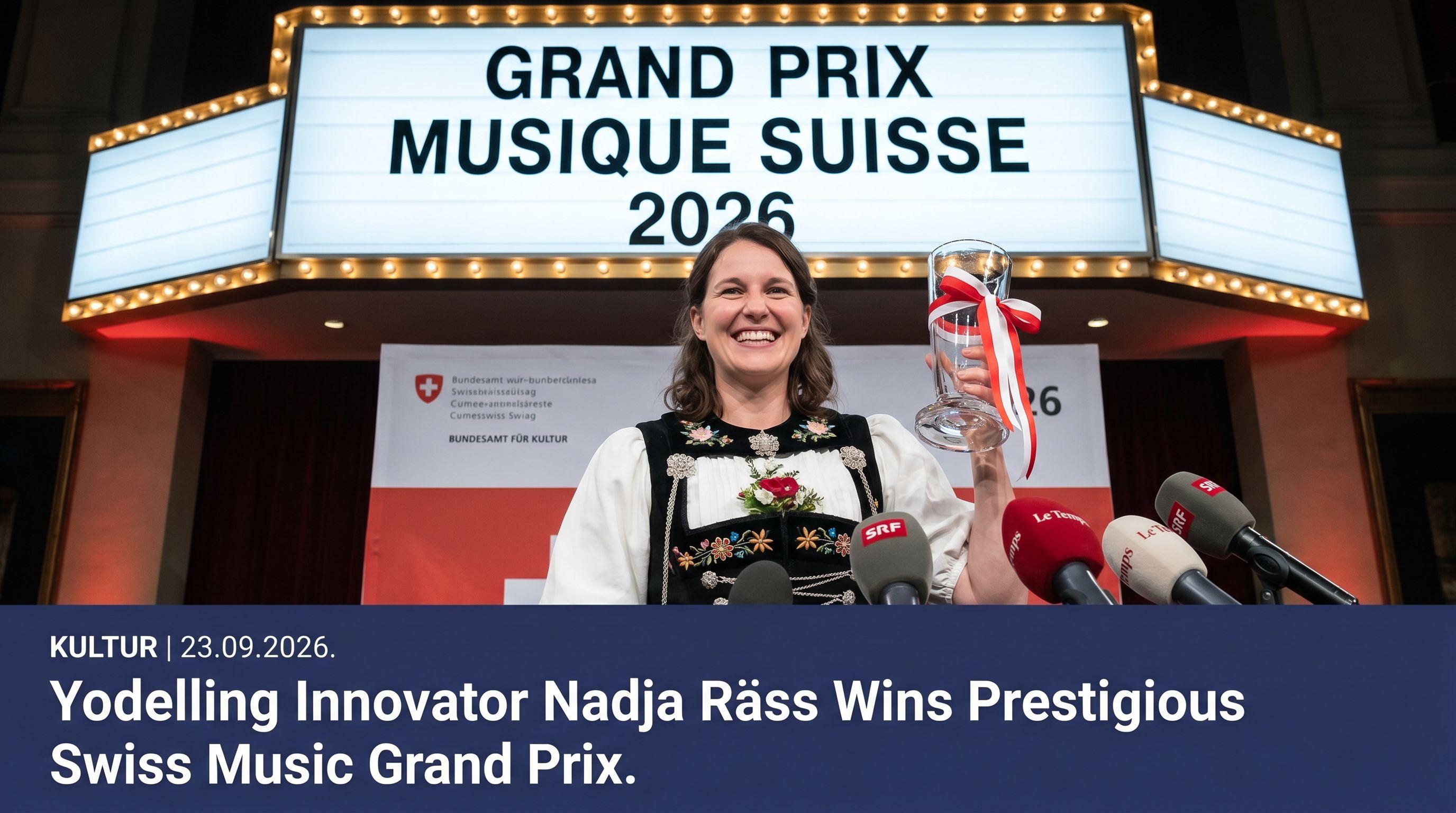
Nadja Räss from canton Schwyz has been awarded the 2026 Swiss Grand Prix for Music, making her the first artist from the Swiss folk music scene to receive the CHF 100,000 prize. The jury celebrated her as one of the most important voices in Swiss yodelling culture.
Folk Tradition Shatters the Glass Ceiling
History has been made in the heart of the Swiss cultural establishment. For the first time ever, a representative of the Swiss folk music scene has claimed the nation's highest musical honor. Nadja Räss, the 47-year-old virtuoso from Canton Schwyz, has been crowned the winner of the 2026 Swiss Grand Prix for Music. This isn't just a win for Räss; it is a seismic shift in how Switzerland perceives its own sonic identity. The Federal Office of Culture confirms that Räss stands as 'one of the most important voices in Swiss yodelling culture,' effectively bridging the gap between ancient alpine traditions and the avant-garde. While previous winners often hailed from the worlds of classical, jazz, or experimental electronic music, Räss’s victory signals that the raw, emotive power of the yodel is no longer a relic of the past but a vibrant force in the contemporary landscape. She confronts the stereotype of folk music as static, proving instead that it is a living, breathing evolution of the Swiss soul.
The 100,000 Franc Voice of a Nation
A staggering CHF 100,000 prize now backs the vocal prowess of Nadja Räss. This massive financial endowment—roughly $126,500—places her at the pinnacle of the Swiss arts scene. The jury, led by Ticino musician and journalist Gian-Andrea Costa, did not merely choose a singer; they chose a pioneer. Räss has spent decades refining a technique that is as technically demanding as any operatic aria, yet remains rooted in the soil of Central Switzerland. While ten other winners were honored with significant accolades, including Flèche Love from Geneva and Louis Schild of Neuchâtel, the Grand Prix remains the ultimate statement of cultural value. This investment by the Federal Office of Culture underscores a critical commitment to artists who act as 'cultural mediators.' Räss does not just perform; she educates, innovates, and ensures that the complex polyphonies of the Alps are studied with the same rigor as a Beethoven symphony. Her influence surges through the music academies of Switzerland, where she has transformed yodelling from a hobby into a high-art discipline.
UNESCO Recognition Fuels a Cultural Renaissance
The momentum behind Räss’s win is inseparable from a global milestone achieved just months ago. In December 2025, yodelling was officially inscribed on UNESCO’s list of intangible cultural heritage, a move that Räss herself championed with relentless energy. This international validation has catapulted Swiss folk music onto the global stage, surpassing local expectations and sparking a renewed interest among younger generations. The jury pointed specifically to her role in this achievement, noting that her work transcends the stage. She is a guardian of a vocal tradition that dates back centuries, yet she approaches it with the urgency of a modern activist. In contrast to the dwindling interest in traditional crafts seen in other regions, Swiss yodelling is currently experiencing an unprecedented surge in popularity. Räss’s leadership has ensured that the 'juuz' and the 'yodel' are not just preserved in archives but are heard in the most prestigious concert halls from Zurich to Tokyo. Her victory is the definitive proof that heritage is Switzerland's most potent export.
Lausanne Braces for a Sonic Revolution
All eyes now turn to Lausanne, where the Swiss Music Awards will reach their crescendo on September 19. This event promises to be a dramatic confrontation between various musical worlds, as Räss takes the stage alongside experimentalists and pop icons. The ceremony will not just be a celebration; it will be a manifesto for the future of Swiss creativity. As the first folk musician to hold the Grand Prix, Räss carries the weight of a nation’s expectations. Her performance is expected to be a masterclass in vocal range and emotional depth, likely silencing any critics who still view yodelling as mere kitsch. Looking ahead, this win is expected to trigger a wave of new funding and interest in regional music projects across the cantons. The implications are clear: the Swiss music scene is diversifying, and the echoes of the mountains are louder than ever. When the lights dim in Lausanne this September, Switzerland will not just be listening to a singer—it will be listening to its own history being rewritten in real-time.