WorldSkills
What Switzerland’s WorldSkills success says about vocational training
Switzerland finished third at WorldSkills in Shanghai, winning 12 medals and ranking as the strongest European team. Use the result to examine the country’s vocational-education model, the skills it is cultivating and the pressures facing apprentices and employers.
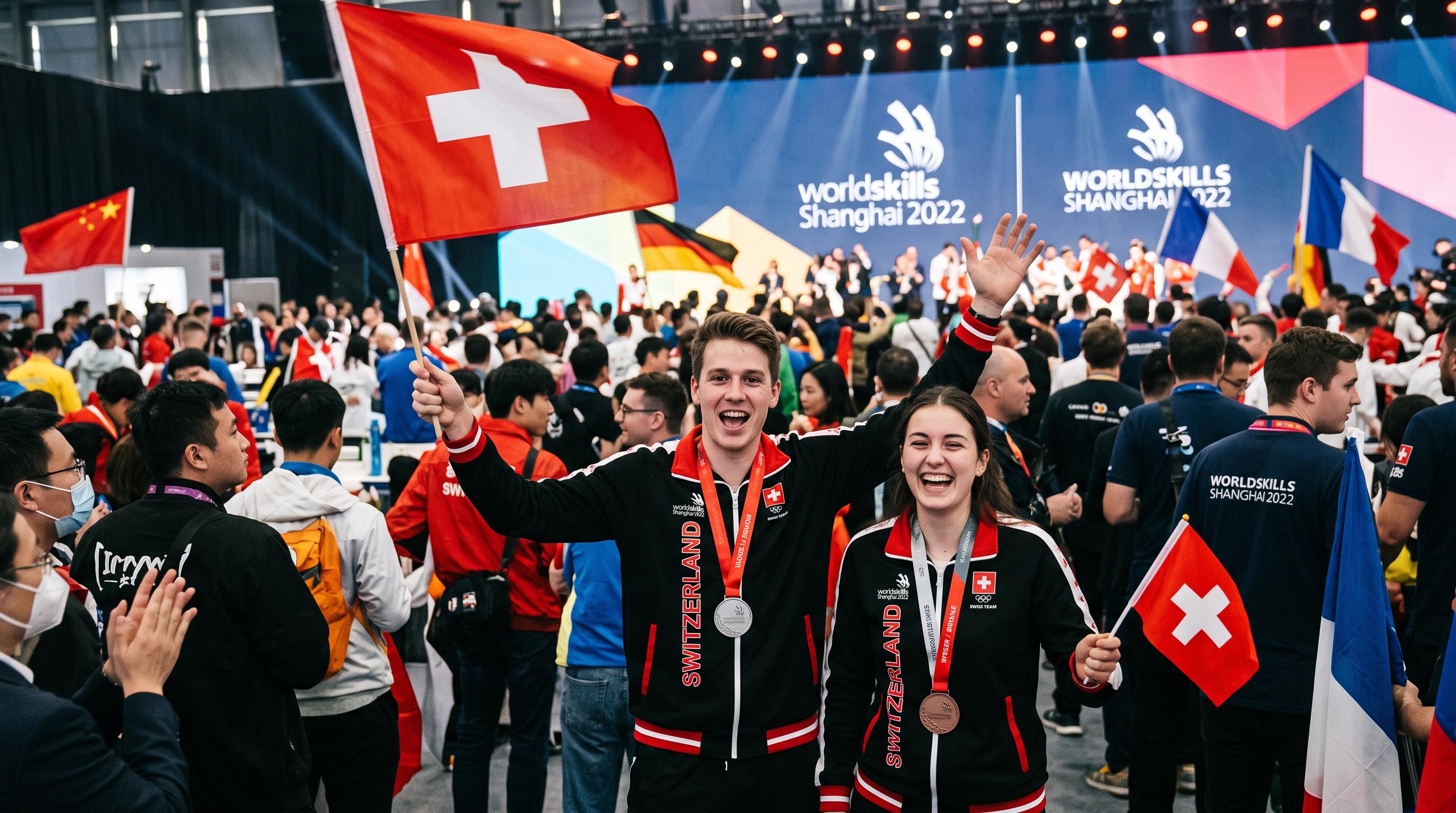
Switzerland takes the WorldSkills stage
Switzerland’s 12 medals in Shanghai put its apprenticeship model on a global stage. The 42-member team finished third at WorldSkills, behind China and South Korea, and ranked as the strongest European delegation. The result came after six days of competition, from 22 to 27 September 2026, involving about 1,400 young competitors from nearly 70 countries and regions.
The Swiss haul included four gold medals, two silvers and six bronzes. A further 23 competitors received medals of excellence, recognising performances that reached a high standard without making the podium. Switzerland’s ranking reflects the average medal points scored by each national team, according to the WorldSkills results table.
The result carries weight beyond the medal ceremony. Switzerland has just over 9 million residents, while China has about 1.4 billion and South Korea around 52 million. Population does not determine technical performance, yet the comparison shows the depth of talent produced by a small country with a highly organised vocational system.
Swiss winners represented a broad spread of work. Hotel reception, plumbing and heating, heavy-vehicle technology, digitalisation and cyber security all produced world champions. Their success gives employers, schools and policymakers a concrete international benchmark for the skills Switzerland is developing.
From plumbing to cyber security
Four Swiss world titles span hospitality, infrastructure, transport and advanced digital industry. Fina Niebergall won gold in hotel reception, bringing customer service and operational judgement into the medal tally. Sandro Amrhein took the heavy-vehicle technology title, while Matthias Steiner won in plumbing and heating. Ian Hofer and Cyrill Koller jointly won Industry 4.0, a discipline focused on digitalisation and cyber security.
That range matters because it places practical competence beside newer technological demands. A Swiss vocational route can lead to work with physical systems, public-facing services, large vehicles or connected industrial equipment. The WorldSkills categories show how employers increasingly need people who can combine precision with diagnosis, communication and digital fluency.
The competition also rewards performance under pressure. Each competitor qualified through national or regional contests before reaching Shanghai. WorldSkills began in Madrid in 1950, when apprentices from Spain and Portugal competed against the backdrop of post-war labour shortages. Its 48th edition now covers 64 skills, from joinery and plumbing to cyber security.
Switzerland’s medal list therefore reflects more than traditional craft pride. It records a training system that continues to place manual expertise, service standards and industrial technology in the same national conversation.
Build the apprenticeship pipeline
Around two-thirds of Swiss young people enter vocational education after compulsory school. Most combine classroom instruction with a paid apprenticeship, giving them a direct connection to a workplace while they continue formal study. Employers help shape the training, creating a route from school into occupations that companies need to fill.
WorldSkills offers a high-profile expression of that arrangement. Competitors do not arrive solely through an academic selection process. They progress through national or regional skills contests, then test their competence against peers from across the world. The system gives practical achievement a public platform and allows firms, teachers and professional organisations to identify talent.
The model also helps explain why Switzerland can compete across such different disciplines. Apprentices learn within occupational communities where standards are set jointly by education providers and industry. Hotel reception, heavy-vehicle technology and Industry 4.0 require different knowledge, yet each depends on structured practice, assessment and feedback.
The Shanghai result does not prove that every apprentice receives the same opportunities or that every employer can train at the same level. It does show that Switzerland has built an institutional pipeline capable of producing internationally competitive specialists in both established trades and fast-changing technical fields.
Support apprentices and employers
The medal table also exposes the demands placed on apprentices and the businesses that train them. WorldSkills competitors must qualify nationally or regionally before facing six days of international competition. Their performance depends on technical preparation, coaching, access to equipment and time away from ordinary work or study. The source material does not quantify those pressures, yet the structure of the contest makes the burden clear.
Employers carry a parallel responsibility. Switzerland’s model relies on firms helping shape vocational training and offering paid apprenticeship places. That links education to real labour demand, while requiring companies to invest supervisors, equipment and working hours in people who are still learning. The arrangement works best when schools and employers coordinate expectations and keep training standards current.
Industry 4.0 illustrates the pace of that task. Ian Hofer and Cyrill Koller won gold in a field involving digitalisation and cyber security, while the same Swiss delegation also excelled in plumbing, heating and heavy-vehicle technology. Training cannot stand still when workplaces combine mechanical systems with software and connected controls.
The medals reward the competitors. They also place attention on the everyday infrastructure that makes high-level performance possible: skilled instructors, supportive companies, credible examinations and a clear transition from compulsory schooling to work.
Keep the model open and current
Swiss vocational success must remain national without becoming uniform. The delegation included competitors from different language regions, including three from French-speaking Switzerland. Augustin Mettraux, a 20-year-old from Fontainemelon in the canton of Neuchâtel, won bronze in joinery. Eliott Vadi from Carouge finished fourth in jewellery after winning gold at Switzerland’s 2025 national skills championships.
Their results show how national competitions can connect regional talent to an international platform. They also underline the importance of keeping pathways visible to young people across the country. A strong vocational system depends on apprenticeships that are respected in French-speaking, German-speaking and Italian-speaking Switzerland, and on employers prepared to offer meaningful training in each region.
The Shanghai medal count gives Switzerland a useful point of confidence. Four golds and eight further medals confirm that the country can match larger populations in selected skills, while 23 medals of excellence show performance extending beyond the podium. The figures also create a responsibility to maintain the conditions behind them.
That means keeping curricula close to technological change, sustaining cooperation between schools and companies, and ensuring apprentices can develop in both established trades and emerging fields. WorldSkills has supplied the headline. The harder work continues in Swiss classrooms, workshops, hotels, garages and industrial sites.