Society
The Swiss Family Dilemma: Birth Rates Fall as Desire for Large Families Fades
Switzerland is experiencing a notable demographic shift as the desire for large families wanes and birth rates drop. While globally, rising childlessness is a key factor, Switzerland presents a unique case with a specific 'third-child dilemma,' even as some cities like Bern see population growth through migration.
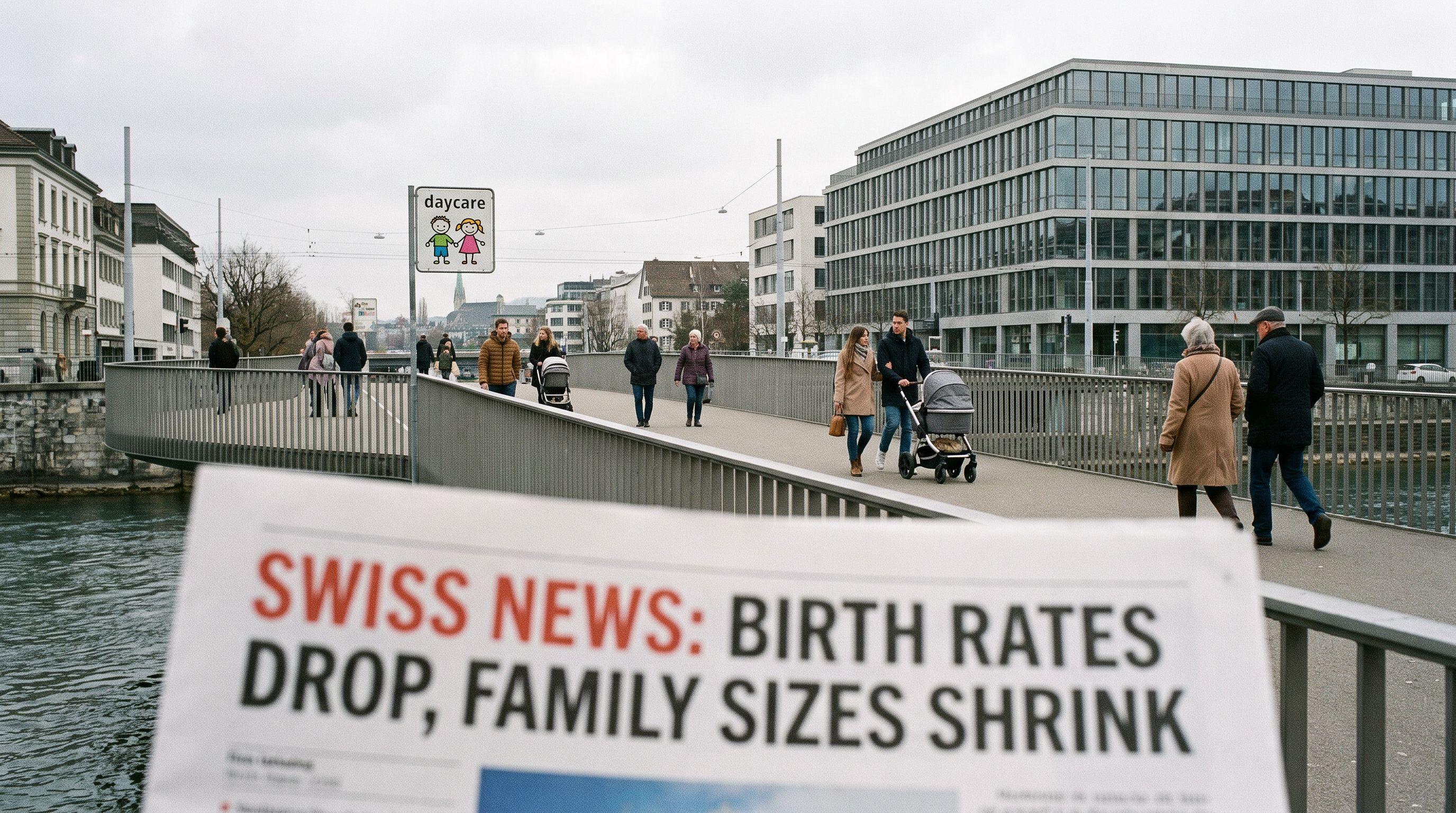
The Cradle Goes Quiet: Switzerland’s Fertility Freefall
Switzerland is confronting a demographic reckoning as the national fertility rate plummets to a staggering 1.29 children per woman—the lowest ever recorded in the nation’s history. This figure sits dangerously below the 2.07 replacement level required to sustain a population without external intervention. In 2024, live births crashed by 9.2% compared to just five years prior, signaling a cultural exodus from the traditional large family model. The Swiss nursery is increasingly a place of 'one and done.' While the two-child family remains a nominal ideal, the reality is shifting toward smaller, later, or non-existent families. Women are now waiting longer than ever to conceive, with the average age of motherhood soaring to 32.4 years. This delay creates a biological bottleneck; by the time the first child arrives, the window for siblings is rapidly closing. The desire for children among the youth is also evaporating: the share of 20-somethings who want no children at all has nearly tripled in a decade, surging from 6% to 17%. This is not a temporary dip; it is a fundamental restructuring of the Swiss social fabric.
The Million-Franc Milestone: The Brutal Economics of Parenting
Raising a child in Switzerland has become a luxury pursuit, with the total price tag now surpassing a staggering CHF 1 million per child when lost career earnings are factored in. In a country where six cities recently swept the top spots of the global Cost of Living Index, the financial math of parenthood simply no longer adds up for many. Young adults are increasingly pessimistic, with 50% of respondents reporting they expect a child to damage their professional prospects. This 'motherhood penalty' is particularly acute in the Swiss corporate landscape, where the lack of affordable childcare and rigid working structures force a choice between the boardroom and the bedroom. Finances and working conditions are now cited as the primary drivers of reproductive decisions, eclipsing traditional or religious motivations. For the modern Swiss couple, a child is no longer a given; it is a high-stakes investment that requires significant sacrifice in a hyper-competitive economy.
The Third-Child Wall: Why Swiss Families are Shrinking
While global birth rates are falling due to rising childlessness, Switzerland faces a unique 'third-child dilemma.' Data reveals a dramatic 13.6% collapse in third-order births, a far steeper decline than the 8.5% drop in first-borns. Experts call this a 'non-linear cost structure.' While a dual-income household can often absorb the costs of one or two children, a third child acts as a financial tipping point. It demands larger housing, which is increasingly scarce in urban centers like Zurich and Geneva, and necessitates a further reduction in working hours that many families cannot afford. As Professor Laura Bernardi notes, having a third child creates a whole new layer of constraints. In the high-altitude reality of Swiss living, the three-child family has transitioned from a common sight to a rare status symbol, comparable to owning a penthouse in Manhattan. The 'Swiss norm' is being squeezed from both ends: fewer people are starting families, and those who do are stopping sooner.
Importing Growth: Migration Masks the Demographic Void
The city of Bern serves as the perfect microcosm for the Swiss demographic paradox: the capital is growing even as its birth rate hits a 20-year low. In the first half of 2026, Bern’s population increased to 147,124, but this growth was fueled almost entirely by migration rather than maternity wards. While there was a net outflow of Swiss nationals, an influx of 382 people from abroad—primarily from Ukraine, Germany, and Afghanistan—kept the city’s numbers in the black. This 'migration mask' hides a sobering reality: without foreign workers and refugees, Swiss cities would be shrinking. The only age group showing positive net migration is the 20-39 bracket, the very cohort that is opting out of parenthood. Switzerland is effectively importing its future workforce to compensate for a domestic birth surplus that has slowed to a trickle. This reliance on migration creates a fragile equilibrium, as the nation grapples with how to integrate new arrivals while its own traditional family structures dissolve.
A Nation Redefined: The Future of the Swiss Household
The implications of this birth dearth are profound and immediate. As the center of gravity for childbearing moves deeper into the thirties, the window for biological intervention narrows, and the success of IVF—which now accounts for 3.1% of births—cannot bridge the gap. Switzerland is hurtling toward a future defined by an aging population and a shrinking domestic workforce. The hardening of attitudes among young adults suggests that government incentives like parental leave and childcare subsidies, while welcome, are failing to address the core anxieties of career damage and financial instability. If the 'desire for children' continues its downward trajectory, the very concept of the Swiss family will need to be redefined. The nation must now decide whether to accept a smaller, older population or radically overhaul its economic and social structures to make the 'third-child' a viable reality once again. The clock is ticking, and the silence in the nurseries is growing louder.