Swiss Amateur Astronomer Makes Rare Asteroid Moon Discovery
Schafmatt Observatory observer makes unexpected discovery of asteroid moon, confirmed by German colleagues in groundbreaking astronomical finding.

"It suddenly became clear to me that I had discovered something truly special. I was simply delighted."
"In football terms, this discovery is comparable to winning the Swiss championship, but not to winning the Champions League."
At 1:00 am on a quiet summer night, the routine became revolutionary. Josef Käser, a veteran amateur astronomer with 50 years of experience, was stationed at the Schafmatt Observatory with a modest goal: to measure the shape of asteroid (108968) 2001 PE40. He did not expect to rewrite the celestial map. Yet, in a moment of pure serendipity, Käser stumbled upon a phenomenon that experts are calling a "sensational discovery."
While tracking the ancient rock, which has been hurtling through the void for over 400 million years, Käser witnessed an anomaly that defies the odds. "It suddenly became clear to me that I had discovered something truly special," Käser stated, his delight palpable. This was not merely a rock in space; it was a complex system. The observation, initially intended to be a standard data collection exercise, transformed instantly into a career-defining moment. It serves as a stark reminder that in the vast darkness of space, the most significant discoveries often hide in the shadows, waiting for a keen eye to expose them.
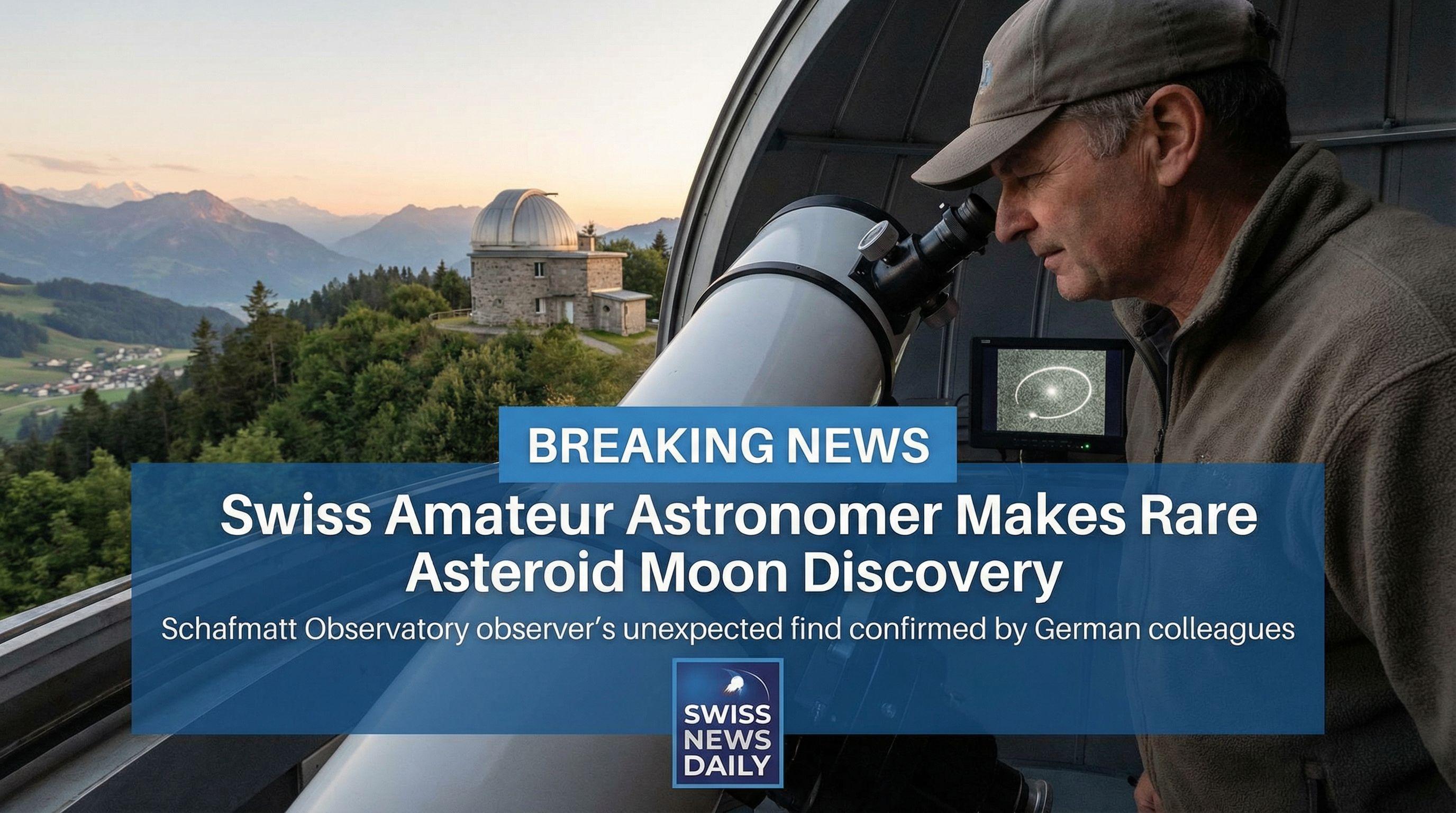
The discovery hinges on a fraction of a second. To find the invisible, Käser utilized the stellar occultation method—a technique demanding absolute temporal precision. As expected, the primary asteroid blocked the target star's light for exactly 1.1 seconds. But then, the impossible happened. Approximately 1.5 seconds after the star reappeared, the light vanished again—this time for a mere blink of an eye.
This second, fleeting blackout was the smoking gun. It indicated a secondary body trailing the main asteroid. Independent confirmation arrived swiftly from Eberfing, Germany, where colleagues recorded the identical anomaly. The data allows for only one conclusion: a previously unknown moon is orbiting the asteroid. This was not a glitch; it was a synchronized celestial dance caught on tape. The event was visible even to the naked eye, but it was Käser's rigorous recording and subsequent analysis that confirmed the existence of this new celestial neighbor. The precision required to catch a 400-million-year-old object obscuring a star for less than two seconds is nothing short of staggering.
The numbers revealed by this observation are specific and striking. Data analysis has stripped away the mystery of asteroid (108968) 2001 PE40, revealing an elongated body measuring 12.6 x 6.8 km. However, the true star of the show is the moon itself. This tiny, rocky satellite measures a mere 2.9 x 1.83 km—a speck of dust in the cosmic scale, yet significant enough to be detected from Earth.
Orbiting at a tight distance of just 23.9 kilometers from its host, the moon's proximity highlights the gravitational interplay at work in these small planetary systems. Uncovering such minute details requires a convergence of perfect timing, clear skies, and flawless equipment. Käser notes the fascination of the feat: catching a rock that has traveled for eons as it blocks a pinprick of light for barely a second. This is not just observation; it is astronomical forensics, reconstructing the physical reality of distant objects using nothing but shadows and time.
This discovery is a victory for Swiss amateur astronomy, proving that significant scientific contributions are not the exclusive domain of billion-dollar space agencies. The website of Orion, the Swiss journal for astronomy, has already labeled the find a "sensational discovery." While Marc Eichenberger, President of the Swiss Astronomical Society (SAG), tempers the hype, his praise remains substantial.
"In football terms, this discovery is comparable to winning the Swiss championship," Eichenberger asserts. While it may not be the "Champions League" of discovering a new planet, it is a prestigious achievement that places Swiss precision in the spotlight. Discoveries of asteroid moons are rare, with only a few spotted globally in recent years. Each new find adds a critical piece to the puzzle of small planet research. Käser's work demonstrates that Switzerland continues to punch above its weight in space exploration, contributing vital data to our understanding of the solar system's formation and history.