Science
Swiss-developed adapter aims to shield satellites from launch vibrations
Researchers at Empa and Beyond Gravity have developed a phononic-crystal adapter that converts damaging rocket-launch vibrations into rotational movement, potentially allowing more sensitive instruments to be sent into space.
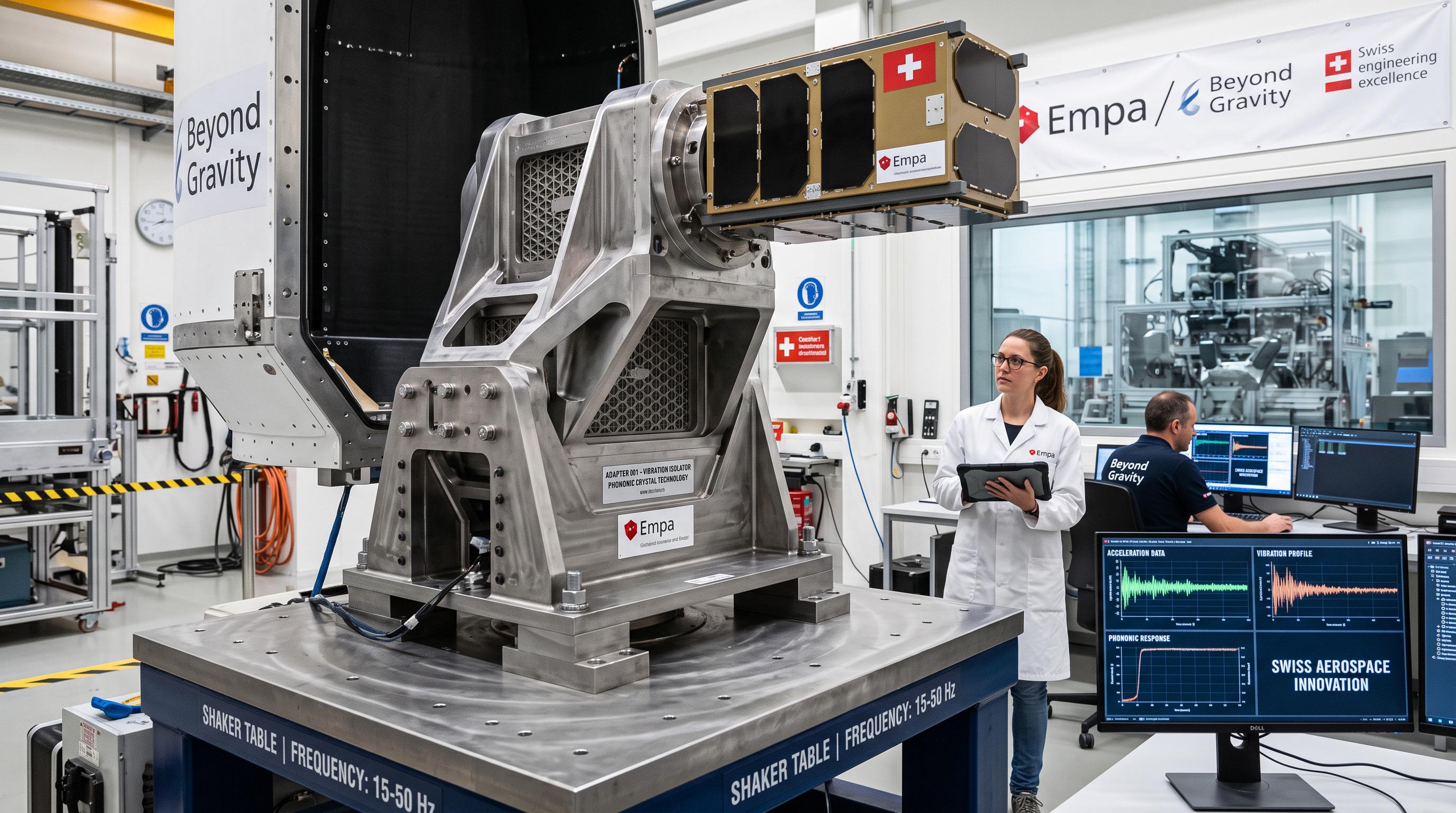
Swiss engineers target launch vibrations
Rocket launches can expose satellites to vibrations strong enough to threaten sensitive onboard electronics. A new Swiss-developed adapter aims to intercept those forces before they reach the spacecraft payload.
Researchers at the Swiss Federal Laboratories for Materials Science and Technology, known as Empa, developed the system with Swiss space company Beyond Gravity. The component sits between a satellite and its launch vehicle, forming the connection through which the payload travels into orbit.
The need is especially acute during the separation of rocket stages. When one stage detaches from another, the resulting mechanical disturbance can travel through the launch structure and into the satellite. Instruments built to measure delicate physical signals may be vulnerable to those movements, even when the satellite itself remains structurally intact.
The project gives Switzerland a role in solving a highly practical problem in space engineering. It combines Empa's research in advanced materials and structures with Beyond Gravity's experience in satellite and launcher hardware. Empa researcher Andrea Bergamini said improved protection could make it possible to send more sensitive measuring instruments into space.
The work was reported on September 22, 2026, after the concept had been examined through simulations and prototype testing.
A crystal structure redirects the shock
The adapter changes the way launch vibrations move through the structure. Rather than treating the component as a passive connector, the researchers redesigned it as a phononic crystal, an engineered structure that controls the transmission of mechanical waves.
In the Swiss design, damaging longitudinal vibrations are converted into rotational movement. Integrated aluminium rings turn as the vibrations pass through the adapter. That movement absorbs and dissipates part of the energy, reducing the forces that continue toward the satellite's payload.
The principle resembles the way carefully designed materials can guide or block sound waves, although the adapter operates with mechanical vibrations in a launch structure. Its geometry determines how the disturbance travels and how the rings respond. The goal is to manage vibration at the connection point, before it reaches fragile instruments mounted inside the spacecraft.
This approach could offer a more targeted solution than simply adding mass or conventional damping material. Satellite designers must balance protection against strict limits on weight, volume and structural strength. Every additional component also has to withstand the severe conditions of launch and remain reliable in space.
Empa and Beyond Gravity have presented the structure as part of a newly designed payload adapter. Further engineering work will determine how it performs across different launch profiles and payload configurations.
Prototype tests set the next challenge
Simulations and prototype tests have already demonstrated the concept's potential, while flight qualification remains ahead. Empa said the structure has proven its worth in computer simulations and tests with a physical prototype.
Those results mark an important development stage, but they do not yet amount to a space mission. An adapter intended for flight must meet demanding requirements for strength, fatigue resistance, thermal behaviour and manufacturing consistency. It must also work with the interfaces used by launch providers and satellite manufacturers.
Beyond Gravity has filed a patent application for the invention, securing protection for the core design while the partners continue to refine it. The company, headquartered in Switzerland, supplies systems and structures for the space industry. Its involvement gives the research a route toward industrial development and possible integration into future payload hardware.
The source report does not identify a launch date, a target rocket or a specific satellite mission. It also does not provide measured vibration reduction figures or a final mass for the adapter. Those details will matter when engineers compare the system with existing launch isolation technologies.
The next phase will focus on optimisation. Researchers will need to adapt the component to real mission constraints without compromising the wave-control effect that gives the phononic crystal its value.
The payoff: finer instruments in orbit
More capable instruments could be the technology's most important payoff. Andrea Bergamini said stronger protection from launch vibrations could allow spacecraft to carry more sensitive measuring instruments into orbit.
That matters for missions that depend on precise readings. Instruments designed to detect small changes in the environment, measure physical conditions or observe distant objects can be affected by mechanical disturbance before they begin their work in space. Protecting them during launch could widen the range of equipment that satellite builders are willing to fly.
For Switzerland, the project connects domestic materials research with the country's established space manufacturing sector. Empa contributes expertise in structures and advanced materials, while Beyond Gravity brings experience in hardware for satellites and launch systems. The partnership also reflects the way Swiss companies and research institutions participate in international missions, even when launches take place abroad.
The adapter remains a technology under development. Engineers must optimise it before it can be used on a rocket, and future testing will establish whether its performance translates from simulations and prototypes to flight conditions. A successful qualification could give satellite designers another tool for controlling launch loads while keeping payloads compact.
The immediate result is a patented Swiss concept with a clear engineering target: reduce vibration at the satellite's point of connection to the rocket.