Health
Rethinking Swiss Healthcare: Santésuisse Head Calls for Telemedicine and Regionalization
Verena Nold, the departing director of health insurance association Santésuisse, has proposed a vision for future healthcare that prioritizes large-scale telemedicine and abolishes cantonal sovereignty in favor of six major healthcare regions to increase efficiency and solve most health problems with outpatient care.
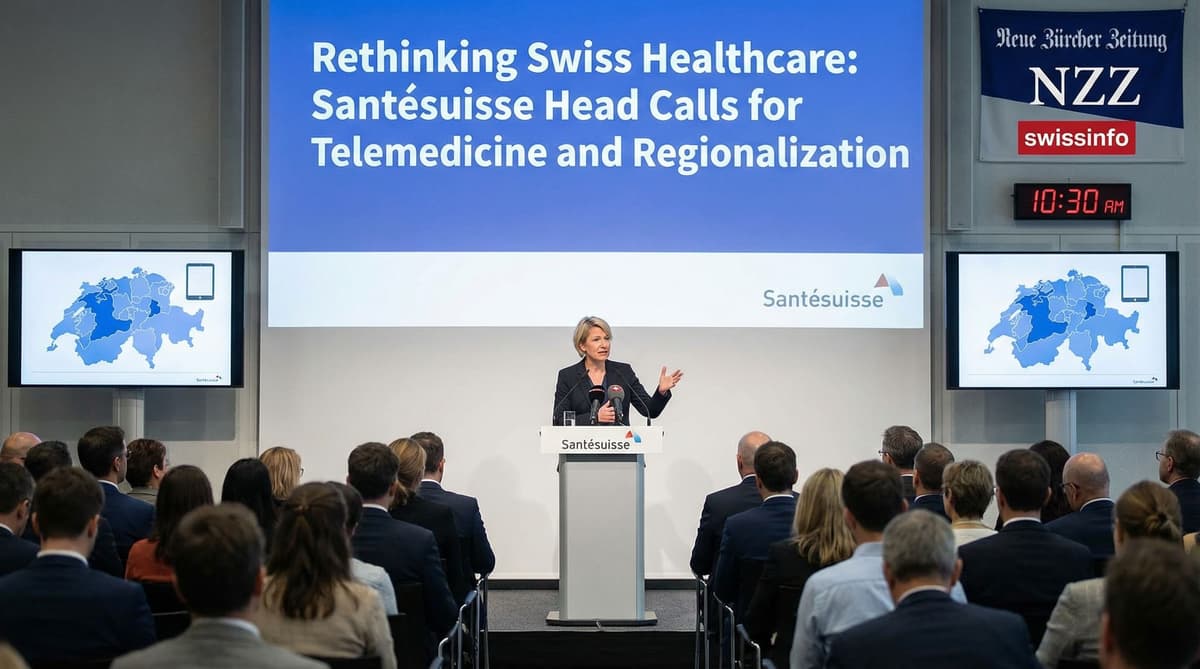
Verena Nold is leaving Santésuisse with a radical parting shot that challenges the very foundation of Swiss healthcare. In a bold vision for the future, the departing director asserts that a staggering 80% of all health problems could be solved without a patient ever stepping foot inside a hospital. Nold is calling for a seismic shift toward large-scale telemedicine, positioning hospitals strictly at the end of the care chain rather than the beginning. This is not merely a suggestion for efficiency; it is a demand for a complete operational overhaul. By prioritizing an efficient outpatient network, Switzerland could drastically reduce the burden on physical infrastructure. The implication is clear: the future of Swiss health is digital, immediate, and decentralized. As Nold exits the stage, she leaves behind a blueprint where the waiting room is replaced by the screen, and the hospital bed becomes a last resort for the critically ill, rather than a default destination for the unwell.
Shattering Cantonal Borders
In a move that strikes at the heart of Swiss federalism, Nold is advocating for the total abolition of cantonal sovereignty over healthcare. The current fragmented system, she argues, must be dismantled in favor of six major healthcare regions. This proposal represents a dramatic centralization of power designed to obliterate inefficiency. Under this new regime, local politics would yield to a compulsory healthcare distribution formula. This algorithm would ruthlessly determine the optimum number of primary care doctors and specialists per 1,000 inhabitants, ignoring traditional cantonal lines in favor of data-driven logic. While controversial, the logic is piercing: disease does not respect cantonal borders, and neither should the healthcare system. Nold warns that if premiums continue their relentless surge, the federal government may be forced to intervene and impose these regions regardless of local sentiment. The era of 26 different healthcare strategies is crumbling; the era of regional efficiency is on the horizon.
The End of Generalist Hospitals
The days of every local hospital offering every procedure are numbered. Nold's vision demands a rigorous application of benchmarks and consistent specialization across the hospital sector. She explicitly targets high-stakes fields such as orthopaedics, obstetrics, and cardiology, arguing that these should be concentrated in specialized centers rather than scattered across general facilities. This is a call for quality over proximity. By forcing hospitals to compete on specific benchmarks, the system would naturally weed out underperforming units and consolidate expertise. Parliament is already grappling with these approaches, signaling that Nold's vision is already infiltrating legislative halls. The message to healthcare providers is stark: specialize or become obsolete. This restructuring aims to ensure that when a patient does require hospital care—that critical 20%—they are treated by teams with high case volumes and deep expertise, rather than generalists spread too thin.