AI
Written with AI assistance•December 6, 2024•
Swiss Federal Institute of Technology Lausanne unveils innovative drone with bird-like legs capable of walking and jumping, breakthrough in robotic mobility for challenging environments.
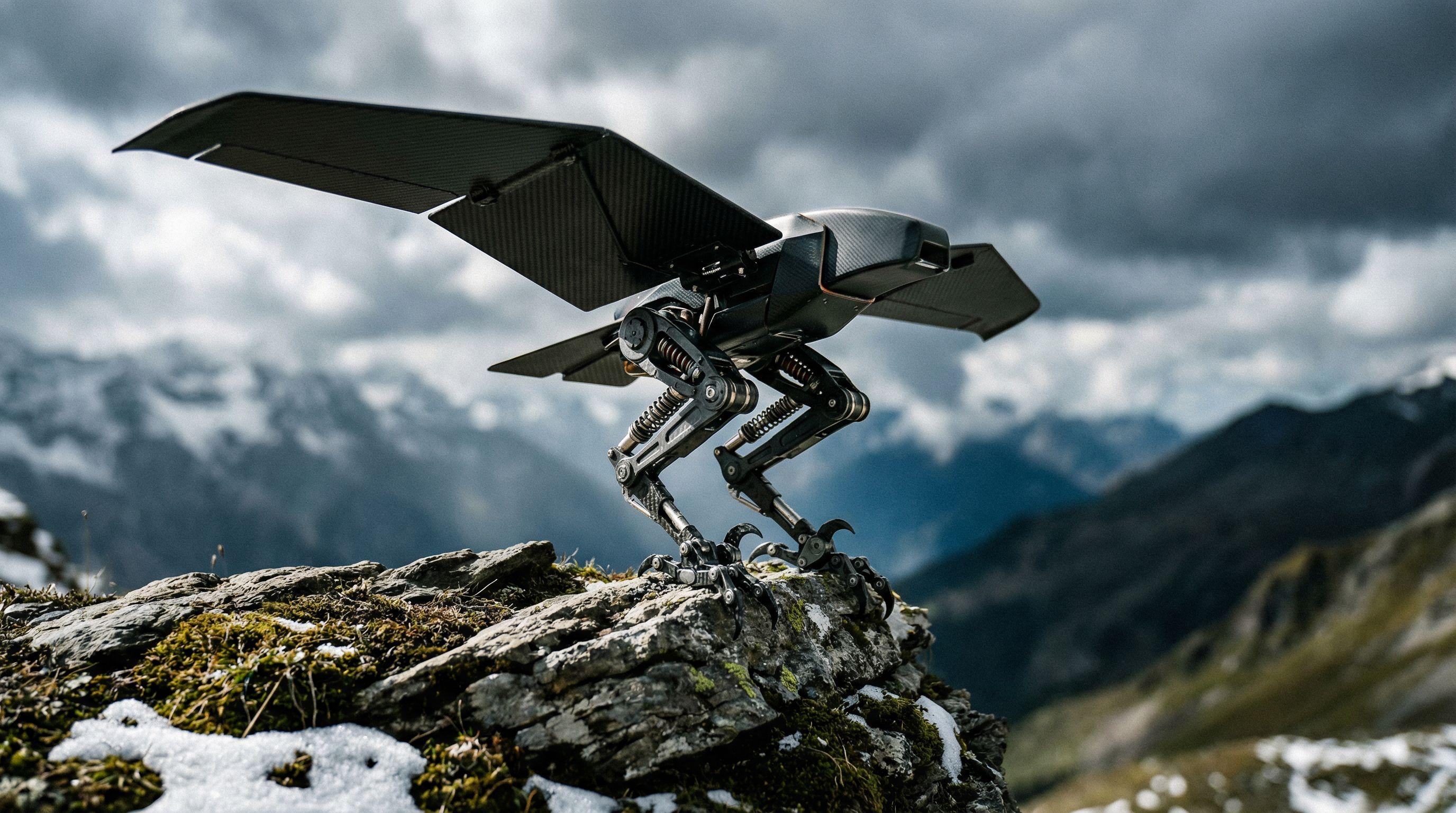
"Birds can alternate between walking and running to take off or land, without the aid of a runway or launcher. Engineering platforms for such movements are still lacking in robotics."
Swiss innovation has once again shattered the boundaries of robotics. In a groundbreaking development from the Swiss Federal Institute of Technology Lausanne (EPFL), researchers have unveiled RAVEN—a drone that defies convention by walking, hopping, and jumping to take flight. This isn't just another flying machine; it is a bio-inspired marvel that mimics the agile movements of corvids, bridging the gap between terrestrial and aerial mobility.
While traditional fixed-wing drones remain shackled to runways or launchers, RAVEN (Robotic Avian-inspired Vehicle for multiple ENvironments) breaks free from these constraints. By integrating bird-like legs, the device can navigate environments previously deemed inaccessible to robotic explorers. The implications are massive: from search and rescue missions in debris-laden disaster zones to environmental monitoring in dense forests, RAVEN promises access where wheels and rotors fail. Published this week in the prestigious journal Nature, this Swiss-led breakthrough marks a pivotal moment in the evolution of autonomous systems.
Designing a robot that flies is difficult; designing one that walks and flies is a staggering engineering challenge. Won Dong Shin, a PhD student at EPFL’s Intelligent Systems Laboratory, confronted this dilemma head-on. Through a rigorous combination of mathematical modeling and computer simulations, Shin engineered a customized leg system that balances mechanical complexity with critical weight restrictions. The result is a masterpiece of efficiency: a drone weighing a mere 620 grams that packs the power to leap.
"Birds can alternate between walking and running to take off or land, without the aid of a runway or launcher. Engineering platforms for such movements are still lacking in robotics," Shin declared. To solve this, the team utilized a sophisticated arrangement of springs and motors to mimic the powerful tendons and muscles found in birds. By keeping the heaviest components close to the body—just as nature designed avian anatomy—the team achieved a center of gravity that allows for stability on the ground without compromising aerodynamics in the air.
Previous attempts at hybrid robots have failed to strike the right balance: walkers were too heavy to fly, and jumpers lacked the precision to walk. RAVEN obliterates these limitations. The robot is capable of climbing over holes and executing vertical jumps onto surfaces raised 26 centimeters high. This dynamic mobility allows it to traverse rough, uneven terrain that would ground standard drones.
The researchers discovered that jumping is not merely a flashy trick—it is the most efficient method for takeoff. By analyzing different flight modes, including standing starts and free-falls, the team found that a powered leap maximizes both kinetic energy (speed) and potential energy (height). This efficiency is critical for autonomous operations in confined areas where human intervention is impossible. RAVEN doesn't just fly; it launches itself into the sky with the explosive power of a predator.
While RAVEN soars in takeoff and flight, the final frontier remains the landing. The EPFL team, supported by American scientists, is currently grappling with the complex physics of bringing the bird-bot back to earth safely in varied environments. Mastering the landing is the final key to unlocking fully autonomous, multi-modal missions.
This development comes at a critical time for Switzerland. As drone warfare and surveillance evolve globally, the Swiss army and civil defense sectors are actively rethinking their strategies. Innovations like RAVEN position Switzerland at the vanguard of this technological revolution. By creating a lightweight, agile platform capable of operating without runways, EPFL has laid the groundwork for the next generation of drones—machines that don't just observe the world from above, but physically interact with it.