migration
Documents reveal Swiss authorities’ cooperation with Taliban over deportations
Documents obtained under transparency laws show how Swiss authorities worked with a Taliban delegation to secure travel papers for Afghan nationals facing deportation. Three men were deported after the delegation visited Geneva in 2025.
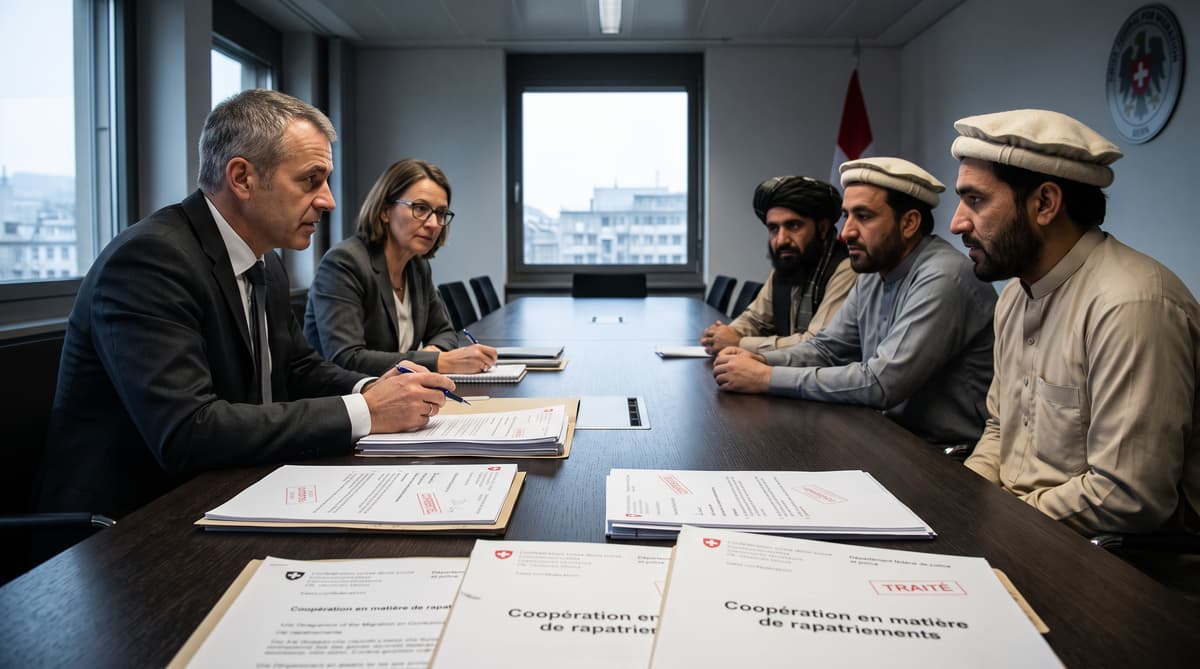
Three Afghan men were deported after Taliban officials came to Geneva to help identify people Switzerland wanted to remove. Documents obtained under transparency laws by Zurich-based research collective WAV, and shared with Le Courrier, detail how Swiss authorities worked with the Taliban administration to secure travel papers. The delegation’s stated task was to identify 13 Afghan nationals convicted of crimes in Switzerland. The State Secretariat for Migration (SEM) said at the time that Kabul accepted only travel documents issued by its authorities. The files add detail to a visit that had already drawn scrutiny: four Taliban officials stayed in Geneva from August 19 to 21, 2025, and Switzerland paid CHF 13,490 for the visit. The documents describe exchanges involving the Swiss embassy in Islamabad, the foreign ministry, the SEM and the Taliban administration. They also show the SEM passing personal details of people it sought to deport to the Afghan authorities.
Trace the Delegation’s Geneva Stay
The delegation stayed at a Geneva hotel, not within the airport perimeter. The four Taliban officials spent two nights at the Mövenpick Hotel between August 19 and 21, 2025. The location conflicts with the SEM’s earlier statement that the Afghan officials did not leave the airport during their stay. The ministry had described the visit as an “investigation carried out by consular staff”. The correspondence obtained by WAV shows Swiss authorities referring to the visitors as a “technical delegation” and a “consular mission”. It records emails between the Swiss embassy in Islamabad, the foreign ministry, the SEM and the Taliban administration. Names and other information considered sensitive were redacted. The visit cost Switzerland CHF 13,490. The hotel stay and the official correspondence sharpen questions about how the mission was organised and how Swiss agencies engaged with representatives of a regime they do not recognise as legitimate.
Follow the Formal Language
The correspondence combined formal diplomatic language with practical cooperation on deportations. A note dated June 23, 2025, says the Swiss embassy in Pakistan “is honoured to hand over a letter from the SEM” to the Afghan Ministry of Foreign Affairs, and closes with an assurance of “highest consideration”. The SEM said such wording was standard international protocol and argued that it could not be used to draw political conclusions. An email said “no official meetings are planned in Switzerland”, yet the programme included a “courtesy dinner for a maximum of nine people”. The four delegates held diplomatic passports. Alongside these exchanges, the SEM sent the Taliban administration personal information about people Switzerland wanted to deport. Asylum law experts criticised that step, warning it could put the deportees’ safety at risk. The documents give a concrete picture of contact between Swiss agencies and Taliban officials, extending beyond the public description of a consular identification mission.