Environment
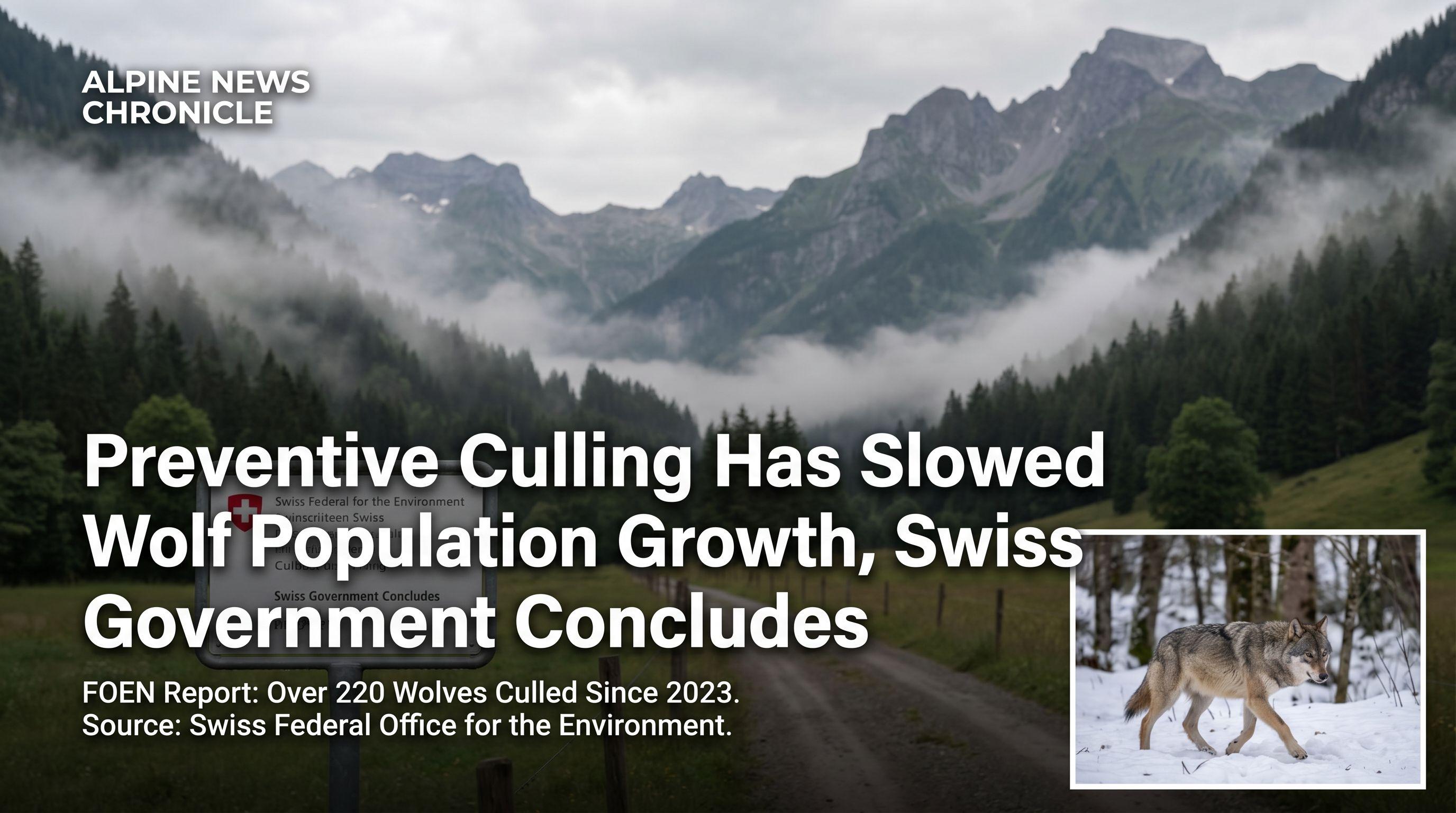
Preventive Culling Has Slowed Wolf Population Growth, Swiss Government Concludes
The Federal Office for the Environment (FOEN) has concluded that preventive culling has effectively slowed the growth of Switzerland's wolf population. Since 2023, over 220 wolves have been killed, with 77 culled in the most recent regulatory period.
Switzerland Halts the Wolf Surge
Switzerland has decisively broken the back of exponential wolf population growth. More than 220 wolves have been eliminated since 2023 under a bold, proactive federal strategy that prioritizes preventive action over reactive damage control. For the first time since the predator's return to the Alps, the Federal Office for the Environment (FOEN) confirms that the relentless expansion of packs is finally losing its momentum. This is not a matter of chance; it is the direct result of a calculated legislative shift in December 2022 that empowered cantons to strike before the first lamb is ever lost. While the wolf was once an untouchable symbol of rewilding, it is now the subject of the most aggressive management program in modern Swiss history. The government’s conclusion is unmistakable: the cull is working. By shifting the burden of proof from the farmer to the predator, Switzerland has fundamentally altered the biological trajectory of the species within its borders, signaling a new era where human interests and Alpine tradition take center stage.
The Lethal Math of Population Control
The numbers tell a story of surgical precision and relentless pressure. During the latest regulatory window from September 2025 to January 2026, hunters and game wardens culled 77 wolves—76 of which were taken preventatively. This follows a staggering 92 kills in the 2024/2025 period and 55 in the initial shortened phase. Despite these removals, the biological engine of the species remains potent: at least 155 wolf pups were born in 2025 alone. Switzerland currently grapples with a documented population of 350 wolves distributed across 40 packs—30 entirely domestic and 10 straddling international borders. While the number of packs has technically increased from 36 to 40 in the last year, the FOEN highlights a critical victory: the growth rate is no longer exponential. The state is now killing wolves faster than they can establish new territories, effectively capping the expansion that once seemed unstoppable. However, the federal government warns that this trend is nascent; it will take several more years of high-intensity culling to ensure this deceleration becomes a permanent fixture of the Swiss landscape.
Livestock Losses and the Cattle Crisis
A dramatic shift in predation patterns is forcing the Swiss government to reach deeper into its pockets. While total livestock kills have plummeted from their 2022 peak—returning to levels not seen since 2020 when only 15 packs roamed the country—the financial burden of compensation is actually soaring. The reason? Wolves are increasingly targeting cattle. In 2025, compensation payments surged because a single cow represents a significantly higher economic loss than a sheep or goat. This evolution in wolf behavior suggests that even as the population growth slows, the remaining packs are becoming more audacious or specialized in their hunting. The FOEN attributes the overall decline in sheep kills to a dual-track strategy: aggressive culling combined with reinforced herd protection measures like livestock guardian dogs and electric fencing. Yet, the rise in cattle attacks creates a new political flashpoint. Farmers who once felt safe with larger livestock are now demanding even more stringent regulations, arguing that the current 'stabilization' is not enough if the remaining wolves are simply switching to more valuable prey.
The Fragile Future of Alpine Coexistence
Switzerland stands at a critical crossroads in wildlife management, balancing on a knife-edge between ecological restoration and agricultural survival. The environment ministry is cautious, noting that the current 'success' in slowing growth must be proven over the long term. The 2022 decision to relax the hunting law remains one of the most controversial pivots in Swiss environmental policy, drawing fierce criticism from conservationists while providing a lifeline to mountain communities. As 13 new packs emerged in the last year—though three quickly disbanded—the resilience of the species is evident. The question now is no longer whether wolves belong in Switzerland, but exactly how many the landscape can tolerate before the social contract with the farming community shatters. With 350 wolves currently documented, the pressure on the FOEN to maintain these high culling quotas will only intensify. The coming years will determine if Switzerland's proactive model becomes a blueprint for the rest of Europe or a cautionary tale of a landscape that lost its wild edge to the demands of the modern economy.