AI
Written with AI assistance•19 marzo 2026•
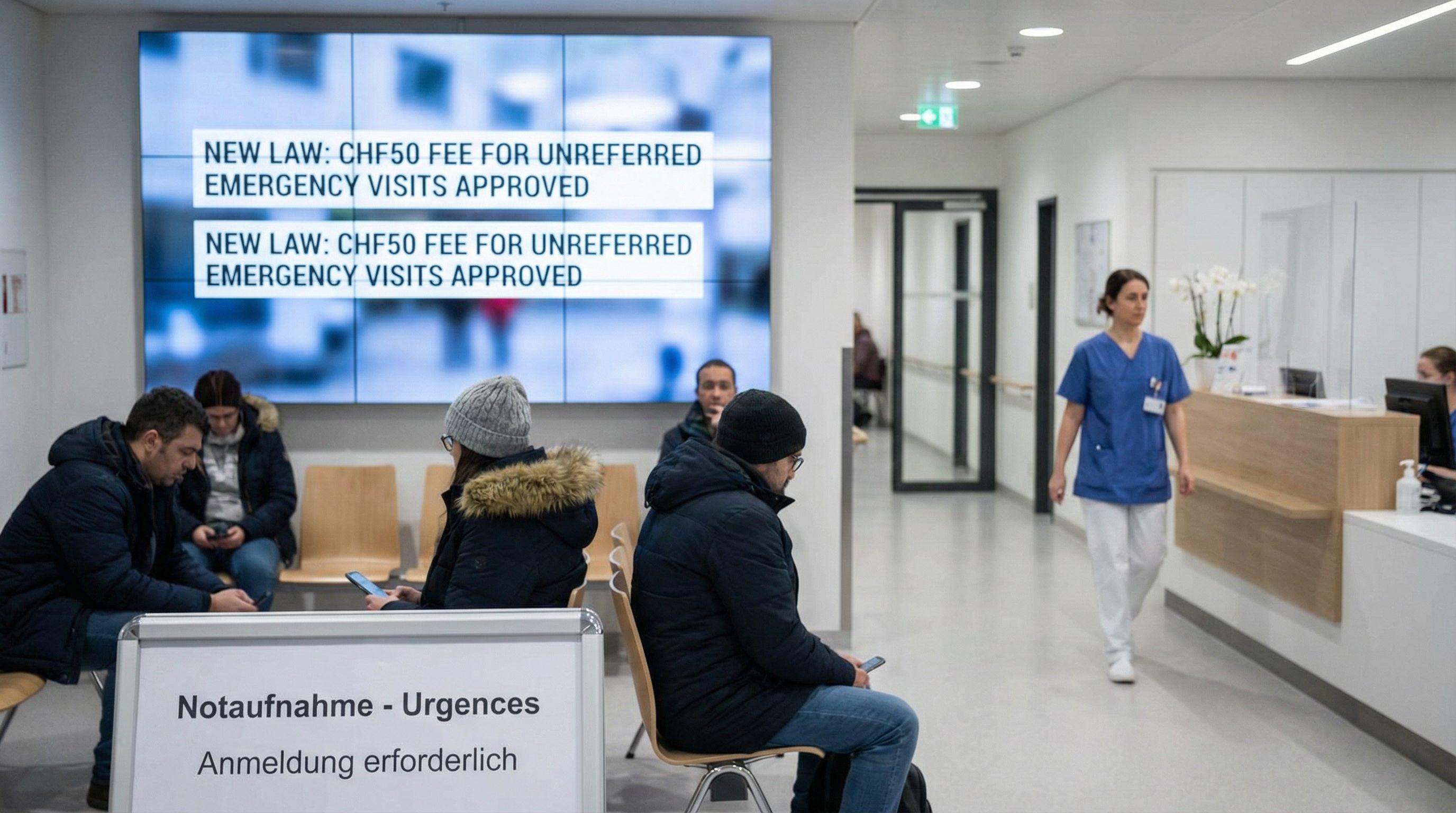
To address rising healthcare costs, the House of Representatives has approved a proposal to charge adults a CHF50 fee for visiting a hospital A&E department without a referral from a doctor, pharmacist, or telemedicine center.
"Absolute bureaucratic monster."
"Personal responsibility is strengthened."
In a decisive move to clamp down on soaring healthcare expenditures, the House of Representatives has officially backed a controversial measure: a CHF50 penalty for unreferred emergency room visits. The proposal passed on Wednesday with a razor-thin margin of 96 votes to 91, signaling a deep divide in Bern. This is not merely a suggestion; it is a legislative strike intended to relieve the crushing pressure on hospital admissions departments across the nation.
Proponents argue this is a critical step toward fiscal sanity. The project aims to curb costs that have spiraled out of control, forcing the hand of lawmakers to implement direct financial disincentives. While the Social Democrats and the Centre Party fought fiercely against the motion, the alliance of the Swiss People’s Party (SVP), Radical-Liberals (FDP), and Liberal Greens (GLP) pushed it through, prioritizing cost control over universal access concerns. The message from the capital is clear: the era of walking freely into an A&E without a gatekeeper is facing an abrupt end.
Under the new regime, adults bypassing the traditional medical hierarchy will face an immediate financial hit. The mandate is simple but strict: present a referral from a doctor, pharmacist, or telemedicine center, or pay CHF50 ($63) out of pocket. This 'incentive tax,' as described by Kris Vietze of the Radical-Liberal Party, is designed to force patients to reconsider whether their ailment truly demands hospital-grade resources.
However, the legislation carves out specific exemptions to protect the most vulnerable. Children and pregnant women are shielded from the fee, as are those referred by outpatient clinics. Yet, for the average adult, the new rule imposes a stark barrier. Patrick Hässig of the Liberal Greens, who championed the proposal, emphasized that the fee targets those who utilize A&E departments unannounced for non-critical issues. By monetizing access, supporters believe they can filter out minor cases that clog the system, though critics warn this simplifies a complex medical reality.
The parliamentary floor erupted in a clash of ideologies, with the opposition branding the fee an administrative nightmare. Sarah Wyss, a Social Democrat from Basel, did not mince words, condemning the proposal as an "absolute bureaucratic monster." The fear is tangible: hospitals, already stretched thin by medical duties, may now be forced to act as tax collectors, verifying referrals and processing payments in high-stress environments.
Conversely, the center-right bloc frames the fee as a triumph of personal accountability. Andreas Glarner of the SVP argued that the measure "strengthens personal responsibility," shifting the burden back onto citizens to utilize the healthcare system rationally. Martin Bäumle of the Liberal Greens dismissed the bureaucratic concerns, framing the bill as a necessary, albeit small, step toward regaining control over the budget. The debate highlights a fundamental fracture in Swiss politics: the tension between administrative efficiency and the principle of barrier-free emergency care.
Despite the parliamentary victory, the proposal faces a wall of resistance outside the Federal Palace. A staggering 87% of participants in the consultation process rejected the fee, a statistic that underscores the public's profound skepticism. Furthermore, 21 out of 26 cantons formally turned it down, signaling a potential implementation disaster at the regional level. Lorenz Hess of the Centre Party highlighted this disconnect, noting that the consultation proved the proposal "would not work."
Even Health Minister Elisabeth Baume-Schneider stands firmly against it, citing six distinct disadvantages. She warns of minimal impact, noting that many patients wouldn't even feel the pinch if they haven't reached their deductible. Worse, she predicts the creation of additional costs if prior medical examinations become mandatory solely to secure emergency authorization. The disconnect between the lawmakers' vote and the experts' advice is glaring, raising questions about the feasibility of a system that the vast majority of stakeholders have already deemed a failure.
The battle is far from over. The proposal now advances to the Senate, where the debate promises to be equally fierce. With the Federal Council rejecting the plan and the Health Minister warning of a lack of standardization—since telemedicine centers currently cannot issue the required written referrals—the logistical hurdles are immense. The current bill allows cantons to introduce the fee voluntarily, a provision that critics label a "special regulation" for Zurich, which supports the measure.
This voluntary nature threatens to fracture the Swiss healthcare landscape, creating a patchwork system where emergency access costs CHF50 in one canton and nothing in the next. As the Senate prepares to deliberate, the stakes are high. Will they uphold the House's push for fiscal discipline, or will the weight of the "bureaucratic monster" and cantonal opposition sink the initiative? The final verdict on the CHF50 fee still hangs in the balance.