AI
Written with AI assistance•3 mars 2026•
In the wake of the tragic New Year's fire in Crans-Montana, the Swiss parliament held a moment of silence and the government offered financial aid to victims. The disaster has also led to a nationwide surge in demand for firefighting equipment.
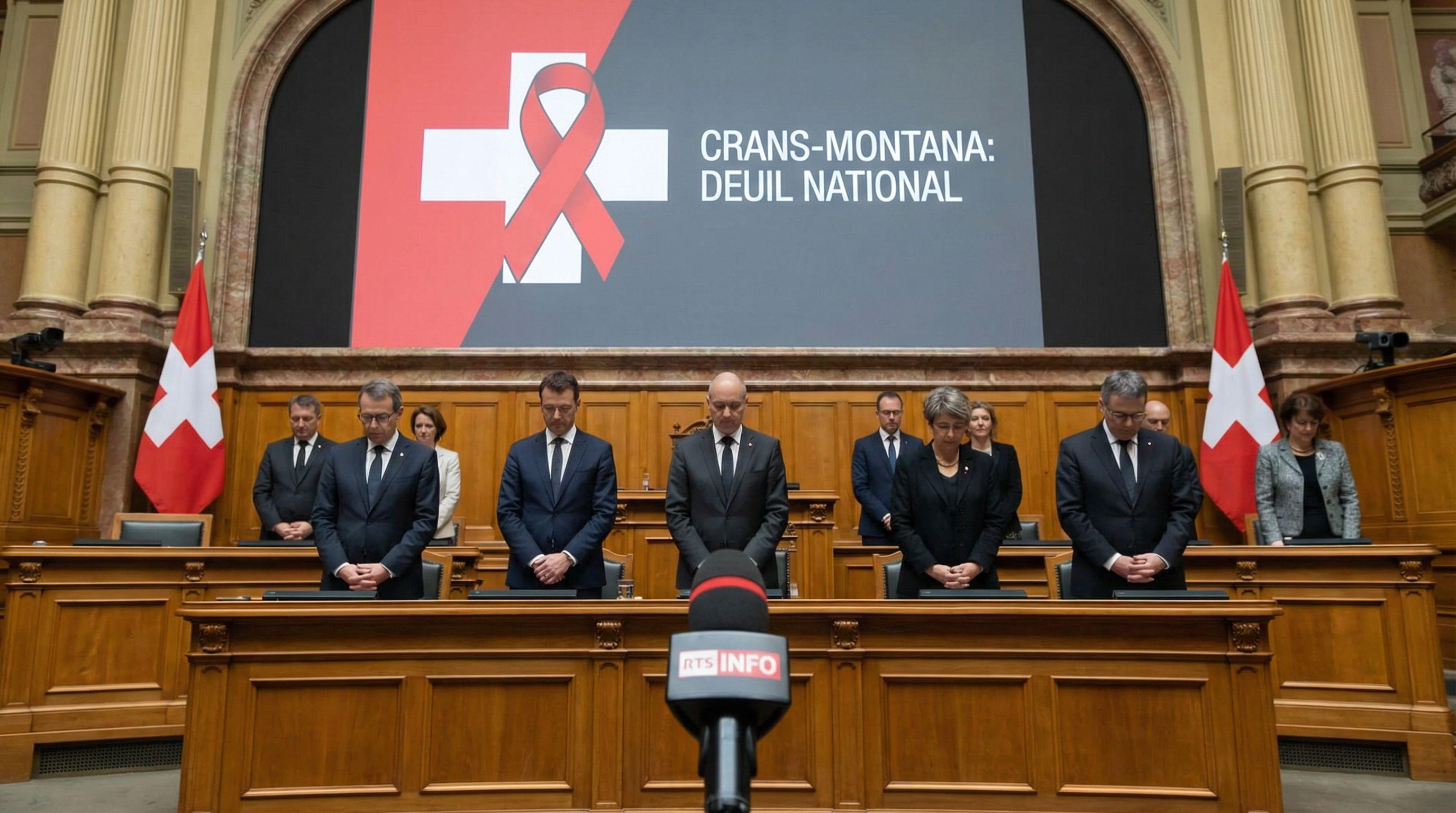
"For them, the world had stood still on New Year’s Eve."
"In an instant, the joy turned into a nightmare. Lives were destroyed, families torn apart, friends lost in misunderstanding and pain."
The silence in Bern was deafening. On March 2, the bustling machinery of Swiss politics ground to a halt as the House of Representatives stood united in grief. Two months have passed since the inferno at the "Le Constellation" bar in Crans-Montana, yet the wound remains raw. The tragedy, which claimed 40 young lives and left over 100 severely injured, has shaken the nation to its core. Pierre-André Page, President of the House, did not mince words: "In an instant, the joy turned into a nightmare."
The toll continues to climb. Just recently, another young man succumbed to his injuries, a grim reminder that this disaster is far from over. As parliamentarians bowed their heads, the message was clear: this is a defining moment for modern Switzerland. The victims had gathered to celebrate the future, but instead, "lives were destroyed, families torn apart," Page declared. This was not merely a ceremonial gesture; it was a mandate. The legislative body is now charged with the heavy burden of ensuring such a catastrophe never repeats, with draft laws to support victims already in motion.
In a decisive break from standard protocol, the Federal Council has authorized an immediate payment of CHF 50,000 to the family of each deceased victim and every seriously injured survivor. This is not a slow-moving insurance payout; it is an urgent "gesture of solidarity" designed to cut through red tape. Federal President Guy Parmelin acknowledged the unimaginable pain of families for whom "the world had stood still on New Year’s Eve."
This level of direct federal intervention is rare. The government cited historical precedents like the 1997 Luxor attack and the 2004 Tsunami to justify the extraordinary measure. Justice Minister Beat Jans categorized the fire as a "tragedy of extraordinary proportions," necessitating a response that goes beyond existing support mechanisms. To ensure the cash flows immediately, the cabinet has adopted an urgent federal law, bypassing the usual legislative crawl. Parliament is expected to rubber-stamp the funding this March session. While money cannot replace the lost, this rapid financial mobilization signals that the state intends to stand shoulder-to-shoulder with the bereaved.
Fear has triggered a massive behavioral shift across the country. Swiss homeowners are rushing to secure their properties, driving an unprecedented surge in demand for fire safety equipment. The statistics are staggering: Digitec Galaxus, the nation's largest online retailer, reports selling nearly five times as many fire extinguishers compared to the same period last year. This is not a subtle uptick; it is a market explosion.
The data paints a picture of a population on edge. Sales of fire alarms have jumped 2.5 times, while general firefighting products have more than tripled. Physical retailers are seeing the same frenzy. Bauhaus recorded a 140% spike in sales for extinguishers and smoke detectors, while Jumbo reports figures two to three times higher than 2025. The Crans-Montana disaster, coupled with reports of lax regulations and flammable soundproofing, has shattered the illusion of safety. The Swiss public is no longer waiting for inspectors; they are taking survival into their own hands, stripping shelves bare in a desperate bid to prevent the next tragedy.
Mourning and preparation are only part of the equation; the Swiss people demand accountability. The narrative of the "Le Constellation" fire is riddled with accusations of negligence, from DIY renovations to the use of highly flammable materials. Pierre-André Page emphasized that the judiciary must now "establish responsibility in complete independence." This investigation is critical not just for the victims, but for the integrity of Swiss institutions.
"Without truth, there can be no lasting trust," Page warned. The pressure is on the authorities to deliver a transparent and unflinching verdict. As the federal government convenes round tables to facilitate out-of-court solutions, the message is stark: there will be no cover-ups. The disaster has exposed potential cracks in our federalist crisis response and safety inspection protocols. As the snow melts in Crans-Montana, it reveals a landscape that has changed forever—one where safety is no longer assumed, but aggressively enforced.