AI
Written with AI assistance•3 juillet 2025•
Japanese Beetle Alert: New Invasive Threat to Swiss Agriculture
Federal authorities issue nationwide warning as destructive Japanese beetles spread in Valais and Ticino regions
Federal authorities issue nationwide warning as destructive Japanese beetles spread in Valais and Ticino regions
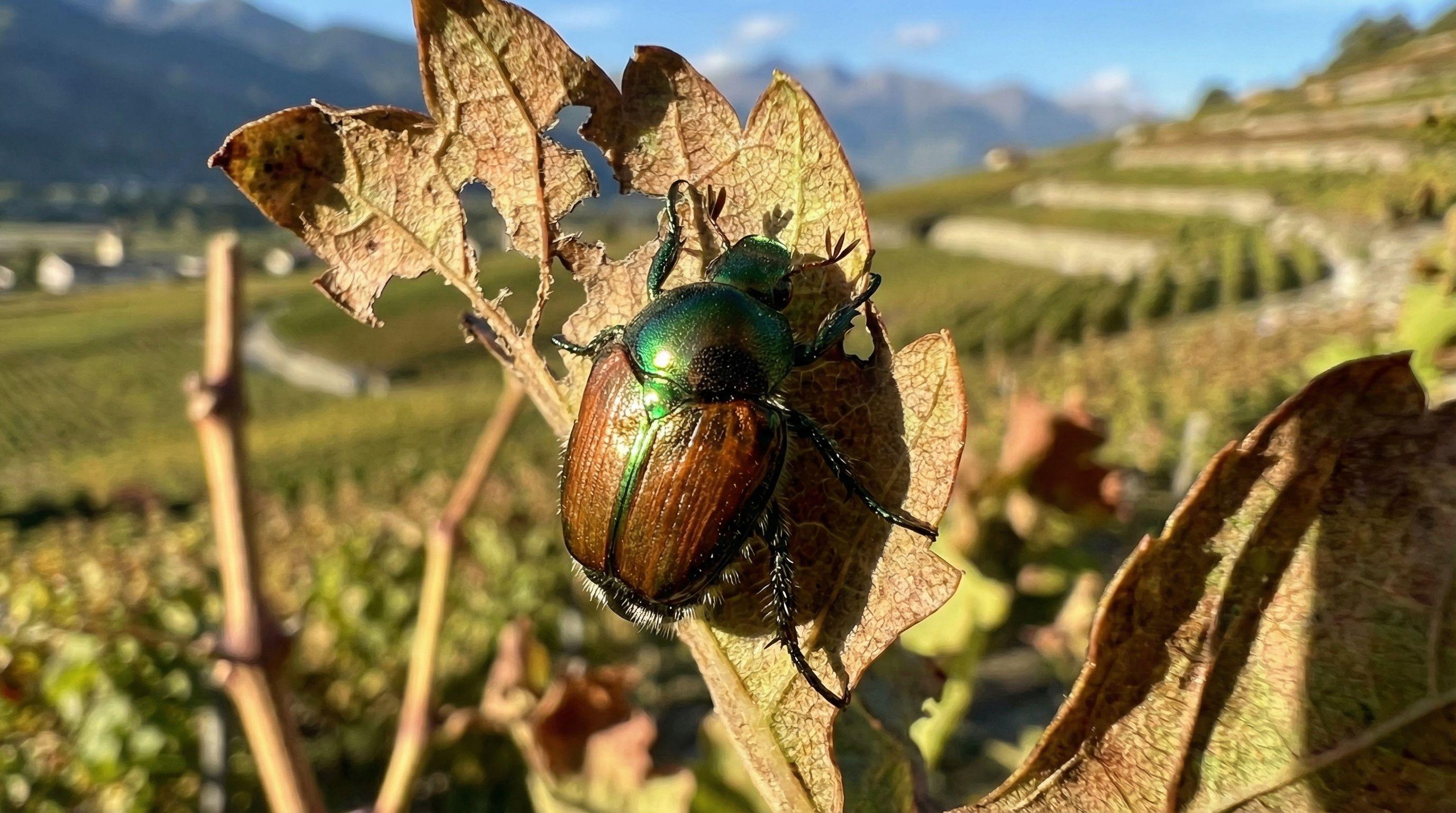
"The beetles could be transported as 'stowaways' over long distances in cars and trains and become dangerous in other regions of Switzerland."
Federal authorities have sounded the alarm on a critical agricultural threat: the Japanese beetle is advancing across Switzerland. On Thursday, July 3, 2025, the Federal Office for Agriculture (FOAG) issued an urgent nationwide warning, marking a significant escalation in the battle against this invasive pest. The situation is dire in the southern cantons; authorities now admit that in specific zones of Valais and Ticino, the prospect of eradicating the beetle has completely vanished. This admission signals a shift from total prevention to desperate containment in these regions.
The threat is not static. These pests are hitchhiking across the country, utilizing Swiss infrastructure to expand their territory. The FOAG warns that the beetles are travelling as "stowaways" in cars and trains, crossing cantonal borders with alarming ease. This mobility transforms a regional issue into a national crisis, as a beetle hopping onto a train in Lugano can wreak havoc in Zurich within hours. The government's message is clear: vigilance is no longer optional—it is a necessity for the protection of Swiss biodiversity.
The FOAG demands immediate action from the public, effectively deputizing citizens in the fight against this biological invader. Passive observation is insufficient; the government has issued a strict protocol for anyone who encounters a suspicious insect. If you spot a beetle, you must capture it immediately. The directive is precise: freeze the specimen, photograph it for verification, and report it to the relevant cantonal plant protection service without delay.
Identification is key to this civilian defense strategy. The Japanese beetle is distinct, recognized primarily by the tell-tale white tufts of hair lining both sides of its abdomen—a marking that separates it from native species. Travelers are under particular scrutiny. The authorities urge everyone to meticulously check luggage and vehicles when moving between regions. A single overlooked beetle in a car trunk could spark a new infestation in a previously clear canton. This is a call to arms for every resident and tourist: your vigilance is the first line of defense.
A staggering 400 plant species are now in the crosshairs of this voracious predator. The Japanese beetle is not a picky eater; it consumes leaves, flowers, and fruit with devastating efficiency, posing a catastrophic risk to Swiss agriculture and horticulture. From the renowned vineyards of Valais to private gardens in Zurich, no green space is safe. The damage is twofold and relentless: while adults decimate foliage above ground, their larvae are silently destroying grass roots beneath the soil.
This subterranean assault jeopardizes green spaces of all kinds, turning lush pastures into dead zones. The economic implications are profound. Farmers face the potential destruction of high-value crops, while municipalities grapple with the degradation of public parks. The federal government has classified the animal as a direct threat to the environment, underscoring the severity of the situation. We are not merely dealing with a nuisance; we are confronting an organism capable of destabilizing entire local ecosystems.
To halt this advance, the government has triggered a robust new emergency plan. This strategy coordinates the efforts of the Confederation and the cantons, establishing a unified front against outbreaks. While Valais and Ticino face containment scenarios, active eradication battles are raging in Basel, Schwyz, and Zurich. The measures are aggressive and multifaceted, designed to break the beetle's lifecycle at every stage.
The plan deploys a combination of surveillance and direct intervention. Authorities are monitoring populations with traps and treating infested areas with insecticides. To target the larvae, tillage of the soil is being employed to physically disrupt their development. Furthermore, the government is making environmental conditions hostile for the pest, including the implementation of irrigation bans to hinder larval survival. This is a total war on an invasive species, utilizing every tool available to protect Switzerland's agricultural heritage from irreversible damage.