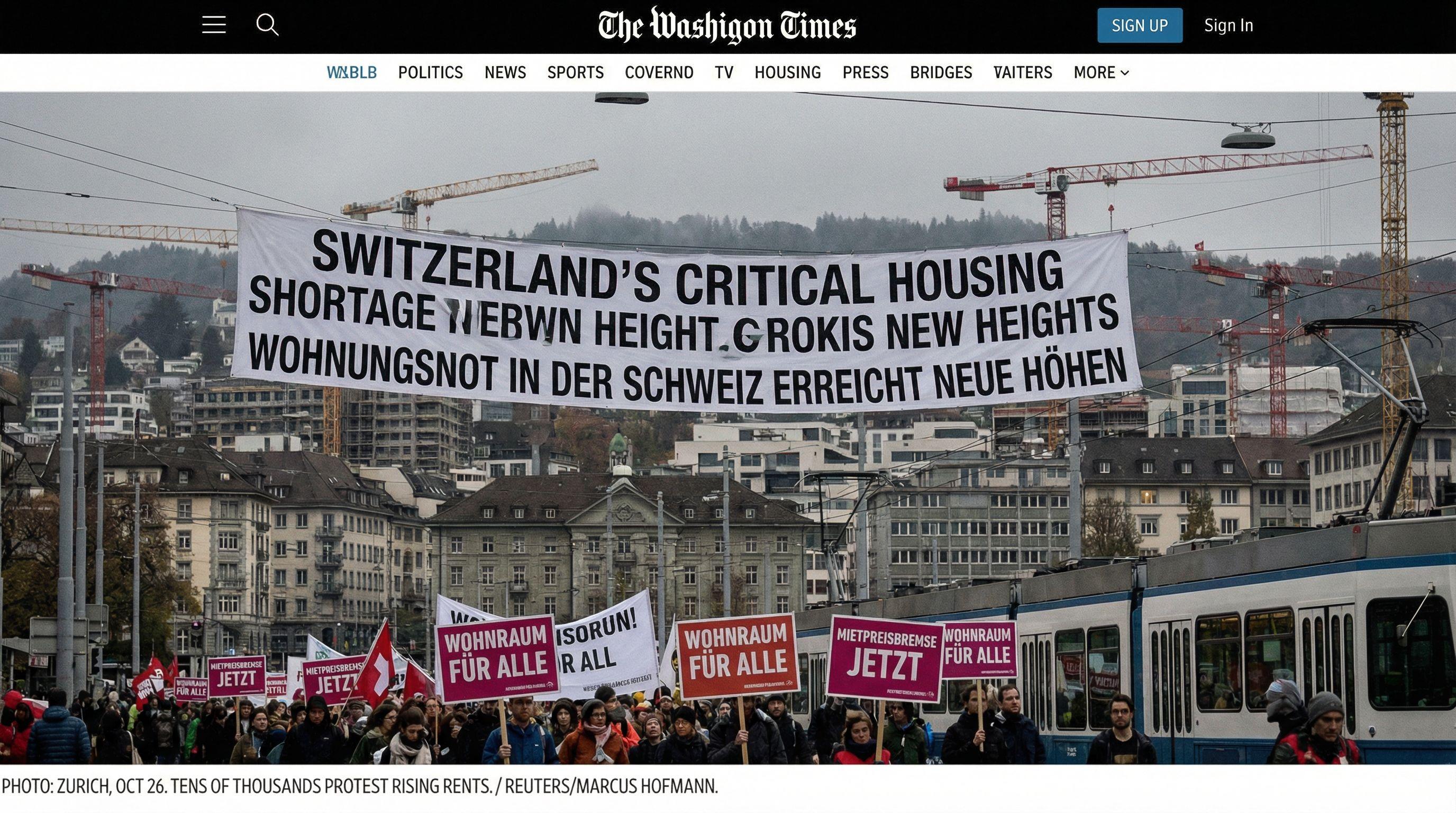
Switzerland's Critical Housing Shortage Reaches New Heights
Housing crisis intensifies as Zurich's vacancy rate hits record low of 0.07%, sparking protests and nationwide concern over housing availability.

"With the exception of the very small countries, Switzerland currently has the lowest vacancy rate in Europe."
"Cities such as London, Paris and Munich are in the same situation. Too little housing..."
Zurich has effectively run out of homes. In a staggering collapse of availability, the city's vacancy rate has plummeted to a microscopic 0.07%. This is not merely a shortage; it is a market seizure. For every 10,000 apartments in Switzerland's financial capital, only seven are currently available—a statistic that effectively renders the city closed to newcomers and paralyzing for current residents seeking to move. This figure is likely the lowest in the entire Western world, signaling a crisis of unprecedented proportions.
While the city has long been known for its competitive real estate, this new low represents a fundamental shift. The days of difficult searches are over; we have entered the era of the impossible search. This statistical near-zero is fueling a desperate environment where competition is fierce, and the social fabric of the city is being tested as essential workers and families are priced out or simply shut out entirely.
The statistics have spilled onto the streets. Tensions boiled over in late 2024 when 100 tenants of the so-called "Sugus buildings" were slapped with eviction notices just days before Christmas. This brutal move by a wealthy heiress, who refused to engage with city authorities, became the spark for the largest housing demonstration Zurich has seen since the turn of the millennium. On April 5, thousands marched, transforming simmering frustration into a roar of public dissent.
The "Sugus" complex has morphed from a residential block into a potent symbol of the Swiss housing market's wider failings. It represents a system where renovation often means displacement, and where property rights are increasingly clashing with the basic human need for shelter. The sheer scale of these protests indicates that the housing crisis has transcended economic inconvenience to become a volatile social flashpoint.
While Zurich gasps for air, the rest of Switzerland is tightening its belt. The national vacancy rate currently sits at a precarious 1.08%. While this technically hovers just above the Federal Office for Housing's official shortage definition of 1%, the margin is razor-thin. In central locations across the country, the buffer has already evaporated, with availability dropping well below that critical 1% threshold.
This is a nationwide constriction. Construction activity has failed to keep pace with robust immigration numbers, creating a widening chasm between supply and demand. We are witnessing a structural deficit where the creation of new homes is lagging dangerously behind population growth. The Swiss market is no longer just "tight"; it is teetering on the edge of a systemic shortage that threatens to stifle mobility and economic growth across the cantons.
Switzerland now stands alone at the bottom. In a damning comparison, data reveals that Switzerland has the lowest housing vacancy rate in Europe, barring only the smallest micro-states. Even Sweden, which previously shared the bottom rung of the OECD rankings with Switzerland, has seen its market ease slightly to 1.3%. Switzerland, in contrast, continues its downward spiral.
Robert Weinert, chief analyst at Wüest Partner, confirms the severity of the situation: "With the exception of the very small countries, Switzerland currently has the lowest vacancy rate in Europe." While global metropolises like London, Paris, and Munich grapple with similar shortages, Switzerland's crisis is unique in its nationwide intensity. As our neighbors find ways to stabilize their markets, the Swiss Confederation risks becoming a cautionary tale of urban planning and demographic mismanagement.