Finance
Switzerland's Role in Magnitsky Case Under Scrutiny as Millions are Transferred Abroad
As the Parliamentary Assembly of the Council of Europe prepares a resolution critical of Switzerland's handling of the Magnitsky affair, investigations reveal that millions of dollars linked to the fraud case have recently been wired out of Swiss bank accounts.
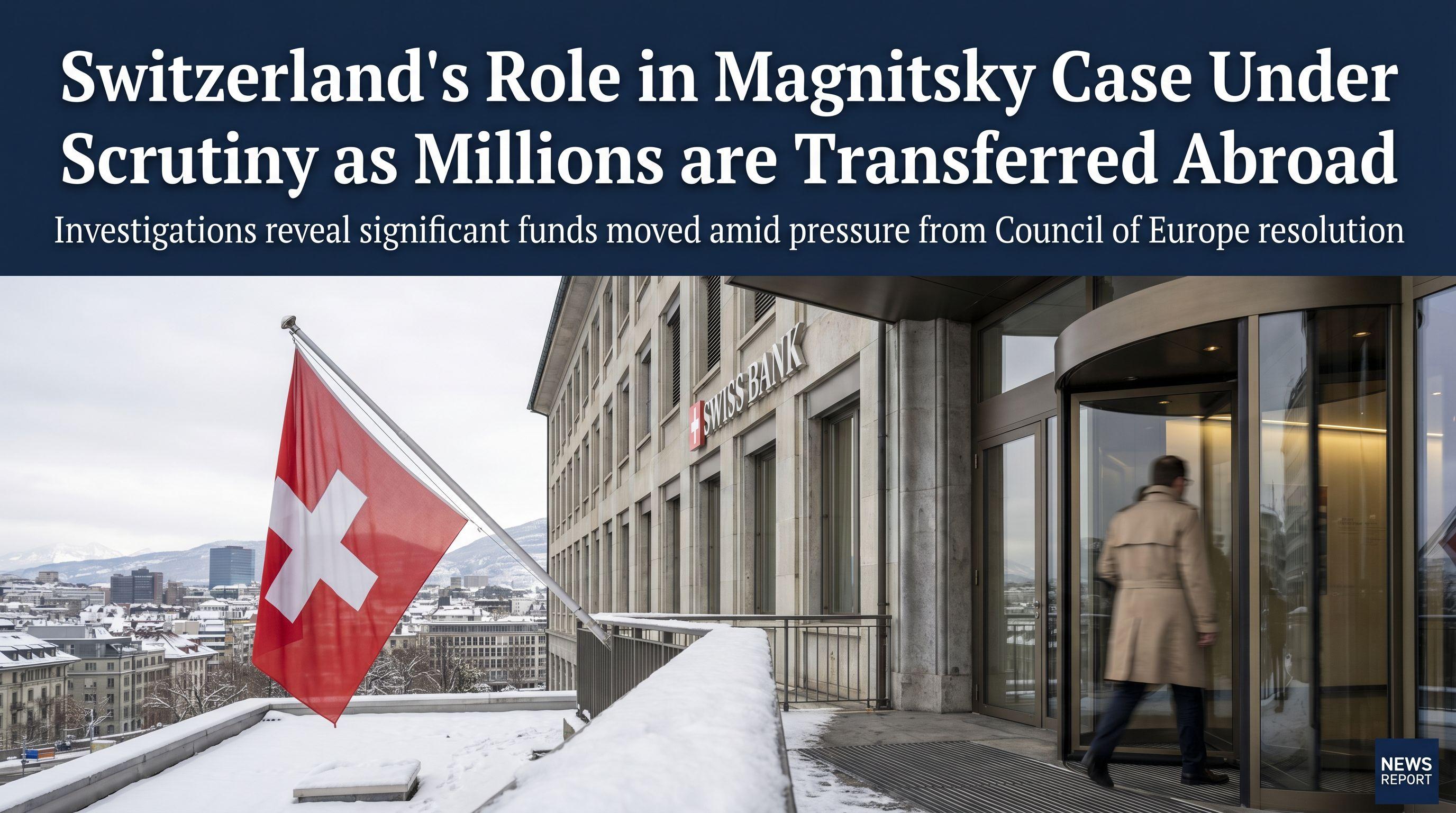
Switzerland Faces Global Rebuke as Millions Vanish
A staggering $230 million fraud case that began in the heart of Moscow has returned to haunt the Swiss Confederation. As the Parliamentary Assembly of the Council of Europe (PACE) prepares to vote on a resolution that could shatter Switzerland’s reputation for legal integrity, the nation's justice system finds itself under fire. The Magnitsky affair—a vast cross-border money-laundering operation—is no longer just a historical footnote; it is a live wire. While Swiss prosecutors closed the case four years ago, international observers are sounding the alarm, questioning whether the Alpine nation has become a safe harbor for illicit Russian capital. The stakes are unprecedented, moving beyond mere frozen funds to the very heart of how Switzerland applies international legal standards in the face of global corruption.
The Great Escape: How CHF 6 Million Slipped Through UBS
More than CHF 6 million has surged out of Swiss bank accounts at UBS and Edmond de Rothschild, bypassing the reach of federal investigators. In February 2026 alone, Denis Katsyv—a Russian citizen linked to the $230 million tax fraud uncovered by the late Sergei Magnitsky—wired approximately CHF 5.5 million to personal accounts in Israel and Armenia. This exodus of capital occurred despite the Swiss Federal Court previously ruling that the method used to calculate 'contaminated' funds was flawed. While Katsyv was originally ordered to forfeit a mere 1% of his holdings—a paltry $78,000—he successfully moved nearly 99% of his assets abroad before the authorities could recalculate the seizure. The timing is alarming: the transfers took place just weeks after a landmark court ruling that should have triggered an immediate freeze.
Constitutional Crisis Hits the Attorney General
The Swiss Federal Court has delivered a crushing blow to the Office of the Attorney General (OAG), declaring its handling of the Magnitsky funds 'unconstitutional.' In a ruling that has sent shockwaves through the legal community, the court found that the OAG’s formula for determining which funds were derived from criminal activity lacked a legal basis. This failure allowed individuals tied to the fraud to retain control over the vast majority of their assets. Legal experts, including Zurich-based lawyer Thomas Rihm, argue that the OAG had a 'legal duty' to sequester these assets following the court's decision. Instead, the lack of immediate action created a vacuum that allowed the capital to flee. This procedural negligence may now expose the Swiss Confederation to strict state liability, as the chance to recover these funds has likely vanished into the offshore ether.
Strasbourg Demands Accountability in the Magnitsky Shadow
Pressure is mounting in Strasbourg as PACE prepares to vote on a resolution that openly criticizes Switzerland’s 'controversial' response to the Magnitsky case. Though PACE resolutions are non-binding, they carry immense political weight, shaping the international debate on the rule of law. The draft resolution, approved unanimously by the Committee on Legal Affairs and Human Rights, demands to know why a case involving such massive corruption was shuttered by Swiss officials while other jurisdictions continued their pursuit. Switzerland, a member of the Council of Europe, now finds itself in the uncomfortable position of defending its judicial independence against accusations of being soft on money laundering. The resolution raises a piercing question: is the Swiss justice system still in line with international norms, or has it diverged to protect its financial sector?
A Reputation on the Brink: The Cost of Inaction
The implications of this failure extend far beyond the CHF 6 million that recently departed Swiss shores. Switzerland now grapples with a dual crisis: a domestic legal failure and an international diplomatic fallout. If the OAG cannot prove it can effectively freeze and confiscate assets linked to global corruption, the nation risks being sidelined in the international financial system. The Magnitsky case has become a litmus test for the 'New Switzerland'—a country that claims to have moved past its era of banking secrecy. However, as millions are wired to Israel and Armenia under the nose of the Attorney General, that claim looks increasingly fragile. Moving forward, the Swiss Parliament must confront whether current laws provide the OAG with the teeth necessary to act, or if the system is designed to allow the powerful to walk away with their spoils.