AI
Written with AI assistance•2. Januar 2026•
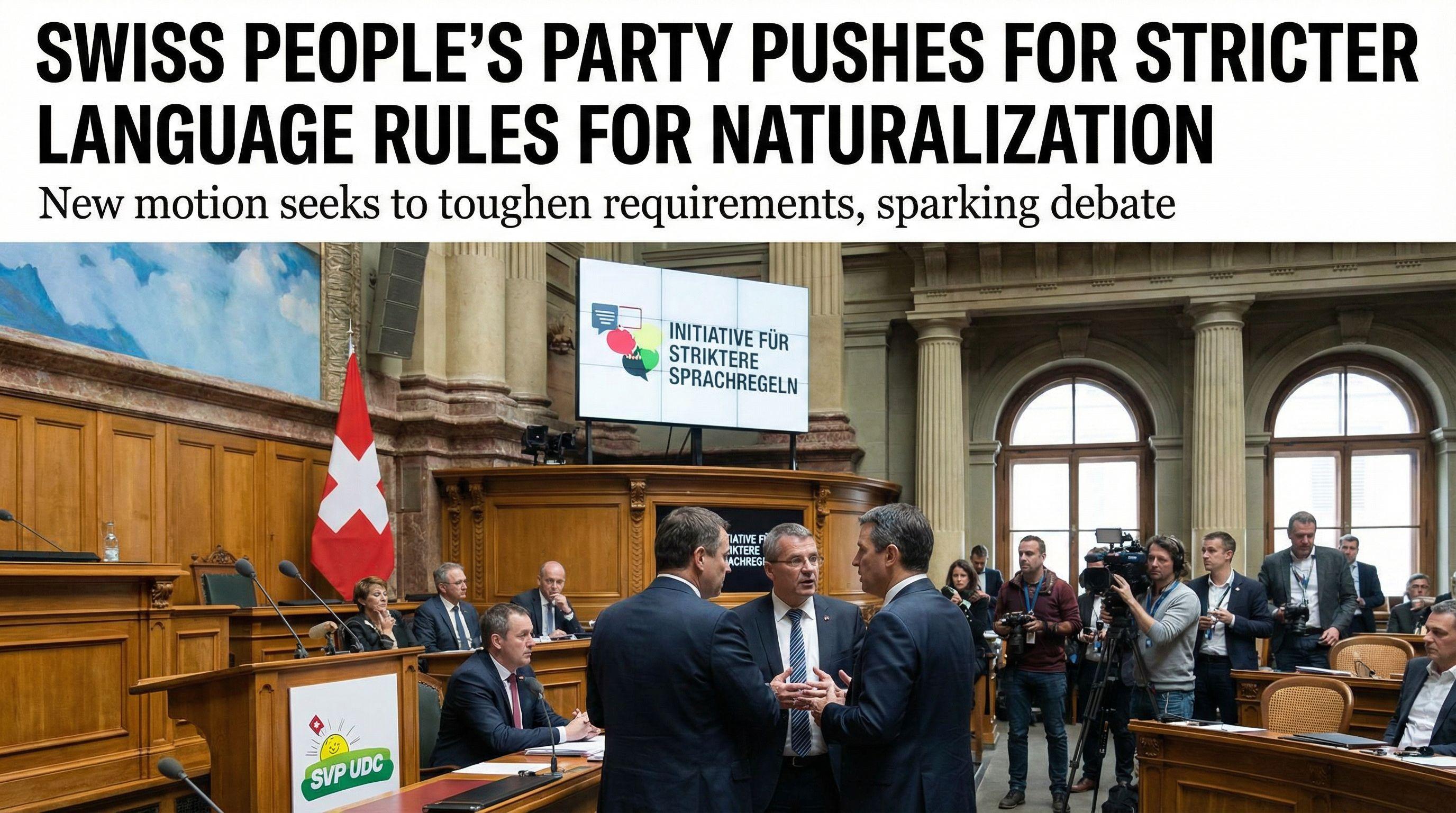
A new political motion tabled by the Swiss People's Party (SVP/UDC) seeks to significantly toughen the language requirements for applicants seeking Swiss citizenship, sparking a new debate on integration and national identity.
"Naturalisation should confirm successful integration — and that includes a degree of linguistic autonomy."
"Tougher standards risk discriminating against people with weaker educational backgrounds who find it hard to reach language levels."
The path to becoming Swiss is poised to become significantly steeper. In a bold move that strikes at the heart of national identity, the Swiss People's Party (SVP/UDC) has tabled a motion to drastically tighten the linguistic screws on citizenship applicants. The party is demanding a surge in proficiency standards, pushing for a mandatory B2 level in oral communication and B1 in written skills. This represents a stark escalation from the current federal baseline, which requires B1 for speaking and a mere A2 for writing.
This is not a minor adjustment; it is a fundamental shifting of the goalposts. Under the Common European Framework of Reference for Languages, the leap to B2 signifies moving from 'routine interaction' to complex, spontaneous fluency. The SVP argues that the current bar is set dangerously low, allowing applicants to slip through the cracks without true linguistic autonomy. With the political machinery now in motion, thousands of hopeful residents face the prospect of a much harder climb to secure the coveted red passport.
Jean-Luc Addor, the National Councillor spearheading this motion, is unequivocal: naturalization must be the crown jewel of integration, not a participation trophy. Addor contends that officials are encountering persistent, alarming gaps in the language skills of new citizens. The SVP's stance is clear—if you want to be Swiss, you must speak like one. They argue that with a residency requirement spanning 10 years, applicants have more than a decade to master the local tongue.
However, this demand for 'linguistic autonomy' raises a critical question: What defines a well-integrated citizen? While the SVP insists on higher academic fluency, the reality on the ground is often different. Current rules focus on the ability to manage everyday life—talking to neighbors, navigating bureaucracy, and working. By demanding B2 oral skills, the SVP is effectively asking for a level of proficiency that allows for technical discussions and abstract argumentation, a standard that shifts the focus from functional integration to cultural assimilation.
Opposition to the motion is fierce and immediate. Nadra Mao of the Initiative for Democracy condemns the proposal as a discriminatory hurdle that disproportionately targets the working class. Critics argue that raising the bar to B2/B1 privileges those with higher education while punishing hardworking residents who may excel in their jobs and communities but struggle with academic grammar.
Switzerland already grapples with a complex linguistic landscape, balancing four national languages. Mao points out the irony that many born-and-bred Swiss citizens possess limited competence outside their own linguistic region. By enforcing a standard that exceeds the daily requirements for dealing with schools, employers, and authorities, the SVP risks creating a two-tier system where citizenship becomes a luxury for the academically inclined rather than a right for the well-integrated. The fear is palpable: this isn't just about language; it's about narrowing the gate to Swiss society.
If this motion passes, Switzerland will vault past its European neighbors to establish some of the continent's most stringent naturalization criteria. Currently, Germany, Italy, Austria, and France generally align on a B1 requirement for both spoken and written skills. The SVP's proposal to demand B2 for oral proficiency would place Switzerland in a league of its own, demanding a level of fluency that surpasses the European norm.
While neighboring nations focus on the B1 'threshold'—sufficient for independent living—the SVP wants Switzerland to push the hurdle higher. This move reinforces the country's reputation for having one of the toughest naturalization processes in the world. As Parliament prepares to debate this contentious issue, the message to potential citizens is loud and clear: in Switzerland, 'good enough' is no longer enough. The definition of what it means to be Swiss is being rewritten, and the ink is drying fast.