Novartis
Novartis CEO Joins AI Firm Anthropic's Board, Signaling Pharma's Tech Pivot
Vasant Narasimhan, CEO of Swiss pharma giant Novartis, has been appointed to the board of AI company Anthropic. The move signals a strategic deepening of the ties between the pharmaceutical industry and the world of artificial intelligence, with major implications for future drug development.
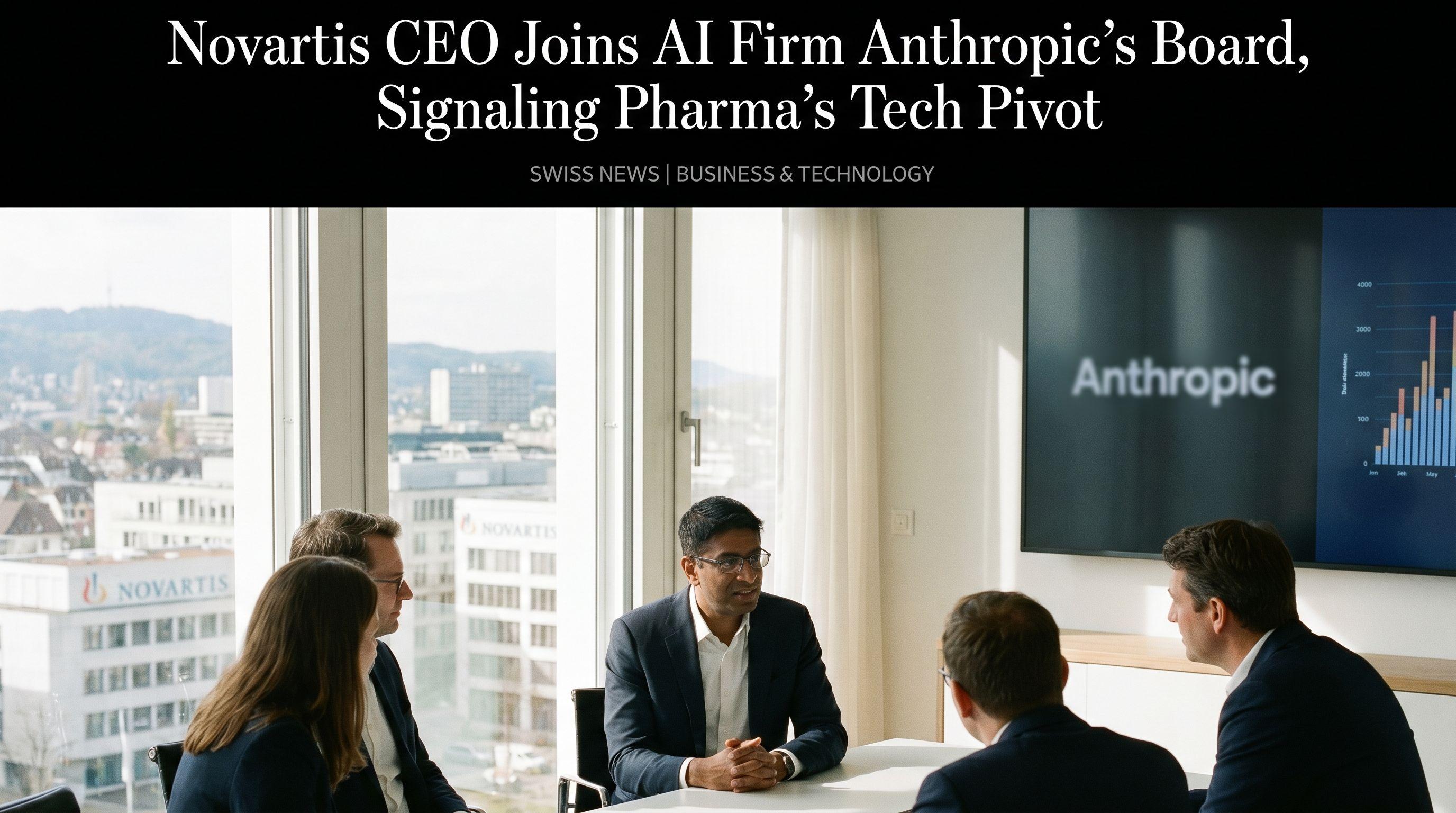
The Power Move: Novartis CEO Bridges the Silicon Divide
Vasant Narasimhan is shattering the traditional boundaries of corporate governance. By joining the board of Anthropic, the CEO of Novartis—a titan with a market cap exceeding CHF 200 billion—is signaling that the future of medicine is no longer written in test tubes, but in code. This isn't just a side hustle; it is a calculated strike. For the first time in his career, Narasimhan is stepping onto an external board, and he is doing so at a company that many view as the primary challenger to OpenAI. The move underscores a radical shift: Big Pharma is no longer just a customer of AI; it is becoming an architect of the technology itself. As drug discovery costs skyrocket and patent cliffs loom, the integration of Anthropic’s 'Claude' models into the Novartis R&D pipeline could shave years off development timelines. This partnership places Switzerland at the absolute epicenter of the global tech-pharma convergence, proving that Basel’s old-world expertise and San Francisco’s new-world disruption are now inseparable.
Zurich’s Gold Rush: Salaries Soar to CHF 680,000
Anthropic is not just visiting Zurich; it is colonizing the local talent market with staggering financial firepower. The company is offering annual salaries reaching a jaw-dropping CHF 680,000 for top-tier AI specialists. This aggressive recruitment strategy is sending shockwaves through the Swiss tech ecosystem, where even senior banking engineers rarely see such figures. Since establishing its Zurich hub in late 2024, Anthropic has made it clear that it will outspend and outmaneuver any competitor to secure the minds capable of building the next generation of Large Language Models. This 'brain drain' poses a critical challenge to local startups and academic institutions like ETH Zurich, who now find themselves competing against a Silicon Valley behemoth with seemingly bottomless pockets. The message to the Swiss workforce is loud and clear: if you speak the language of algorithms, you are currently the most valuable commodity in the country. This influx of capital and talent is transforming Zurich from a financial fortress into a global AI powerhouse, rivaling London and Berlin.
The $400 Million Gamble: AI Swallows Biotech
The acquisition of Coefficient Bio for a staggering $400 million (CHF 312 million) marks Anthropic’s definitive pivot from general-purpose AI to specialized healthcare dominance. This is a predatory expansion into the 'wet lab' space. By absorbing a biotech startup, Anthropic is no longer just predicting text; it is predicting protein folding, molecular interactions, and clinical outcomes. This move, coupled with Narasimhan’s appointment, suggests that Anthropic is positioning itself for a massive Initial Public Offering (IPO) as early as this year. The market is watching closely as the company transitions from a research lab into a commercial juggernaut capable of disrupting the $1.5 trillion global pharmaceutical industry. While Roche races to power up its own supercomputers, Anthropic’s acquisition strategy indicates that the fastest way to win the AI race is to buy the biological data at its source. The synergy here is undeniable: Anthropic provides the 'brain,' and the biotech acquisition provides the 'body' for experimental validation.
Guardians of the Mission: The Long-Term Benefit Trust
Anthropic operates under a governance model that is as radical as its technology: the Long-Term Benefit Trust. This independent body is designed to act as a 'kill switch' for corporate greed, ensuring that the company’s mission to develop safe AI remains untainted by short-term shareholder pressure. Narasimhan joins a board that includes heavyweights like Chris Liddell, former Microsoft executive and White House official. This seven-member council holds the power to veto decisions that compromise safety or ethics. In an era where AI safety is a matter of national security, this structure provides a unique layer of protection that appeals to Swiss sensibilities regarding stability and long-term planning. However, the tension is palpable: how does a company maintain a 'benefit trust' while simultaneously gearing up for a multi-billion dollar IPO? Narasimhan’s experience navigating the heavily regulated pharmaceutical world will be vital as Anthropic attempts to balance these altruistic goals with the cutthroat demands of the public markets.
Swiss Sovereignty in the Age of Algorithms
The implications for Switzerland are profound. As Novartis deepens its ties with Anthropic, the nation’s economic identity is undergoing a forced evolution. We are witnessing the birth of 'Bio-Digital Switzerland.' This pivot ensures that the Swiss pharma sector—responsible for nearly 40% of the country's exports—remains competitive against emerging tech hubs in China and the US. However, this reliance on American-made AI platforms like Anthropic raises critical questions about digital sovereignty. While the Zurich office brings jobs and prestige, the core intellectual property remains in the hands of a US-based entity. Switzerland must now decide if it is content being the world’s premier laboratory for foreign AI, or if it will invest in its own sovereign infrastructure. For now, the Narasimhan-Anthropic alliance is a bold bet that the future of Swiss prosperity lies in the marriage of Basel’s chemistry and Zurich’s compute. The race is on, and the stakes have never been higher.