AI
Written with AI assistance•6. Januar 2026•
Major US corporations, including Microsoft and McKinsey, are paying up to $1 million each to sponsor a 'USA House' venue at the World Economic Forum in Davos, designed to support US government officials during President Donald Trump's upcoming visit.
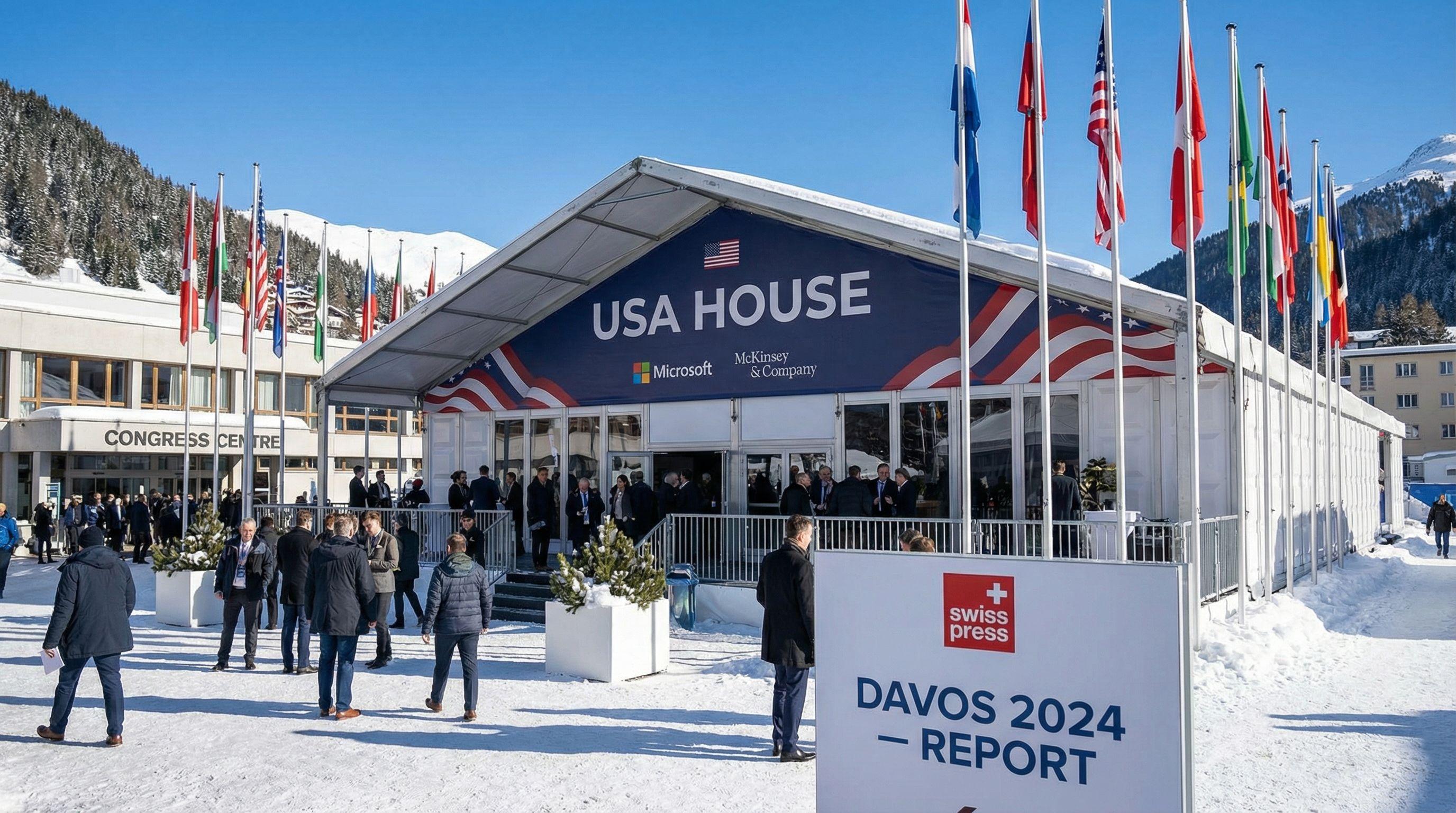
"support the US delegation in Davos"
"Burning Man for billionaires"
Corporate America is doubling down on Davos with a staggering $1 million (CHF 790,000) price tag for access. In a bold move to align with the incoming administration, industry giants Microsoft and McKinsey, alongside cryptocurrency disruptor Ripple, are paying up to seven figures each to bankroll the 'USA House.' This isn't just a sponsorship; it is a calculated purchase of proximity to power. As President Donald Trump prepares for his first in-person WEF appearance in six years, these corporations are seizing the opportunity to get their brands directly in front of global decision-makers.
The sheer scale of this investment signals a dramatic shift in corporate strategy. While JPMorgan Chase has also been approached, the confirmed lineup suggests a diverse coalition of tech, consulting, and finance eager to secure their footing. The venue, explicitly designed to 'support the US delegation,' operates with a clear mandate: bridge the gap between private enterprise and the new administration's inner circle. This financial surge underscores a critical reality—in the high-stakes environment of Davos, access is the ultimate currency, and the price of admission has never been higher.
A 19th-century church is transforming into the epicenter of American power, orchestrated by a man who once envisioned a 'Burning Man for billionaires.' The English Church, founded in the 1880s and sitting just outside the WEF's security perimeter, will serve as the physical vessel for this high-stakes networking. At the helm is Richard Stromback, a former ice hockey player turned investor, whose reputation for throwing Davos's most exclusive parties is legendary. His involvement guarantees that this will not be a standard diplomatic outpost.
The contrast is jarring and deliberate. While the venue is a place of worship, the atmosphere promises to be electric, blending strict security protocols with high-end networking. Stromback's vision turns the traditional 'house' model on its head, creating a privately organized enclave that—while officially claiming it 'does not represent the US government'—will undoubtedly serve as its de facto headquarters. By draping the historic stone structure in memorabilia celebrating the 250th anniversary of the Declaration of Independence, the organizers are creating a visual and symbolic fortress that stands apart from the globalist tone of the main forum.
The agenda for USA House is unapologetically nationalist, signaling a sharp departure from the WEF's traditional globalist rhetoric. With themes like 'peace through strength' and 'faith-based initiatives,' the programming mirrors the core tenets of the Trump doctrine. Perhaps most telling is the inclusion of 'digital assets & economic resilience'—a nod to sponsor Ripple and the administration's growing interest in cryptocurrency. This is a platform built to amplify a specific vision of American dominance, one that prioritizes 'liquid gold' fossil fuels over the Paris climate accord.
Trump's return to the Swiss Alps is poised to be disruptive. His last appearance was a virtual address that blasted climate agreements; this year, his physical presence brings the weight of policy intervention, particularly regarding Venezuela and oil markets. While the official WEF theme pleads for 'a spirit of dialogue,' the USA House stands as a bastion of unilateral strength. The juxtaposition is stark: while the rest of Davos discusses cooperation, this hub is laser-focused on American economic resilience and the projection of power, effectively creating a rival center of gravity within the resort town.
The rise of the USA House exemplifies a fracturing of the Davos model, where the real action increasingly shifts from the Congress Centre to privatized enclaves. This 'house' system—where nations like Saudi Arabia, Belgium, and now the US corporate sector rent out local shops and hotels—is reshaping the landscape of the forum. For Switzerland, the host nation, this fragmentation presents a complex challenge. The WEF is already grappling with an identity crisis and recent scandals, fighting to prove its relevance in a polarized world.
As corporations and nations build their own fortresses along the promenade, the unified 'Davos Spirit' is diluting into competing spheres of influence. The USA House is the most aggressive manifestation of this trend yet—a privately funded, corporate-backed diplomatic zone that operates by its own rules. For the Swiss public and local authorities, this means navigating heightened security protocols and an even denser concentration of power in an already crowded valley. The World Economic Forum may technically be the host, but with millions flowing into satellite venues like the English Church, the center of gravity is undeniably shifting away from the main stage.