AI
Written with AI assistance•12. März 2025•
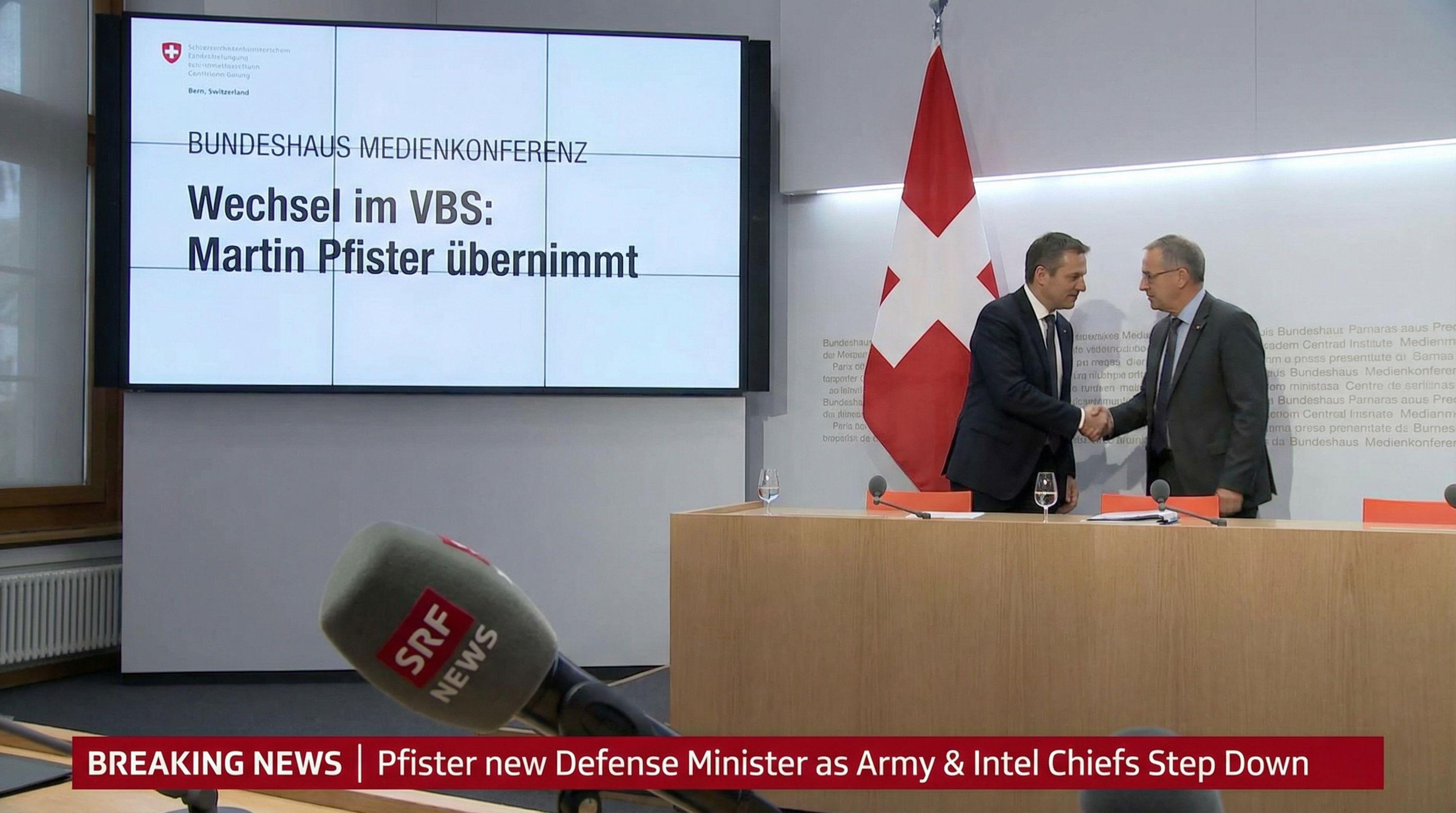
Switzerland faces significant leadership transition as new Federal Council member Martin Pfister inherits defense ministry amid simultaneous departures of army and intelligence chiefs.
"I know the barracks better than the Federal Palace."
"Switzerland’s founding principles of trust, cooperation and stability have recently been weakened."
Switzerland’s security architecture confronts an unprecedented leadership vacuum as a staggering three top officials exit the stage simultaneously. In a move that has sent shockwaves through the Federal Palace, the Department of Defense, Civil Protection and Sport (DDPS) is effectively being decapitated. While the nation processes the resignation of Defense Minister Viola Amherd, effective March 2025, the turmoil deepens with the abrupt departures of Army Chief Thomas Süssli and Intelligence Chief Christian Dussey.
This is not a standard transition; it is a complete overhaul of the nation's command structure during a period of geopolitical fragility. While Süssli will remain until the end of the year and Dussey until March 2026, the optics of this simultaneous exodus are alarming. Parliamentarian Pierre-Alain Fridez has already voiced concerns, suggesting these departures signal deeper, unrevealed systemic issues. The Swiss public is left asking: Why is the entire defense leadership walking away now? As the security situation in Europe deteriorates, Switzerland finds itself scrambling to replace the very architects of its safety.
Stepping into the breach is Martin Pfister, a man who boldly declared, "I know the barracks better than the Federal Palace." In a decisive second-round victory securing 134 votes, the Centre Party politician and Health Minister from Canton Zug defeated farmers' lobbyist Markus Ritter to claim the vacant seat. Pfister is no stranger to discipline; as a former colonel and historian, he brings a military pedigree that his supporters claim is critical for the times.
Pfister’s election is a calculated move by the Federal Assembly to inject military competence back into the executive branch. "Switzerland’s founding principles of trust, cooperation and stability have recently been weakened," Pfister asserted in his acceptance speech, signaling his intent to restore public confidence immediately. While he may be relatively unknown in the corridors of Bern compared to veteran lobbyists, his background suggests a no-nonsense approach to governance. The Colonel is now in charge, and his mandate is clear: stabilize the ship before it lists further.
Pfister is not inheriting a well-oiled machine; he is taking command of a department under siege. The Swiss military is currently grappling with a severe recruitment crisis, struggling to fill its ranks even as global threats mount. Worse, the institution’s reputation has been battered by a damning report released late last year revealing widespread discrimination and abuse within the armed forces. Trust is at an all-time low, and the pressure to reform is suffocating.
Financially, the situation is equally volatile. A fierce political battle is raging over defense spending. While hawks push for dramatic budget increases to modernize the force, fiscal conservatives and left-wing factions are pushing back, citing a strained federal budget. Pfister must navigate this minefield immediately. He faces the impossible task of securing billions in funding while simultaneously purging the toxic culture identified in the discrimination report. The honeymoon period will be non-existent; the new minister must deliver solutions to these critical failures from day one.
Pfister’s ascent marks a dramatic shift in the demographic composition of Switzerland’s executive body. While linguistic harmony is preserved—restoring the balance of four German speakers, two French, and one Italian—the gender balance has taken a significant hit. With the departure of Viola Amherd, the Federal Council is left with only two women: Karin Keller-Sutter and Elisabeth Baume-Schneider. This regression has sparked immediate outrage from the Social Democrats and the Greens, who decry the under-representation of women in the nation's highest office.
However, for Central Switzerland, this is a moment of triumph. The region has been locked out of the Federal Council for over two decades, with no representative since Kaspar Villiger stepped down in 2003. Pfister’s election ends a 22-year drought for the region, bringing the perspective of Canton Zug back to the federal table. The political geography of Switzerland has been redrawn, favoring regional inclusion at the steep cost of gender equity.