AI
Written with AI assistance•25. Februar 2025•
Swiss researchers develop AI system to monitor railway bridge stability, marking a significant advance in infrastructure safety technology.
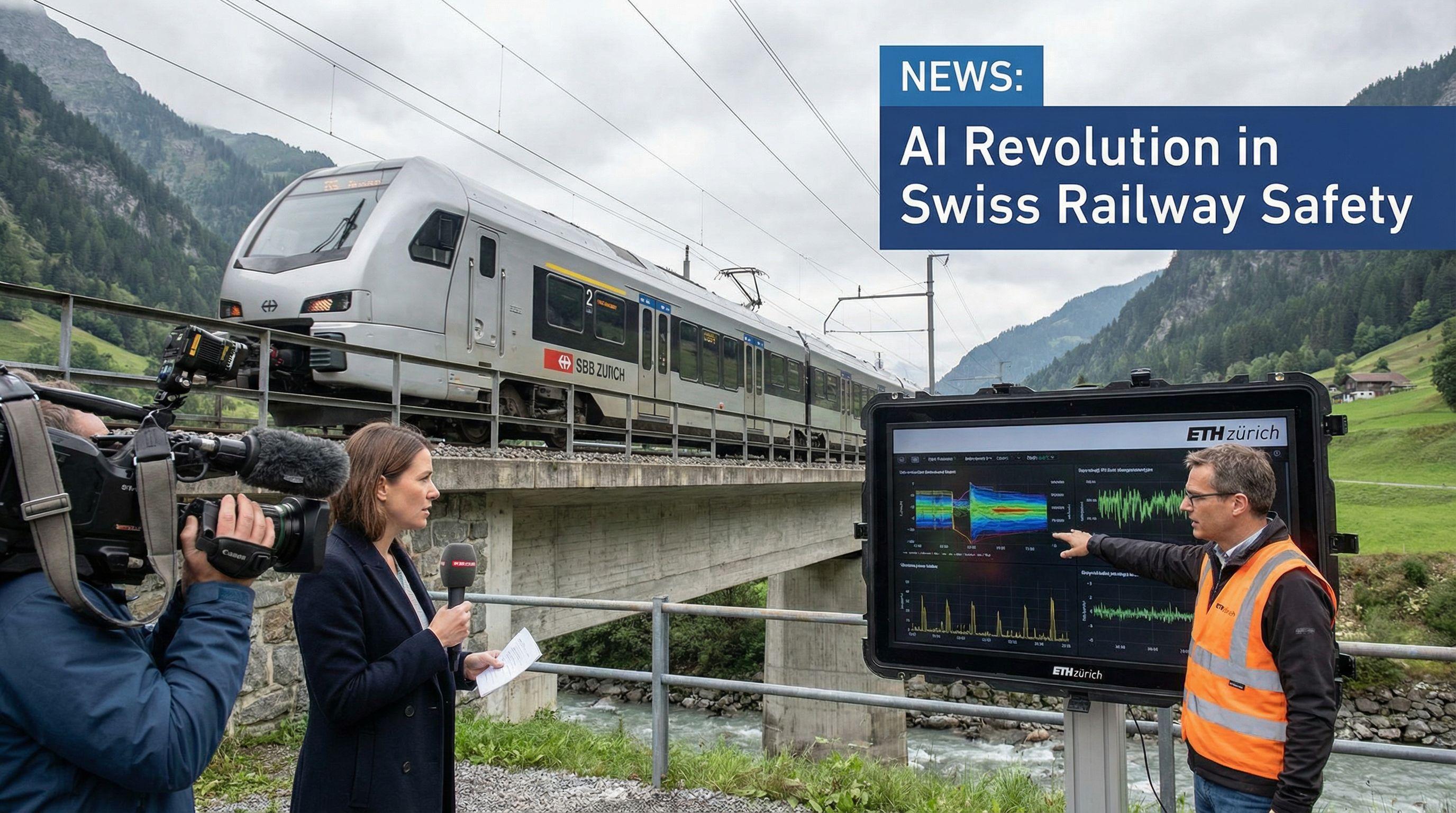
"In Switzerland, a considerable part of the infrastructure is approaching the end of its life expectancy and therefore needs to be checked and possibly strengthened."
Swiss engineering prowess has taken a quantum leap forward. Researchers at ETH Zurich have successfully deployed a cutting-edge artificial intelligence system capable of autonomously verifying the structural integrity of railway bridges. This is not merely an incremental update; it is a fundamental shift in how we protect the nation's vital transport arteries. By leveraging advanced machine learning, this new model acts as a digital guardian, scrutinizing the stability of critical infrastructure with a precision that traditional methods struggle to match.
Developed in tight collaboration with the Swiss Federal Railways (SBB), this breakthrough addresses a critical need for real-time, data-driven safety assessments. The system does not just look at a bridge; it understands it. By processing vast amounts of structural data, the AI provides engineers with immediate insights into which bridges are standing strong and which are silently deteriorating. As Switzerland continues to rely heavily on its world-class rail network, this technological intervention ensures that safety remains paramount, blending historic engineering with futuristic digital oversight.
Switzerland is facing a ticking clock regarding its infrastructure. A staggering number of the country’s concrete railway bridges are rapidly approaching the end of their designed life expectancy. These silent giants, which have carried millions of passengers over decades, are now in critical need of evaluation. Sophia Kuhn, the developer of the AI model at ETH Zurich, put it starkly: “In Switzerland, a considerable part of the infrastructure is approaching the end of its life expectancy and therefore needs to be checked and possibly strengthened.”
This is not a theoretical problem; it is a physical reality that demands immediate action. The aging concrete structures must be rigorously monitored to prevent potential failures. The sheer volume of bridges requiring inspection presents a logistical nightmare for human crews alone. However, this new AI technology confronts the crisis head-on, offering a scalable solution to a national challenge. By identifying the most vulnerable structures first, the system ensures that resources are directed exactly where they are needed most, preventing the degradation of Switzerland's legendary transport reliability.
The core of this innovation is a sophisticated artificial neural network—an algorithm designed to mimic the learning processes of the human brain. Unlike static software, this system evolves. It has been trained on a massive database of information regarding existing bridges, allowing it to recognize patterns of stress and stability that might escape the human eye. This "brain" absorbs data, learns from historical structural behaviors, and applies that knowledge to current assessments.
Crucially, the system possesses a unique capability that sets it apart from standard AI tools: self-awareness of its own accuracy. It does not simply output a binary "safe" or "unsafe" verdict. Instead, it highlights the reliability of its own estimate. This feature is a game-changer for safety engineers. Knowing the confidence level of the AI's prediction allows human experts to trust the data when the certainty is high and intervene personally when the AI signals ambiguity. This symbiotic relationship between human expertise and machine learning creates a safety net far tighter than either could achieve alone.
Efficiency is the new watchword for the Swiss Federal Railways. With this AI tool, the era of reactive maintenance is ending, replaced by a proactive, strategic approach. The technology empowers the SBB to set precise priorities for inspections. Instead of a blanket approach to maintenance, which is costly and time-consuming, the AI pinpoints exactly which bridges require immediate physical intervention and which are stable.
This targeted strategy dramatically optimizes the workflow for maintenance crews. By filtering out stable structures from urgent lists, the SBB can focus its manpower on the bridges that truly need attention. This breakthrough ensures that Switzerland remains at the forefront of infrastructure technology, proving that even the most traditional industries can be revolutionized by digital innovation. As the system continues to learn and refine its predictions, the safety of Swiss railways becomes not just a promise, but a calculated certainty.